


Page 484 - Clinical Application of Mechanical Ventilation
P. 484
450    Chapter 13


                                              TABLE 13-21 Potential Procedures to Reverse Delirium

                                              Withdrawal of Medications      Improvement of Clinical Conditions

                                              Alcohol                        Fever

                                              Analgesics                     Head injury
                                              Anticholinergics               Hepatic failure

                                              Anticonvulsants                Hyperparathyroidism and
                                                                               hypoparathyroidism
                                              Antihistamines
                                              Antihypertensives              Hyperthyroidism and hypothyroidism

                                              Antiparkinsonian agents        Renal failure
                                              Cardiac drugs

                                              Corticosteroids
                                              Psychiatric agents

                                            © Cengage Learning 2014


                                            defined as a reversible global impairment of cognitive processes manifested chiefly by
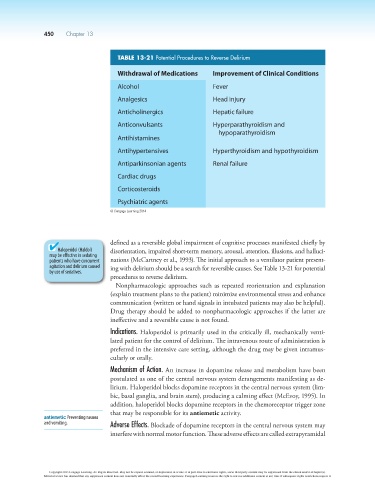
                          Haloperidol (Haldol)   disorientation, impaired short-term memory, arousal, attention, illusions, and halluci-
                        may be effective in sedating
                        patients who have concurrent   nations (McCartney et al., 1993). The initial approach to a ventilator patient present-
                        agitation and delirium caused   ing with delirium should be a search for reversible causes. See Table 13-21 for potential
                        by use of sedatives.
                                            procedures to reverse delirium.
                                             Nonpharmacologic approaches such as repeated reorientation and explanation
                                            (explain treatment plans to the patient) minimize environmental stress and enhance
                                            communication (written or hand signals in intubated patients may also be helpful).
                                            Drug therapy should be added to nonpharmacologic approaches if the latter are
                                            ineffective and a reversible cause is not found.

                                            Indications. Haloperidol is primarily used in the critically ill, mechanically venti-
                                            lated patient for the control of delirium. The intravenous route of administration is
                                            preferred in the intensive care setting, although the drug may be given intramus-
                                            cularly or orally.

                                            Mechanism of Action. An increase in dopamine release and metabolism have been
                                            postulated as one of the central nervous system derangements manifesting as de-
                                            lirium. Haloperidol blocks dopamine receptors in the central nervous system (lim-
                                            bic, basal ganglia, and brain stem), producing a calming effect (McEvoy, 1995). In
                                            addition, haloperidol blocks dopamine receptors in the chemoreceptor trigger zone
                                            that may be responsible for its antiemetic activity.
                      antiemetic: Preventing nausea
                      and vomiting.         Adverse Effects. Blockade of dopamine receptors in the central nervous system may
                                            interfere with normal motor function. These adverse effects are called extrapyramidal


                        Copyright 2013 Cengage Learning. All Rights Reserved. May not be copied, scanned, or duplicated, in whole or in part. Due to electronic rights, some third party content may be suppressed from the eBook and/or eChapter(s).
                      Editorial review has deemed that any suppressed content does not materially affect the overall learning experience. Cengage Learning reserves the right to remove additional content at any time if subsequent rights restrictions require it.

