


Page 543 - Clinical Application of Mechanical Ventilation
P. 543
Critical Care Issues in Mechanical Ventilation  509


                                                            100


                                                         Cerebral Blood Flow  ml/100g/min  50


                                                                                                         © Cengage Learning 2014


                                                              0
                                                                        22.5      45       67.5       90
                                                                             PaCO 2  (mm Hg)
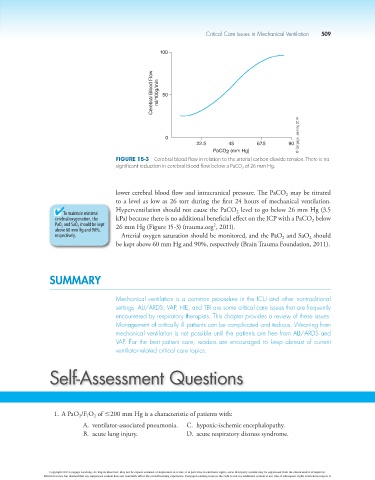
                                             Figure 15-3  Cerebral blood flow in relation to the arterial carbon dioxide tension. There is no
                                             significant reduction in cerebral blood flow below a PaCO 2  of 26 mm Hg.


                                             lower cerebral blood flow and intracranical pressure. The PaCO  may be titrated
                                                                                                     2
                                             to a level as low as 26 torr during the first 24 hours of mechanical ventilation.
                                             Hyperventilation should not cause the PaCO  level to go below 26 mm Hg (3.5
                            To maintain minimal                                      2
                          cerebral oxygenation, the   kPa) because there is no additional beneficial effect on the ICP with a PaCO  below
                                                                                                             2
                          PaO 2  and SaO 2  should be kept   26 mm Hg (Figure 15-3) (trauma.org , 2011).
                                                                             2
                          above 60 mm Hg and 90%,
                          respectively.        Arterial oxygen saturation should be monitored, and the PaO  and SaO  should
                                                                                                             2
                                                                                                    2
                                             be kept above 60 mm Hg and 90%, respectively (Brain Trauma Foundation, 2011).


                        SUMMARY


                                             Mechanical ventilation is a common procedure in the ICU and other nontraditional
                                             settings. ALI/ARDS, VAP, HIE, and TBI are some critical care issues that are frequently
                                             encountered by respiratory therapists. This chapter provides a review of these issues.
                                             Management of critically ill patients can be complicated and tedious. Weaning from
                                             mechanical ventilation is not possible until the patients are free from ALI/ARDS and
                                             VAP. For the best patient care, readers are encouraged to keep abreast of current
                                             ventilator-related critical care topics.


                        Self-Assessment Questions


                          1. A PaO /F O  of #200 mm Hg is a characteristic of patients with:
                                 2
                                      2
                                    I
                                   A.  ventilator-associated pneumonia.   C.  hypoxic-ischemic encephalopathy.
                                   B.  acute lung injury.            D.  acute respiratory distress syndrome.


                        Copyright 2013 Cengage Learning. All Rights Reserved. May not be copied, scanned, or duplicated, in whole or in part. Due to electronic rights, some third party content may be suppressed from the eBook and/or eChapter(s).
                      Editorial review has deemed that any suppressed content does not materially affect the overall learning experience. Cengage Learning reserves the right to remove additional content at any time if subsequent rights restrictions require it.

