


Page 541 - Clinical Application of Mechanical Ventilation
P. 541
Critical Care Issues in Mechanical Ventilation  507


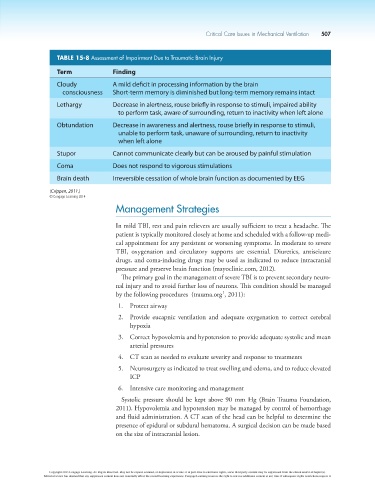
                          TABLE 15-8 Assessment of Impairment Due to Traumatic Brain Injury

                          Term              Finding
                          Cloudy            A mild deficit in processing information by the brain
                            consciousness   Short-term memory is diminished but long-term memory remains intact

                          Lethargy          Decrease in alertness, rouse briefly in response to stimuli, impaired ability
                                              to perform task, aware of surrounding, return to inactivity when left alone

                          Obtundation       Decrease in awareness and alertness, rouse briefly in response to stimuli,
                                              unable to perform task, unaware of surrounding, return to inactivity
                                              when left alone

                          Stupor            Cannot communicate clearly but can be aroused by painful stimulation
                          Coma              Does not respond to vigorous stimulations

                          Brain death       Irreversible cessation of whole brain function as documented by EEG
                        (Crippen, 2011.)
                        © Cengage Learning 2014
                                             management Strategies


                                             In mild TBI, rest and pain relievers are usually sufficient to treat a headache. The
                                             patient is typically monitored closely at home and scheduled with a follow-up medi-
                                             cal appointment for any persistent or worsening symptoms. In moderate to severe
                                             TBI,  oxygenation  and  circulatory  supports  are  essential.  Diuretics,  antiseizure
                                             drugs, and coma-inducing drugs may be used as indicated to reduce intracranial
                                             pressure and preserve brain function (mayoclinic.com, 2012).
                                               The primary goal in the management of severe TBI is to prevent secondary neuro-
                                             nal injury and to avoid further loss of neurons. This condition should be managed
                                             by the following procedures  (trauma.org , 2011):
                                                                                1
                                              1.  Protect airway
                                              2.  Provide  eucapnic  ventilation  and  adequate  oxygenation  to  correct  cerebral
                                                  hypoxia
                                              3.  Correct hypovolemia and hypotension to provide adequate systolic and mean
                                                  arterial pressures
                                              4.  CT scan as needed to evaluate severity and response to treatments
                                              5.  Neurosurgery as indicated to treat swelling and edema, and to reduce elevated
                                                  ICP
                                              6.  Intensive care monitoring and management

                                               Systolic  pressure  should  be  kept  above  90  mm  Hg  (Brain Trauma  Foundation,
                                             2011). Hypovolemia and hypotension may be managed by control of hemorrhage
                                             and fluid administration. A CT scan of the head can be helpful to determine the
                                             presence of epidural or subdural hematoma. A surgical decision can be made based
                                             on the size of intracranial lesion.


                        Copyright 2013 Cengage Learning. All Rights Reserved. May not be copied, scanned, or duplicated, in whole or in part. Due to electronic rights, some third party content may be suppressed from the eBook and/or eChapter(s).
                      Editorial review has deemed that any suppressed content does not materially affect the overall learning experience. Cengage Learning reserves the right to remove additional content at any time if subsequent rights restrictions require it.

