


Page 605 - Clinical Application of Mechanical Ventilation
P. 605
Neonatal Mechanical Ventilation  571


                                                 Desired
                                               Gas Mixture


                                                                          Patient
                                                                          Bridge
                                                            Heat
                                                          Exchanger


                                                      Membrane
                                                      Oxygenator

                                                                                    Infusion Sites
                                                                                                                  © Cengage Learning 2014
                                                                                   Reservoir
                                                                                    Bladder
                                                                 Roller Pump
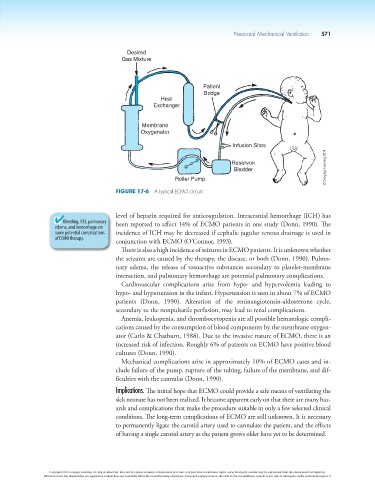
                                             Figure 17-6  A typical ECMO circuit.


                                             level of heparin required for anticoagulation. Intracranial hemorrhage (ICH) has
                            Bleeding, ICH, pulmonary   been reported to affect 14% of ECMO patients in one study (Donn, 1990). The
                          edema, and hemorrhage are
                          some potential complications   incidence of ICH may be decreased if cephalic jugular venous drainage is used in
                          of ECMO therapy.
                                             conjunction with ECMO (O’Connor, 1993).
                                               There is also a high incidence of seizures in ECMO patients. It is unknown whether
                                             the seizures are caused by the therapy, the disease, or both (Donn, 1990). Pulmo-
                                             nary edema, the release of vasoactive substances secondary to platelet-membrane
                                             interaction, and pulmonary hemorrhage are potential pulmonary complications.
                                               Cardiovascular  complications  arise  from  hypo-  and  hypervolemia  leading  to
                                             hypo- and hypertension in the infant. Hypertension is seen in about 7% of ECMO
                                             patients  (Donn,  1990).  Alteration  of  the  reninangiotensin-aldosterone  cycle,
                                             secondary to the nonpulsatile perfusion, may lead to renal complications.
                                               Anemia, leukopenia, and thrombocytopenia are all possible hematologic compli-
                                             cations caused by the consumption of blood components by the membrane oxygen-
                                             ator (Carlo & Chatburn, 1988). Due to the invasive nature of ECMO, there is an
                                             increased risk of infection. Roughly 6% of patients on ECMO have positive blood
                                             cultures (Donn, 1990).
                                               Mechanical complications arise in approximately 10% of ECMO cases and in-
                                             clude failure of the pump, rupture of the tubing, failure of the membrane, and dif-
                                             ficulties with the cannulas (Donn, 1990).

                                             Implications. The initial hope that ECMO could provide a safe means of ventilating the
                                             sick neonate has not been realized. It became apparent early on that there are many haz-
                                             ards and complications that make the procedure suitable in only a few selected clinical
                                             conditions. The long-term complications of ECMO are still unknown. It is necessary
                                             to permanently ligate the carotid artery used to cannulate the patient, and the effects
                                             of having a single carotid artery as the patient grows older have yet to be determined.


                        Copyright 2013 Cengage Learning. All Rights Reserved. May not be copied, scanned, or duplicated, in whole or in part. Due to electronic rights, some third party content may be suppressed from the eBook and/or eChapter(s).
                      Editorial review has deemed that any suppressed content does not materially affect the overall learning experience. Cengage Learning reserves the right to remove additional content at any time if subsequent rights restrictions require it.

