


Page 679 - Clinical Application of Mechanical Ventilation
P. 679
Case	Studies  645


                                                                        1

                                                                                         5


                                                                                              2


                                                                      3
                                                                                                       © Cengage Learning 2014
                                                                                         4


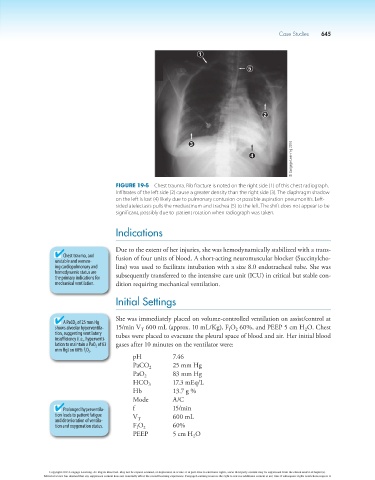
                                             Figure 19-5  Chest trauma. Rib fracture is noted on the right side (1) of this chest radiograph.
                                             Infiltrates of the left side (2) cause a greater density than the right side (3). The diaphragm shadow
                                             on the left is lost (4) likely due to pulmonary contusion or possible aspiration pneumonitis. Left-
                                             sided atelectasis pulls the mediastinum and trachea (5) to the left. The shift does not appear to be
                                             significant, possibly due to  patient rotation when radiograph was taken.

                                             Indications


                                             Due to the extent of her injuries, she was hemodynamically stabilized with a trans-
                            Chest trauma, and   fusion of four units of blood. A short-acting neuromuscular blocker (Succinylcho-
                          unstable and worsen-
                          ing cardiopulmonary and   line) was used to facilitate intubation with a size 8.0 endotracheal tube. She was
                          hemodynamic status are   subsequently transferred to the intensive care unit (ICU) in critical but stable con-
                          the primary indications for
                          mechanical ventilation.  dition requiring mechanical ventilation.

                                             Initial Settings


                                             She was immediately placed on volume-controlled ventilation on assist/control at
                            A PaCO 2  of 25 mm Hg
                          shows alveolar hyperventila-  15/min V  600 mL (approx. 10 mL/Kg), F O  60%, and PEEP 5 cm H O. Chest
                                                      T
                                                                                  I
                                                                                                           2
                                                                                    2
                          tion, suggesting ventilatory   tubes were placed to evacuate the pleural space of blood and air. Her initial blood
                          insufficiency (i.e., hyperventi-
                          lation to maintain a PaO 2  of 83   gases after 10 minutes on the ventilator were:
                          mm Hg) on 60% F I O 2 .
                                                   pH           7.46
                                                   PaCO 2       25 mm Hg
                                                   PaO 2        83 mm Hg
                                                         -
                                                   HCO          17.3 mEq/L
                                                        3
                                                   Hb           13.7 g %
                                                   Mode         A/C
                            Prolonged hyperventila-     f       15/min
                          tion leads to patient fatigue      V  600 mL
                          and deterioration of ventila-  T
                          tion and oxygenation status.     F O 2   60%
                                                    I
                                                   PEEP         5 cm H O
                                                                       2


                        Copyright 2013 Cengage Learning. All Rights Reserved. May not be copied, scanned, or duplicated, in whole or in part. Due to electronic rights, some third party content may be suppressed from the eBook and/or eChapter(s).
                      Editorial review has deemed that any suppressed content does not materially affect the overall learning experience. Cengage Learning reserves the right to remove additional content at any time if subsequent rights restrictions require it.

