


Page 674 - Clinical Application of Mechanical Ventilation
P. 674
640    Chapter	19


                                                                                      1


                                                                            2

                                                                       4
                                                                                       3

                                                                                                     © Cengage Learning 2014


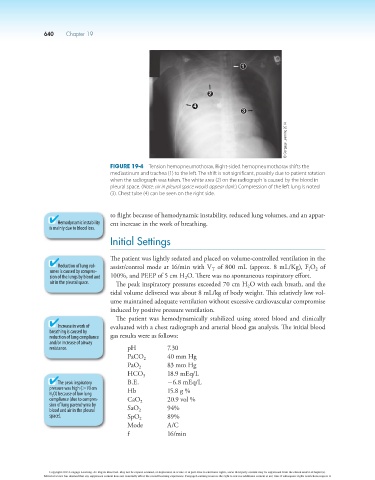
                                            Figure 19-4  Tension hemopneumothorax. Right-sided hemopneumothorax shifts the
                                            mediastinum and trachea (1) to the left. The shift is not significant, possibly due to patient rotation
                                            when the radiograph was taken. The white area (2) on the radiograph is caused by the blood in
                                            pleural space. (Note: air in pleural space would appear dark.) Compression of the left lung is noted
                                            (3). Chest tube (4) can be seen on the right side.


                                            to flight because of hemodynamic instability, reduced lung volumes, and an appar-
                          Hemodynamic instability   ent increase in the work of breathing.
                        is mainly due to blood loss.
                                            Initial Settings


                                            The patient was lightly sedated and placed on volume-controlled ventilation in the
                           Reduction of lung vol-  assist/control mode at 16/min with V  of 800 mL (approx. 8 mL/Kg), F O  of
                        umes is caused by compres-                           T                              I  2
                        sion of the lungs by blood and   100%, and PEEP of 5 cm H O. There was no spontaneous respiratory effort.
                                                                    2
                        air in the pleural space.  The peak inspiratory pressures exceeded 70 cm H O with each breath, and the
                                                                                        2
                                            tidal volume delivered was about 8 mL/kg of body weight. This relatively low vol-
                                            ume maintained adequate ventilation without excessive cardiovascular compromise
                                            induced by positive pressure ventilation.
                                             The  patient  was  hemodynamically  stabilized  using  stored  blood  and  clinically
                          Increase in work of   evaluated with a chest radiograph and arterial blood gas analysis. The initial blood
                        breathing is caused by
                        reduction of lung compliance   gas results were as follows:
                        and/or increase of airway
                        resistance.              pH           7.30
                                                 PaCO 2       40 mm Hg
                                                 PaO 2        83 mm Hg
                                                       -
                                                 HCO          18.9 mEq/L
                                                      3
                          The peak inspiratory      B.E.      26.8 mEq/L
                        pressure was high (.70 cm      Hb     15.8 g %
                        H 2 O) because of low lung
                        compliance (due to compres-     CaO 2   20.9 vol %
                        sion of lung parenchyma by
                        blood and air in the pleural      SaO 2   94%
                        space).                  SpO 2        89%
                                                 Mode         A/C
                                                 f            16/min


                        Copyright 2013 Cengage Learning. All Rights Reserved. May not be copied, scanned, or duplicated, in whole or in part. Due to electronic rights, some third party content may be suppressed from the eBook and/or eChapter(s).
                      Editorial review has deemed that any suppressed content does not materially affect the overall learning experience. Cengage Learning reserves the right to remove additional content at any time if subsequent rights restrictions require it.

