


Page 680 - Clinical Application of Mechanical Ventilation
P. 680
646    Chapter	19


                                             Over the next 24 hours, her condition quickly deteriorated, requiring 100% F O
                                                                                                               I
                                                                                                                 2
                                            and increasing levels of PEEP to maintain adequate oxygenation.
                                            Patient Monitoring


                                            The increasing pressure required to ventilate her lungs began to compromise her
                           Pressure Control-Inverse   cardiac output and, as such, limit perfusion to her tissues. As a result, she was
                        Ratio Ventilation (PC-IRV) uses
                        a predetermined inspiratory   deeply  sedated  and  changed  to  pressure-controlled  inverse  ratio  ventilation  (PC-
                        pressure to minimize the oc-
                                                                                                               2
                        currence of pressure-induced   IRV) mode at a frequency of 12/min and an inspiratory pressure of 30 cm H O.
                        lung injury. Use of inverse I:E   Her inspiratory time (T ) was adjusted accordingly to obtain an I:E ratio of 3:1.
                        ratio is intended to increase            I
                        inspiratory time and lung   Her PEEP and F O  requirements were 8 cm H O and 100%, respectively. These
                                                          I
                                                            2
                                                                                     2
                        expansion, and to improve   settings provided hyperexpansion of the chest in order to stabilize the thorax and
                        oxygenation.
                                            limit movement of the rib fractures. She was monitored by an end-tidal CO  moni-
                                                                                                           2
                                            tor. Frequent blood gases were done to evaluate her ventilatory and oxygenation
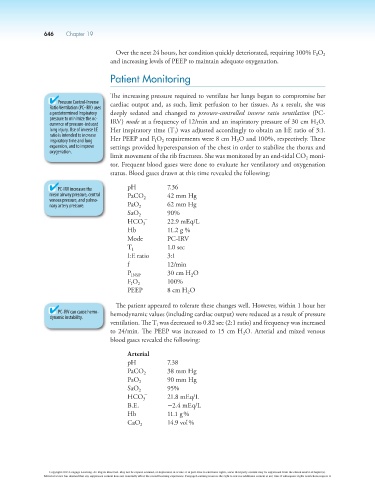
                                            status. Blood gases drawn at this time revealed the following:
                          PC-IRV increases the      pH        7.36
                        mean airway pressure, central      PaCO  42 mm Hg
                        venous pressure, and pulmo-   2
                        nary artery pressure.     PaO 2       62 mm Hg
                                                 SaO 2        90%
                                                       -
                                                 HCO          22.9 mEq/L
                                                      3
                                                 Hb           11.2 g %
                                                 Mode         PC-IRV
                                                 T I          1.0 sec
                                                 I:E ratio    3:1
                                                 f            12/min
                                                 P INSP       30 cm H O
                                                                      2
                                                 F O 2        100%
                                                  I
                                                 PEEP         8 cm H O
                                                                     2
                                             The patient appeared to tolerate these changes well. However, within 1 hour her
                           PC-IRV can cause hemo-  hemodynamic values (including cardiac output) were reduced as a result of pressure
                        dynamic instability.
                                            ventilation. The T  was decreased to 0.82 sec (2:1 ratio) and frequency was increased
                                                           I
                                            to 24/min. The PEEP was increased to 15 cm H O. Arterial and mixed venous
                                                                                       2
                                            blood gases revealed the following:

                                            	    Arterial
                                                 pH           7.38
                                                 PaCO 2       38 mm Hg
                                                 PaO 2        90 mm Hg
                                                 SaO 2        95%
                                                       -
                                                 HCO          21.8 mEq/L
                                                      3
                                                 B.E.         22.4 mEq/L
                                                 Hb           11.1 g %
                                                 CaO 2        14.9 vol %


                        Copyright 2013 Cengage Learning. All Rights Reserved. May not be copied, scanned, or duplicated, in whole or in part. Due to electronic rights, some third party content may be suppressed from the eBook and/or eChapter(s).
                      Editorial review has deemed that any suppressed content does not materially affect the overall learning experience. Cengage Learning reserves the right to remove additional content at any time if subsequent rights restrictions require it.

