


Page 685 - Clinical Application of Mechanical Ventilation
P. 685
Case	Studies  651


                                             and a nasal cannula at 6 L/min simply to maintain oxygen saturation of 86% to
                                             92% without activity. Every effort was made to forestall clinical deterioration within
                                             the treatment parameters that family members permitted. Practitioners were able to
                                             convince the family to utilize free-standing CPAP at 12 cm H O and F O  of 50% to
                                                                                                2
                                                                                                        I
                                                                                                          2
                                             improve oxygenation, but the patient became fatigued to the extent that she was only
                                             able to tolerate the procedure 20 minutes every 2–3 hours, if at all. At that time she
                                             had a vital capacity of 0.9 L and MIP of 275 cm H O. This treatment continued for
                                                                                        2
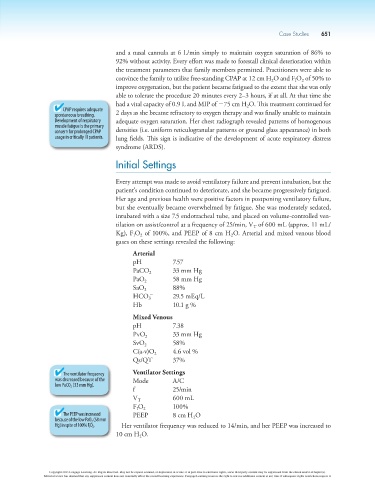
                            CPAP requires adequate
                         spontaneous breathing.   2 days as she became refractory to oxygen therapy and was finally unable to maintain
                         Development of respiratory   adequate oxygen saturation. Her chest radiograph revealed patterns of homogenous
                         muscle fatigue is the primary
                         concern for prolonged CPAP   densities (i.e. uniform reticulogranular patterns or ground glass appearance) in both
                         usage in critically ill patients.  lung fields. This sign is indicative of the development of acute respiratory distress
                                             syndrome (ARDS).

                                             Initial Settings


                                             Every attempt was made to avoid ventilatory failure and prevent intubation, but the
                                             patient’s condition continued to deteriorate, and she became progressively fatigued.
                                             Her age and previous health were positive factors in postponing ventilatory failure,
                                             but she eventually became overwhelmed by fatigue. She was moderately sedated,
                                             intubated with a size 7.5 endotracheal tube, and placed on volume-controlled ven-
                                             tilation on assist/control at a frequency of 25/min, V  of 600 mL (approx. 11 mL/
                                                                                          T
                                             Kg), F O  of 100%, and PEEP of 8 cm H O. Arterial and mixed venous blood
                                                   I
                                                     2
                                                                                   2
                                             gases on these settings revealed the following:
                                             	     Arterial
                                                   pH           7.57
                                                   PaCO 2       33 mm Hg
                                                   PaO 2        58 mm Hg
                                                   SaO 2        88%
                                                         -
                                                   HCO          29.5 mEq/L
                                                        3
                                                   Hb           10.1 g %
                                             	     Mixed	Venous
                                                   pH           7.38
                                                   PvO 2        33 mm Hg
                                                   SvO 2        58%
                                                   C(a-v)O 2    4.6 vol %
                                                   Qs/QT        37%

                            The ventilator frequency   	  Ventilator	Settings
                          was decreased because of the      Mode   A/C
                          low PaCO 2  (33 mm Hg).
                                                   f            25/min
                                                   V T          600 mL
                                                   F O 2        100%
                                                    I
                            The PEEP was increased      PEEP    8 cm H O
                          because of the low PaO 2  (58 mm             2
                          Hg) in spite of 100% F I O 2 .  Her ventilator frequency was reduced to 14/min, and her PEEP was increased to
                                             10 cm H O.
                                                     2


                        Copyright 2013 Cengage Learning. All Rights Reserved. May not be copied, scanned, or duplicated, in whole or in part. Due to electronic rights, some third party content may be suppressed from the eBook and/or eChapter(s).
                      Editorial review has deemed that any suppressed content does not materially affect the overall learning experience. Cengage Learning reserves the right to remove additional content at any time if subsequent rights restrictions require it.

