


Page 210 - Cardiac Nursing
P. 210
6 P
                                        M
                                     6 P
                                   0:1
                                   0:1
                                           g
                                           g
                                          Pa
                                        M
                                          Pa
                             6
                              /29
                             6
                           xd
                           xd
                                   1
                                   1
                                /09
                              /29
                                /09
                                                  ara
                                                   a
                                                  ara
                                                  t
                                                  t
                                                      c.
                                                      c.
                                                    In
                                                   a
                                                    In
                                              86
                                              86
                                            e 1
                                           g
                                            e 1
                                                 p
                                                 p
                                                 p
                                                A
                                                A
                          q
            K34
               0-c
                    17
         LWBK340-c08_
                   p
         LWB K34 0-c 08_ p pp177-203.qxd  6/29/09  10:16 PM  Page 186 Aptara Inc.
         LWB
                    17
                        03.
                        03.
                          q
                          q
                 08_
                      7-2
                      7-2
                  186    PA R T  I I / Physiologic and Pathologic Responses
                   DISPLAY 8-2 International Classification of Sleep Disorders (continued)
                    Propriospinal myoclonus at sleep onset            Sleep-related gastroesophageal reflux disease
                    Excessive fragmentary myoclonus                   Sleep-related coronary artery ischemia
                                                                      Sleep-related abnormal swallowing, choking,
                    Other Sleep Disorders                               and laryngospasm
                    Other physiological (organic) sleep disorder
                    Other sleep disorder not due to substance or known   Appendix B: Other Psychiatric and Behavioral
                     physiological condition                          Disorders Frequently Encountered in the
                    Environmental sleep disorder                      Differential Diagnosis of Sleep Disorders
                                                                      Mood disorders
                    Appendix A: Sleep Disorders Associated With       Anxiety disorders
                    Conditions Classifiable Elsewhere
                                                                      Somatoform disorders
                    Fatal familial insomnia                           Schizophrenia and other psychotic disorders
                    Fibromyalgia                                      Disorders usually first diagnosed in infancy, childhood,
                    Sleep-related epilepsy                              or adolescence
                    Sleep-related headaches                           Personality disorders
                  From AASM. (2005). The international classification of sleep disorders. Westchester, IL: American Academy of Sleep Medicine.
                  severe; however, it can be debilitating, causing a broad range of neu-  lar impact of sleep in obstructive sleep apnea (OSA), central sleep ap-
                  ropsychological deficits affecting daytime functioning and quality  nea (CSA), and snoring/upper airway resistance syndrome (UARS).
                  of life. EDS can even be life threatening because of associated alter-
                  ations in alertness and reactivity. 124–130  Increased napping has also  Obstructive Sleep Apnea
                  been associated with increased mortality in the elderly. 137,138  Patients with sleep apnea repeatedly stop breathing during sleep
                                                                                                       10
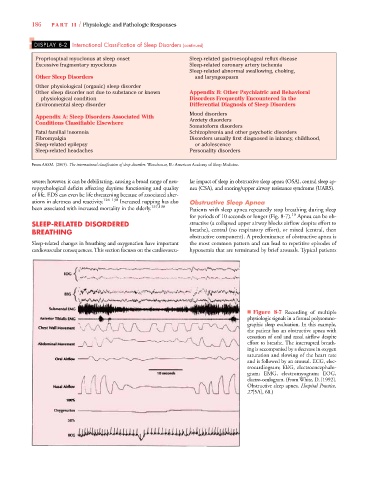
                                                                      for periods of 10 seconds or longer (Fig. 8-7). Apnea can be ob-
                  SLEEP-RELATED DISORDERED                            structive (a collapsed upper airway blocks airflow despite effort to
                  BREATHING                                           breathe), central (no respiratory effort), or mixed (central, then
                                                                      obstructive component). A predominance of obstructive apnea is
                  Sleep-related changes in breathing and oxygenation have important  the most common pattern and can lead to repetitive episodes of
                  cardiovascular consequences. This section focuses on the cardiovascu-  hypoxemia that are terminated by brief arousals. Typical patients
                                                                                         ■ Figure 8-7 Recording of multiple
                                                                                         physiologic signals in a formal polysomno-
                                                                                         graphic sleep evaluation. In this example,
                                                                                         the patient has an obstructive apnea with
                                                                                         cessation of oral and nasal airflow despite
                                                                                         effort to breathe. The interrupted breath-
                                                                                         ing is accompanied by a decrease in oxygen
                                                                                         saturation and slowing of the heart rate
                                                                                         and is followed by an arousal. ECG, elec-
                                                                                         trocardiogram; EEG, electroencephalo-
                                                                                         gram; EMG, electromyogram; EOG,
                                                                                         electro-oculogram. (From White, D. [1992].
                                                                                         Obstructive sleep apnea. Hospital Practice,
                                                                                          7
                                                                                         27[5A], 68.)
                                                                                          7

