


Page 208 - Cardiac Nursing
P. 208
c.
                      7-2
                                                 p
                                                  t
                                                  t
                        03.
                          q
                        03.
                      7-2
                                                      c.
                                                  ara
                                            e 1
                                                 p
                                              84
                                           g
                                            e 1
                                              84
                                                  ara
                                                A
                                                 p
                                                A
                          q
                                     6 P
                                        M
                                     6 P
                                   0:1
                                   0:1
                                           g
                                           g
                                          Pa
                                        M
                                          Pa
                                   1
                             6
                             6
                           xd
                          q
                           xd
                                /09
                                   1
                                /09
                              /29
                              /29
                                                    In
                                                    In
                    17
                 08_
                   p
                   p
                                                   a
                                                   a
                    17
         LWB
            K34
         LWBK340-c08_ pp177-203.qxd  6/29/09  10:16 PM  Page 184 Aptara Inc.
         LWB
            K34
                 08_
               0-c
               0-c
                  184    PA R T  I I / Physiologic and Pathologic Responses
                                                            SLEEP DISRUPTION
                    SLEEP DEPRIVATION                       Fragmented sleep due to:
                    Inadequate sleep quantity due to:
                                                            Angina
                    Genetic predisposition                  Pain
                    Aging                                   Palpitations
                    Sleep behaviors & poor sleep hygiene    Leg movements
                    Curtailed bedtime
                    Early awakenings                        Disordered breathing
                                                            Co-morbidities
                    Shift work                              Anxiety
                    Environmental stimuli                   Caffeine and/or alcohol
                    Circadian desynchronization             Obesity
                    Medications
                    Diet                                    Nocturia
                                                            Fluid overload & orthopnea
                    Co-morbidities (ex-obesity, diabetes)
                       Nursing                                              Nursing
                    interventions to                                      interventions to
                      prevent and             IMPAIRED QUANTITY            prevent and
                    minimize sleep           AND QUALITY OF SLEEP         minimize sleep
                        loss                                                  loss
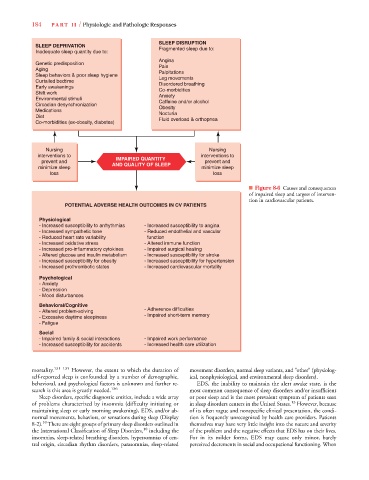
                                                                                         ■ Figure 8-6 Causes and consequences
                                                                                         of impaired sleep and targets of interven-
                                                                                         tion in cardiovascular patients.
                             POTENTIAL ADVERSE HEALTH OUTCOMES IN CV PATIENTS
                     Physiological
                     - Increased susceptibility to arrhythmias  - Increased susceptibility to angina
                     - Increased sympathetic tone      - Reduced endothelial and vascular
                     - Reduced heart rate variability    function
                     - Increased oxidative stress      - Altered immune function
                     - Increased pro-inflammatory cytokines  - Impaired surgical healing
                     - Altered glucose and insulin metabolism  - Increased susceptibility for stroke
                     - Increased susceptibility for obesity  - Increased susceptibility for hypertension
                     - Increased prothrombotic states  - Increased cardiovascular mortality
                     Psychological
                     - Anxiety
                     - Depression
                     - Mood disturbances
                     Behavioral/Cognitive
                     - Altered problem-solving         - Adherence difficulties
                     - Excessive daytime sleepiness    - Impaired short-term memory
                     - Fatigue
                     Social
                     - Impaired family & social interactions  - Impaired work performance
                     - Increased susceptibility for accidents  - Increased health care utilization
                  mortality. 131–135  However, the extent to which the duration of  movement disorders, normal sleep variants, and “other” (physiolog-
                  self-reported sleep is confounded by a number of demographic,  ical, nonphysiological, and environmental sleep disorders).
                  behavioral, and psychological factors is unknown and further re-  EDS, the inability to maintain the alert awake state, is the
                  search is this area is greatly needed. 136          most common consequence of sleep disorders and/or insufficient
                     Sleep disorders, specific diagnostic entities, include a wide array  or poor sleep and is the most prevalent symptom of patients seen
                                                                                                       13
                  of problems characterized by insomnia (difficulty initiating or  in sleep disorders centers in the United States. However, because
                  maintaining sleep or early morning awakening), EDS, and/or ab-  of its often vague and nonspecific clinical presentation, the condi-
                  normal movements, behaviors, or sensations during sleep (Display  tion is frequently unrecognized by health care providers. Patients
                      10
                  8-2). There are eight groups of primary sleep disorders outlined in  themselves may have very little insight into the nature and severity
                  the International Classification of Sleep Disorders, 10  including the  of the problem and the negative effects that EDS has on their lives.
                  insomnias, sleep-related breathing disorders, hypersomnias of cen-  For in its milder  forms, EDS may cause only minor,  barely
                  tral origin, circadian rhythm disorders, parasomnias, sleep-related  perceived decrements in social and occupational functioning. When

