


Page 209 - Cardiac Nursing
P. 209
g
                                           g
                                           g
                                            e 1
                                            e 1
                                        M
                      7-2
                                        M
                                          Pa
                                          Pa
                                                 p
                                                 p
                                                  t
                                                  ara
                                                  t
                                              85
                                              85
                                                A
                                                 p
                                                A
                          q
                          q
                          q
                        03.
                        03.
                             6
                              /29
                             6
                           xd
                           xd
                                   0:1
                                   0:1
                                     6 P
                      7-2
                                     6 P
                                /09
                              /29
                                /09
                                   1
                                   1
               0-c
                 08_
         LWBK340-c08_
            K34
                    17
                    17
                   p
                   p
         LWB
                                                    In
                                                    In
                                                   a
                                                  ara
                                                   a
         LWB K34 0-c 08_ pp177-203.qxd  6/29/09  10:16 PM  Page 185 Aptara Inc.
                                                      c.
                                                      c.
                                                                                             C HAPTER  8 / Sleep   185
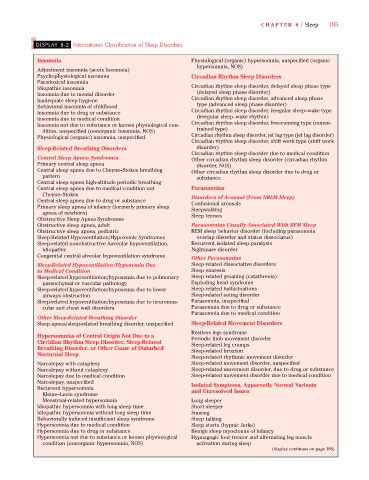
                    DISPLAY 8-2 International Classification of Sleep Disorders
                    Insomnia                                           Physiological (organic) hypersomnia, unspecified (organic
                                                                        hypersomnia, NOS)
                    Adjustment insomnia (acute Insomnia)
                    Psychophysiological insomnia                       Circadian Rhythm Sleep Disorders
                    Paradoxical insomnia
                    Idiopathic insomnia                                Circadian rhythm sleep disorder, delayed sleep phase type
                    Insomnia due to mental disorder                     (delayed sleep phase disorder)
                    Inadequate sleep hygiene                           Circadian rhythm sleep disorder, advanced sleep phase
                    Behavioral insomnia of childhood                    type (advanced sleep phase disorder)
                    Insomnia due to drug or substance                  Circadian rhythm sleep disorder, irregular sleep–wake type
                    Insomnia due to medical condition                   (irregular sleep–wake rhythm)
                    Insomnia not due to substance or known physiological con-  Circadian rhythm sleep disorder, free-running type (nonen-
                      dition, unspecified (nonorganic insomnia, NOS)     trained type)
                    Physiological (organic) insomnia, unspecified       Circadian rhythm sleep disorder, jet lag type (jet lag disorder)
                                                                       Circadian rhythm sleep disorder, shift work type (shift work
                    Sleep-Related Breathing Disorders                   disorder)
                                                                       Circadian rhythm sleep disorder due to medical condition
                    Central Sleep Apnea Syndromes                      Other circadian rhythm sleep disorder (circadian rhythm
                    Primary central sleep apnea                         disorder, NOS)
                    Central sleep apnea due to Cheyne–Stokes breathing  Other circadian rhythm sleep disorder due to drug or
                      pattern                                           substance
                    Central sleep apnea high-altitude periodic breathing
                    Central sleep apnea due to medical condition not   Parasomnias
                      Cheyne–Stokes
                    Central sleep apnea due to drug or substance       Disorders of Arousal (From NREM Sleep)
                                                                       Confusional arousals
                    Primary sleep apnea of infancy (formerly primary sleep   Sleepwalking
                      apnea of newborn)
                    Obstructive Sleep Apnea Syndromes                  Sleep terrors
                    Obstructive sleep apnea, adult                     Parasomnias Usually Associated With REM Sleep
                    Obstructive sleep apnea, pediatric                 REM sleep behavior disorder (including parasomnia
                    Sleep-Related Hypoventilation/Hypoxemic Syndromes   overlap disorder and status dissociatus)
                    Sleep-related nonobstructive Aaveolar hypoventilation,   Recurrent isolated sleep paralysis
                      idiopathic                                       Nightmare disorder
                    Congenital central alveolar hypoventilation syndrome
                                                                       Other Parasomnias
                    Sleep-Related Hypoventilation/Hypoxemia Due        Sleep-related dissociative disorders
                    to Medical Condition                               Sleep enuresis
                    Sleep-related hypoventilation/hypoxemia due to pulmonary  Sleep related groaning (catathrenia)
                      parenchymal or vascular pathology                Exploding head syndrome
                    Sleep-related hypoventilation/hypoxemia due to lower  Sleep-related hallucinations
                      airways obstruction                              Sleep-related eating disorder
                    Sleep-related hypoventilation/hypoxemia due to neuromus-  Parasomnia, unspecified
                      cular and chest wall disorders                   Parasomnia due to drug or substance
                                                                       Parasomnia due to medical condition
                    Other Sleep-Related Breathing Disorder
                    Sleep apnea/sleep-related breathing disorder, unspecified  Sleep-Related Movement Disorders
                                                                       Restless legs syndrome
                    Hypersomnias of Central Origin Not Due to a        Periodic limb movement disorder
                    Circidian Rhythm Sleep Disorder, Sleep-Related     Sleep-related leg cramps
                    Breathing Disorder, or Other Cause of Disturbed    Sleep-related bruxism
                    Nocturnal Sleep
                                                                       Sleep-related rhythmic movement disorder
                    Narcolepsy with cataplexy                          Sleep-related movement disorder, unspecified
                    Narcolepsy without cataplexy                       Sleep-related movement disorder, due to drug or substance
                    Narcolepsy due to medical condition                Sleep-related movement disorder due to medical condition
                    Narcolepsy, unspecified                             Isolated Symptoms, Apparently Normal Variants
                    Recurrent hypersomnia                              and Unresolved Issues
                      Kleine–Levin syndrome
                      Menstrual-related hypersomnia                    Long sleeper
                    Idiopathic hypersomnia with long sleep time        Short sleeper
                    Idiopathic hypersomnia without long sleep time     Snoring
                    Behaviorally induced insufficient sleep syndrome    Sleep talking
                    Hypersomnia due to medical condition               Sleep starts (hypnic Jerks)
                    Hypersomnia due to drug or substance               Benign sleep myoclonus of infancy
                    Hypersomnia not due to substance or known physiological  Hypnagogic foot tremor and alternating leg muscle
                      condition (nonorganic hypersomnia, NOS)           activation during sleep
                                                                                                 (display continues on page 186)

