


Page 229 - Cardiac Nursing
P. 229
Pa
                                           g
                                        M
                                          Pa
                                           g
                                            e 2
                                              05
                                           g
                                            e 2
                                   1
                                   1
                                /09
                                /09
                                   1:1
                                     7 P
                                        M
                                   1:1
                                     7 P
                                              05
                                                   a
                                                   a
                                                  ara
                                                   a
                                                   a
                                                      c.
                                                      c.
                                                    In
                                                    In
                                                 p
                                                 p
                                                A
                                                A
                                                 p
                                                  ara
                                                  ara
                                                  t
                                                  t
                      4-2
                      4-2
                        10.
                        10.
                    20
                 09_
               0-c
                    20
                 09_
                          q
                              /29
                             6
                             6
                              /29
                              6
                          q
                          q
                           xd
                           xd
               0-c
         LWBK340-c09_ p p pp204-210.qxd  6/29/09  11:17 PM  Page 205 Aptara Inc.
            K34
            K34
                                                                    C HAPTER  9 / Physiologic Adaptations With Aging  205
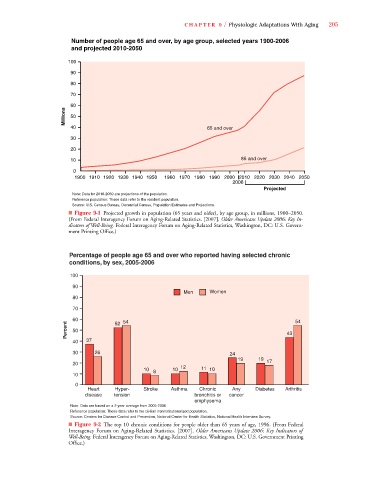
                               Number of people age 65 and over, by age group, selected years 1900-2006
                               and projected 2010-2050
                              100
                               90
                               80
                               70
                               60
                             Millions  50
                               40                                           65 and over
                               30
                               20
                               10                                                      85 and over
                                0
                                1900  1910 1920 1930 1940 1950   1960  1970  1980  1990  2000  2010  2020 2030 2040 2050
                                                                                    2006
                                                                                              Projected
                                Note: Data for 2010-2050 are projections of the population.
                                Reference population: These data refer to the resident population.
                                Source: U.S. Census Bureau, Decennial Census, Population Estimates and Projections.
                              ■ Figure 9-1 Projected growth in population (65 years and older), by age group, in millions, 1900–2050.
                              (From Federal Interagency Forum on Aging-Related Statistics. [2007]. Older Americans Update 2006: Key In-
                              dicators of Well-Being. Federal Interagency Forum on Aging-Related Statistics, Washington, DC: U.S. Govern-
                              ment Printing Office.)
                               Percentage of people age 65 and over who reported having selected chronic
                               conditions, by sex, 2005-2006
                               100
                                90
                                                                    Men      Women
                                80
                                70
                                60            52  54                                                     54
                              Percent  50                                                             43
                                40  37
                                30     26                                          24
                                                                                      19    19  17
                                20
                                                       10  8    10  12    11 10
                                10
                                 0
                                     Heart    Hyper-   Stroke   Asthma   Chronic    Any    Diabetes  Arthritis
                                    disease  tension                    bronchitis or  cancer
                                                                        emphysema
                               Note: Data are based on a 2-year average from 2005-2006.
                               Reference population: These data refer to the civilian noninstitutionalized population.
                               Source: Centers for Disease Control and Prevention, National Center for Health Statistics, National Health Interview Survey.
                              ■ Figure 9-2 The top 10 chronic conditions for people older than 65 years of age, 1996. (From Federal
                              Interagency Forum on Aging-Related Statistics. [2007]. Older Americans Update 2006: Key Indicators of
                              Well-Being. Federal Interagency Forum on Aging-Related Statistics, Washington, DC: U.S. Government Printing
                              Office.)

