


Page 230 - Cardiac Nursing
P. 230
7 P
                                        M
                                     7 P
                                   1:1
                                   1:1
                                        M
                                           g
                                           g
                                           g
                                          Pa
                                          Pa
                             6
                             6
                              6
                           xd
                           xd
                              /29
                                   1
                                   1
                                /09
                              /29
                                /09
                                                   a
                                                   a
                                                  ara
                                                  ara
                                                  ara
                                                   a
                                                      c.
                                                      c.
                                                    In
                                                   a
                                                    In
                                              06
                                                A
                                              06
                                            e 2
                                            e 2
                                                A
                                                  t
                                                  t
                                                 p
                                                 p
                                                 p
                    20
                      4-2
                   p
                    20
                        10.
                          q
                      4-2
                        10.
            K34
               0-c
         LWBK340-c09_ pp204-210.qxd  6/29/09  11:17 PM  Page 206 Aptara Inc.
            K34
                 09_
                   p
               0-c
                 09_
                          q
                          q
                  206    PA R T  I I / Physiologic and Pathologic Responses
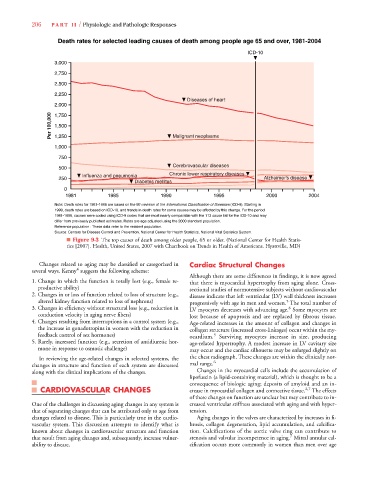
                           Death rates for selected leading causes of death among people age 65 and over, 1981-2004
                                                                                         ICD-10
                          3,000
                          2,750
                          2,500
                          2,250
                                                                     Diseases of heart
                          2,000
                         Per 100,000  1,750                     Malignant neoplasms
                          1,500
                          1,250
                          1,000
                           750
                                                                Cerebrovascular diseases
                           500
                                                                        er respir
                                                                              ator
                                             p
                                   Influenza and pneumonia     Chronic lower respiratory diseasesy diseases
                           250                                                                Alzheimer’s disease
                                                          s mellitus
                                                    Diabetes mellitus
                             0
                             1981          1985              1990             1995                           2004
                          Note: Death rates for 1981-1998 are based on the 9th revision of the International Classification of Diseases (ICD-9). Starting in
                                                                                  s
                          1999, death rates are based on ICD-10, and trends in death rates for some causes may be affected by this change. For the period
                          1981-1998, causes were coded using ICD-9 codes that are most nearly comparable with the 113 cause list for the ICD-10 and may
                          differ from previously published estimates. Rates are age adjusted using the 2000 standard population.
                          Reference population : These data refer to the resident population.
                          Source: Centers for Disease Control and Prevention, National Center for Health Statistics, National Vital Statistics System.
                              ■ Figure 9-3 The top causes of death among older people, 65 or older. (National Center for Health Statis-
                              tics [2007]. Health, United States, 2007 with Chartbook on Trends in Health of Americans. Hyattville, MD)
                     Changes related to aging may be classified or categorized in  Cardiac Structural Changes
                                 4
                  several ways. Kenny suggests the following scheme:
                                                                      Although there are some differences in findings, it is now agreed
                  1. Change in which the function is totally lost (e.g., female re-  that there is myocardial hypertrophy from aging alone. Cross-
                    productive ability)                               sectional studies of normotensive subjects without cardiovascular
                  2. Changes in or loss of function related to loss of structure (e.g.,  disease indicate that left ventricular (LV) wall thickness increases
                    altered kidney function related to loss of nephrons)  progressively with age in men and women. The total number of
                                                                                                      5
                  3. Changes in efficiency without structural loss (e.g., reduction in  LV myocytes decreases with advancing age. Some myocytes are
                                                                                                      6
                    conduction velocity in aging nerve fibers)         lost because of apoptosis and are replaced by fibrous tissue.
                  4. Changes resulting from interruptions in a control system (e.g.,  Age-related increases in the amount of collagen and changes in
                    the increase in gonadotropins in women with the reduction in  collagen structure (increased cross-linkages) occur within the my-
                    feedback control of sex hormones)                 ocardium. Surviving myocytes increase in size, producing
                                                                              5
                  5. Rarely, increased function (e.g., secretion of antidiuretic hor-  age-related hypertrophy. A modest increase in LV cavitary size
                    mone in response to osmotic challenge)            may occur and the cardiac silhouette may be enlarged slightly on
                     In reviewing the age-related changes in selected systems, the  the chest radiograph. These changes are within the clinically nor-
                                                                              6
                  changes in structure and function of each system are discussed  mal range.
                  along with the clinical implications of the changes.  Changes in the myocardial cells include the accumulation of
                                                                      lipofuscin (a lipid-containing material), which is thought to be a
                                                                      consequence of biologic aging; deposits of amyloid and an in-
                     CARDIOVASCULAR CHANGES                           crease in myocardial collagen and connective tissue. 2,7  The effects
                                                                      of these changes on function are unclear but may contribute to in-
                  One of the challenges in discussing aging changes in any system is  creased ventricular stiffness associated with aging and with hyper-
                  that of separating changes that can be attributed only to age from  tension.
                  changes related to disease. This is particularly true in the cardio-  Aging changes in the valves are characterized by increases in fi-
                  vascular system. This discussion attempts to identify what is  brosis, collagen degeneration, lipid accumulation, and calcifica-
                  known about changes in cardiovascular structure and function  tion. Calcifications of the aortic valve ring can contribute to
                                                                                                       7
                  that result from aging changes and, subsequently, increase vulner-  stenosis and valvular incompetence in aging. Mitral annular cal-
                  ability to disease.                                 cification occurs more commonly in women than men over age

