


Page 281 - Cardiac Nursing
P. 281
1
1
0:2
/29
/09
/09
M
M
Pa
0:2
1 P
1 P
/29
66.
q
q
5-2
5-2
66.
6
6
6
q
xd
xd
Pa
ara
a
a
t
ara
ara
In
c.
c.
a
a
In
t
e 2
e 2
57
g
g
g
p
p
p
57
A
A
0-c
p
11_
K34
LWB K34 0-c 11_ p pp245-266.qxd 6/29/09 10:21 PM Page 257 Aptara Inc.
LWB
LWBK340-c11_
24
24
C HAPTER 11 / Laboratory Tests Using Blood 257
system, and may cause MI, angina, congestive heart failure, or usual precautions should be taken to avoid hemolysis and ensure
stroke. accuracy. The specimen should be rapidly transported to the lab-
oratory to avoid changes in distribution of the cells within the
Corpuscular Indices. With the RBC count, the quantity of
plasma. RBC tests can be done using capillary blood, but massage
Hb, and the Hct, the characteristics of individual RBCs can be de-
of the fingertip or earlobe can lead to cell destruction and alter the
scribed in terms of cell size (mean corpuscular volume [MCV]),
sample. If difficulty is encountered in locating a vein, the tourni-
amount of Hb present in a single cell (mean corpuscular Hb
quet should be removed long enough to allow restoration of cir-
[MCH]), and the proportion of each cell occupied by Hb (mean
culation to avoid a hemoconcentrated sample. A blood smear
corpuscular Hb concentration [MCHC]). The indices are calcu-
should also be examined if there is an abnormality in one or more
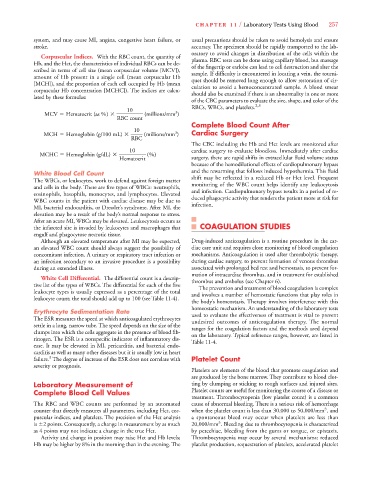
lated by these formulas:
of the CBC parameters to evaluate the size, shape, and color of the
RBCs, WBCs, and platelets. 2,3
10
3
MCV Hematocrit (as %) (millions/mm )
RBC count
Complete Blood Count After
10
3
MCH Hemoglobin (g/100 mL) (millions/mm ) Cardiac Surgery
RBC
The CBC including the Hb and Hct levels are monitored after
10 cardiac surgery to evaluate bloodloss. Immediately after cardiac
MCHC Hemoglobin (g/dL) (%)
Hematocrit surgery, there are rapid shifts in extracellular fluid volume status
because of the hemodilutional effects of cardiopulmonary bypass
White Blood Cell Count and the rewarming that follows induced hypothermia. This fluid
shift may be reflected in a reduced Hb or Hct level. Frequent
The WBCs, or leukocytes, work to defend against foreign matter
monitoring of the WBC count helps identify any leukocytosis
and cells in the body. There are five types of WBCs: neutrophils,
and infection. Cardiopulmonary bypass results in a period of re-
eosinophils, basophils, monocytes, and lymphocytes. Elevated
duced phagocytic activity that renders the patient more at risk for
WBC counts in the patient with cardiac disease may be due to
infection.
MI, bacterial endocarditis, or Dressler’s syndrome. After MI, the
elevation may be a result of the body’s normal response to stress.
After an acute MI, WBCs may be elevated. Leukocytosis occurs as
the infarcted site is invaded by leukocytes and macrophages that COAGULATION STUDIES
engulf and phagocytose necrotic tissue.
Although an elevated temperature after MI may be expected, Drug-induced anticoagulation is a routine procedure in the car-
an elevated WBC count should always suggest the possibility of diac care unit and requires close monitoring of blood coagulation
concomitant infection. A urinary or respiratory tract infection or mechanisms. Anticoagulation is used after thrombolytic therapy,
an infection secondary to an invasive procedure is a possibility during cardiac surgery, to prevent formation of venous thrombus
during an extended illness. associated with prolonged bed rest and hemostasis, to prevent for-
mation of intracardiac thrombus, and in treatment for established
White Cell Differential. The differential count is a descrip- thrombus and embolus (see Chapter 6).
tive list of the types of WBCs. The differential for each of the five The prevention and treatment of blood coagulation is complex
leukocyte types is usually expressed as a percentage of the total and involves a number of hemostatic functions that play roles in
leukocyte count; the total should add up to 100 (see Table 11-4).
the body’s homeostasis. Therapy involves interference with this
homeostatic mechanism. An understanding of the laboratory tests
Erythrocyte Sedimentation Rate used to evaluate the effectiveness of treatment is vital to prevent
The ESR measures the speed at which anticoagulated erythrocytes undesired outcomes of anticoagulation therapy. The normal
settle in a long, narrow tube. The speed depends on the size of the ranges for the coagulation factors and the methods used depend
clumps into which the cells aggregate in the presence of blood fib- on the laboratory. Typical reference ranges, however, are listed in
rinogen. The ESR is a nonspecific indicator of inflammatory dis- Table 11-4.
ease. It may be elevated in MI, pericarditis, and bacterial endo-
carditis as well as many other diseases but it is usually low in heart
3
failure. The degree of increase of the ESR does not correlate with Platelet Count
severity or prognosis.
Platelets are elements of the blood that promote coagulation and
are produced by the bone marrow. They contribute to blood clot-
Laboratory Measurement of ting by clumping or sticking to rough surfaces and injured sites.
Complete Blood Cell Values Platelet counts are useful for monitoring the course of a disease or
treatment. Thrombocytopenia (low platelet count) is a common
The RBC and WBC counts are performed by an automated cause of abnormal bleeding. There is a serious risk of hemorrhage
3
counter that directly measures all parameters, including Hct, cor- when the platelet count is less than 30,000 to 50,000/mm , and
puscular indices, and platelets. The precision of the Hct analysis a spontaneous bleed may occur when platelets are less than
3
is 2 points. Consequently, a change in measurement by as much 20,000/mm . Bleeding due to thrombocytopenia is characterized
as 4 points may not indicate a change in the true Hct. by petechiae, bleeding from the gums or tongue, or epistaxis.
Activity and change in position may raise Hct and Hb levels; Thrombocytopenia may occur by several mechanisms: reduced
Hb may be higher by 8% in the morning than in the evening. The platelet production, sequestration of platelets, accelerated platelet

