


Page 278 - Cardiac Nursing
P. 278
/09
                                    1
                                   1
                              /29
                                /09
                                /09
                                   1
                                     1 P
                                        M
                                        M
                                   0:2
                                   0:2
                                     1 P
                              /29
                      5-2
                        66.
                        66.
                    24
                    24
                      5-2
                          q
                           xd
                             6
                             6
                          q
                          q
                           xd
                                                  ara
                                                  ara
                                                   a
                                                 p
                                                  t
                                                  t
                                                   a
                                                    In
                                                      c.
                                                      c.
                                                   a
                                                   a
                                                    In
                                                 p
                                           g
                                           g
                                           g
                                          Pa
                                          Pa
                                          Pa
                                            e 2
                                                A
                                                A
                                                 p
                                            e 2
                                              54
                                              54
            K34
               0-c
                 11_
         LWB K34 0-c 11_ p p pp245-266.qxd  6/29/09  10:21 PM  Page 254 Aptara Inc.
         LWBK340-c11_
         LWB
                  254    P A R T  III / Assessment of Heart Disease
                  acute injury. CRP is a more sensitive indicator of inflammation  To evaluate CRP as a risk factor for CHD, the hs-CRP is
                  and responds more rapidly to inflammation than erythrocyte  monitored. In order to classify an individual’s risk for athero-
                  sedimentation rate (ESR). CRP was discovered approximately  sclerotic disease, the American Heart Association recommends
                  70 years ago and has been used for decades to monitor the  that two separate hs-CRP measurements be evaluated at least a
                  effectiveness of treatment for patients with lupus erythematosus,  month apart. 53  Among patients with known CHD, it is sug-
                  rheumatoid arthritis, and other immune-related conditions.  gested that a value greater than 3 mg/L is appropriate for pre-
                  Patients with acute MI, sepsis, or post-surgery have elevated  dicting outcomes in patients with stable CHD and that a
                  CRP levels.                                         threshold greater than 10 mg/L may be more predictive in
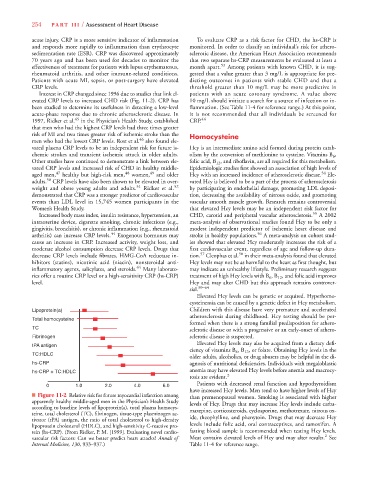
                     Interest in CRP changed since 1996 due to studies that link el-  patients with an acute coronary syndrome. A value above
                  evated CRP levels to increased CHD risk (Fig. 11-2). CRP has  10 mg/L should initiate a search for a source of infection or in-
                  been studied to determine its usefulness in detecting a low-level  flammation. (See Table 11-4 for reference range.) At this point,
                  acute-phase response due to chronic atherosclerotic disease. In  it is not recommended that all individuals be screened for
                  1997, Ridker et al. 45  in the Physician’s Health Study, established  CRP. 44
                  that men who had the highest CRP levels had three times greater
                  risk of MI and two times greater risk of ischemic stroke than the  Homocysteine
                  men who had the lowest CRP levels. Rost et al. 46  also found ele-
                  vated plasma CRP levels to be an independent risk for future is-  Hcy is an intermediate amino acid formed during protein catab-
                  chemic strokes and transient ischemic attack in older adults.  olism by the conversion of methionine to cysteine. Vitamins B 6 ,
                  Other studies have continued to demonstrate a link between ele-  folic acid, B 12 , and riboflavin, are all required for this metabolism.
                  vated CRP levels and increased risk of CHD in healthy middle-  Epidemiologic studies first showed an association of high levels of
                  aged men, 47  healthy but high-risk men, 48  women, 49  and older  Hcy with an increased incidence of atherosclerotic disease. 54  Ele-
                  adults. 50  CRP levels have also been shown to be elevated in over-  vated Hcy is believed to be a part of the process of atherosclerosis
                  weight and obese young adults and adults. 51  Ridker et al.  52  by participating in endothelial damage, promoting LDL deposi-
                  demonstrated that CRP was a stronger predictor of cardiovascular  tion, decreasing the availability of nitrous oxide, and promoting
                  events than LDL  level in 15,745 women participants in the  vascular smooth muscle growth. Research remains controversial
                  Women’s Health Study.                               that elevated Hcy levels may be an independent risk factor for
                     Increased body mass index, insulin resistance, hypertension, an  CHD, carotid and peripheral vascular atherosclerosis. 55  A 2002
                  intrauterine device, cigarette smoking, chronic infections (e.g.,  meta-analysis of observational studies found Hcy to be only a
                  gingivitis, bronchitis), or chronic inflammation (e.g., rheumatoid  modest independent  predictor of ischemic  heart  disease and
                  arthritis) can increase CRP levels. 44  Exogenous hormones may  stroke in healthy populations. 56  A meta-analysis on cohort stud-
                  cause an increase in CRP. Increased activity, weight loss, and  ies showed that elevated Hcy moderately increases the risk of a
                  moderate alcohol consumption decrease CRP levels. Drugs that  first cardiovascular event, regardless of age and follow-up dura-
                                                                         57
                                                                                      58
                  decrease CRP levels include fibrates, HMG-CoA reductase in-  tion. Cleophas et al. in their meta-analysis found that elevated
                  hibitors (statins), nicotinic acid (niacin), nonsteroidal anti-  Hcy levels may not be as harmful to the heart as first thought, but
                  inflammatory agents, salicylates, and steroids. 44  Many laborato-  may indicate an unhealthy lifestyle. Preliminary research suggests
                  ries offer a routine CRP level or a high-sensitivity CRP (hs-CRP)  treatment of high Hcy levels with B 6 , B 12 , and folic acid improves
                  level.                                              Hcy and may alter CHD but this approach remains controver-
                                                                      sial. 59–64
                                                                        Elevated Hcy levels can be genetic or acquired. Hyperhomo-
                                                                      cysteinemia can be caused by a genetic defect in Hcy metabolism.
                   Lipoprotein(a)                                     Children with this disease have very premature and accelerated
                                                                      atherosclerosis during childhood. Hcy testing should be per-
                   Total homocysteine
                                                                      formed when there is a strong familial predisposition for athero-
                   TC
                                                                      sclerotic disease or with a progressive or an early-onset of athero-
                   Fibrinogen                                         sclerotic disease is suspected.
                                                                        Elevated Hcy levels may also be acquired from a dietary defi-
                  tPA antigen
                                                                      ciency of vitamins B 6 , B 12 , or folate. Obtaining Hcy levels in the
                   TC:HDLC
                                                                      older adults, alcoholics, or drug abusers may be helpful in the di-
                   hs-CRP                                             agnosis of nutritional deficiencies. Individuals with megaloblastic
                   hs-CRP + TC:HDLC                                   anemia may have elevated Hcy levels before anemia and macrocy-
                                                                      tosis are evident. 2
                                                                        Patients with decreased renal function and hypothyroidism
                       0         1.0      2.0       4.0      6.0
                                                                      have increased Hcy levels. Men tend to have higher levels of Hcy
                  ■ Figure 11-2 Relative risk for future myocardial infarction among  than premenopausal women. Smoking is associated with higher
                  apparently healthy middle-aged men in the Physician’s Health Study  levels of Hcy. Drugs that may increase Hcy levels include carba-
                  according to baseline levels of lipoprotein(a), total plasma homocys-  mazepine, corticosteroids, cyclosporine, methotrexate, nitrous ox-
                  teine, total cholesterol (TC), fibrinogen, tissue-type plasminogen ac-
                  tivator (tPA) antigen, the ratio of total cholesterol to high-density  ide, theophylline, and phenytoin. Drugs that may decrease Hcy
                  lipoprotein cholesterol (HDLC), and high-sensitivity C-reactive pro-  levels include folic acid, oral contraceptives, and tamoxifen. A
                  tein (hs-CRP). (From Ridker, P. M. [1999]. Evaluating novel cardio-  fasting blood sample is recommended when testing Hcy levels.
                                                                                                                  2
                  vascular risk factors: Can we better predict heart attacks? Annals of  Meat contains elevated levels of Hcy and may alter results. See
                  Internal Medicine, 130, 933–937.)                   Table 11-4 for reference range.

