


Page 436 - Cardiac Nursing
P. 436
pta
                                          M
                                                41
                                                  2 A
                                            P
                               6
                           qxd
                                        P
                                  /09
                    p40
                                                      ra
                         19.
                       0-4
                                                        Inc
                                             a
                                             a
                                /30
                                      :57
            K34
               0-c
                 18_
         LWB K34 0-c 18_ p40 0-4 19. qxd  6 /30 /09  7 7 :57  P M  P a g g e e  41 2 A pta ra  Inc . .
         LWBK340-c18_p400-419.qxd  6/30/09  7:57 PM Page 412 Aptara Inc.
         LWB
                  412    P A R T  III / Assessment of Heart Disease
                                                                            Right ventricular
                                                                            permanent
                                                                            pacing lead
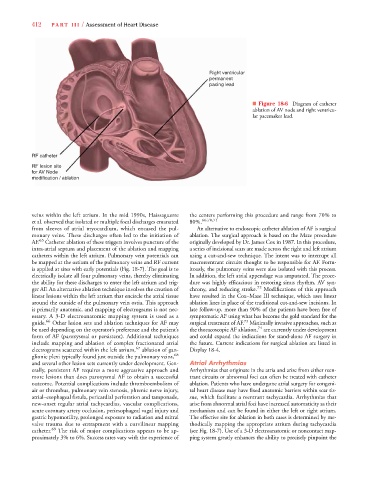
                                                                                           ■ Figure 18-6  Diagram of catheter
                                                                                           ablation of AV node and right ventricu-
                                                                                           lar pacemaker lead.


                  R RF catheter
                  R RF lesion site
                   o
                  for AV Node
                  m modification / ablation


                  veins within the left atrium. In the mid 1990s, Haissaguerre   the centers performing this procedure and range from 70% to
                  et al. observed that isolated or multiple focal discharges emanated  80%. 66,70,71
                  from sleeves of atrial myocardium, which encased the pul-  An alternative to endoscopic catheter ablation of AF is surgical
                  monary veins. These discharges often led to the initiation of  ablation. The surgical approach is based on the Maze procedure
                  AF. 65  Catheter ablation of these triggers involves puncture of the  originally developed by Dr. James Cox in 1987. In this procedure,
                  intra-atrial septum and placement of the ablation and mapping  a series of incisional scars are made across the right and left atrium
                  catheters within the left atrium. Pulmonary vein potentials can  using a cut-and-sew technique. The intent was to interrupt all
                  be mapped at the ostium of the pulmonary veins and RF current  macroreentrant circuits thought to be responsible for AF. Fortu-
                  is applied at sites with early potentials (Fig. 18-7). The goal is to  itously, the pulmonary veins were also isolated with this process.
                  electrically isolate all four pulmonary veins, thereby eliminating  In addition, the left atrial appendage was amputated. The proce-
                  the ability for these discharges to enter the left atrium and trig-  dure was highly efficacious in restoring sinus rhythm, AV syn-
                  ger AF. An alternative ablation technique involves the creation of  chrony, and reducing stroke. 72  Modifications of this approach
                  linear lesions within the left atrium that encircle the atrial tissue  have resulted in the Cox–Maze III technique, which uses linear
                  around the outside of the pulmonary vein ostia. This approach  ablation lines in place of the traditional cut-and-sew incisions. In
                  is primarily anatomic, and mapping of electrograms is not nec-  late follow-up, more than 90% of the patients have been free of
                  essary. A 3-D electroanatomic mapping system is used as a  symptomatic AF using what has become the gold standard for the
                                                                                        73
                  guide. 66  Other lesion sets and ablation techniques for AF may  surgical treatment of AF. Minimally invasive approaches, such as
                                                                                            74
                  be used depending on the operator’s preference and the patient’s  the thoracoscopic AF ablation, are currently under development
                  form of AF (paroxysmal or persistent). Additional techniques  and could expand the indications for stand-alone AF surgery in
                  include mapping and ablation of complex fractionated atrial  the future. Current indications for surgical ablation are listed in
                  electrograms scattered within the left atrium, 67  ablation of gan-  Display 18-4.
                  glionic plexi typically found just outside the pulmonary veins, 68
                  and several other lesion sets currently under development. Gen-  Atrial Arrhythmias
                  erally, persistent AF requires a more aggressive approach and  Arrhythmias that originate in the atria and arise from either reen-
                  more lesions than does paroxysmal AF to obtain a successful  trant circuits or abnormal foci can often be treated with catheter
                  outcome. Potential complications include thromboembolism of  ablation. Patients who have undergone atrial surgery for congeni-
                  air or thrombus, pulmonary vein stenosis, phrenic nerve injury,  tal heart disease may have fixed anatomic barriers within scar tis-
                  atrial–esophageal fistula, pericardial perforation and tamponade,  sue, which facilitate a reentrant tachycardia. Arrhythmias that
                  new-onset regular atrial tachycardias, vascular complications,  arise from abnormal atrial foci have increased automaticity as their
                  acute coronary artery occlusion, periesophageal vagal injury and  mechanism and can be found in either the left or right atrium.
                  gastric hypomotility, prolonged exposure to radiation and mitral  The effective site for ablation in both cases is determined by me-
                  valve trauma due to entrapment with a curvilinear mapping  thodically mapping the appropriate atrium during tachycardia
                  catheter. 69  The risk of major complications appears to be ap-  (see Fig. 18-7). Use of a 3-D electroanatomic or noncontact map-
                  proximately 3% to 6%. Success rates vary with the experience of  ping system greatly enhances the ability to precisely pinpoint the

