


Page 622 - Cardiac Nursing
P. 622
009
                                  009
                                0/2
                              6/3
                                0/2
                                      7:4
                                        5
                                      7:4
                                     1
                                     1
                              6/3
                          q
                          q
                          q
                        22.
                        22.
                             0
                             0
                              0
                           xd
                           xd
                                                 p
                                                 p
                                                A
                                                A
                                                A
                                                  ara
                                                  ara
                                                 t
                                                 p
                                                 t
                                              98
                                         Pa
                                           g
                                         Pa
                                        5
                                         Pa
                                            e 5
                                              98
                                            e 5
                                           g
                                           g
         LWBK340-c25_
         LWB
         LWB K34 0-c 25_ p pp595-622.qxd  06/30/2009  17:45  Page 598 Aptara
                 25_
               0-c
            K34
                    59
                      5-6
                      5-6
                   p
                    59
                  598    PA R T  I V / Pathophysiology and Management of Heart Disease
                                                 C
                                        B
                                                  D
                                  A
                                            E
                                                     F
                                          G
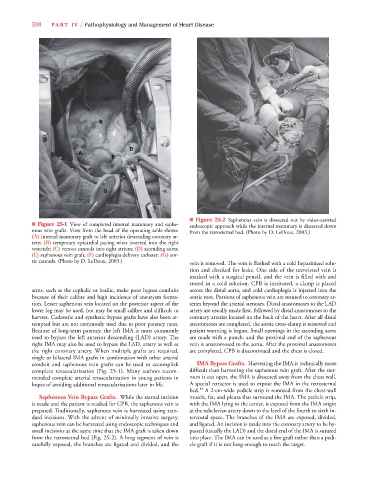
                                                                      ■ Figure 25-2 Saphenous vein is dissected out by video-assisted
                  ■ Figure 25-1 View of completed internal mammary and saphe-  endoscopic approach while the internal mammary is dissected down
                  nous vein grafts. View from the head of the operating table shows:  from the retrosternal bed. (Photo by D. LeDoux, 2003.)
                  (A) internal mammary graft to left anterior descending coronary ar-
                  tery; (B) temporary epicardial pacing wires inserted into the right
                  ventricle; (C) venous cannula into right atrium; (D) ascending aorta;
                  (E) saphenous vein graft; (F) cardioplegia delivery catheter; (G) aor-
                  tic cannula. (Photo by D. LeDoux, 2003.)            vein is removed. The vein is flushed with a cold heparinized solu-
                                                                      tion and checked for leaks. One side of the untwisted vein is
                                                                      marked with a surgical pencil, and the vein is filled with and
                                                                      stored in a cold solution. CPB is instituted, a clamp is placed
                  arms, such as the cephalic or basilic, make poor bypass conduits  across the distal aorta, and cold cardioplegia is injected into the
                  because of their calibre and high incidence of aneurysm forma-  aortic root. Portions of saphenous vein are sutured to coronary ar-
                  tion. Lesser saphenous vein located on the posterior aspect of the  teries beyond the arterial stenoses. Distal anastomoses to the LAD
                  lower leg may be used, but may be small calibre and difficult to  artery are usually made first, followed by distal anastomoses to the
                  harvest. Cadaveric and synthetic bypass grafts have also been at-  coronary arteries located on the back of the heart. After all distal
                  tempted but are not commonly used due to poor patency rates.  anastomoses are completed, the aortic cross-clamp is removed and
                  Because of long-term patency, the left IMA is most commonly  patient warming is begun. Small openings in the ascending aorta
                  used to bypass the left anterior descending (LAD) artery. The  are made with a punch, and the proximal end of the saphenous
                  right IMA may also be used to bypass the LAD, artery as well as  vein is anastomosed to the aorta. After the proximal anastomoses
                  the right coronary artery. When multiple grafts are required,  are completed, CPB is discontinued and the chest is closed.
                  single or bilateral IMA grafts in combination with other arterial
                  conduit and saphenous vein grafts can be used to accomplish  IMA Bypass Grafts. Harvesting the IMA is technically more
                  complete revascularization (Fig. 25-1). Many authors recom-  difficult than harvesting the saphenous vein graft. After the ster-
                  mended complete arterial revascularization in young patients in  num is cut open, the IMA is dissected away from the chest wall.
                  hopes of avoiding additional revascularizations later in life.  A special retractor is used to expose the IMA in the retrosternal
                                                                         13
                                                                      bed. A 2-cm-wide pedicle strip is removed from the chest-wall
                     Saphenous Vein Bypass Grafts. While the sternal incision  muscle, fat, and pleura that surround the IMA. The pedicle strip,
                  is made and the patient is readied for CPB, the saphenous vein is  with the IMA lying in the center, is exposed from the IMA origin
                  prepared. Traditionally, saphenous vein is harvested using stan-  at the subclavian artery down to the level of the fourth to sixth in-
                  dard incisions. With the advent of minimally invasive surgery,  tercostal space. The branches of the IMA are exposed, divided,
                  saphenous vein can be harvested using endoscopic techniques and  and ligated. An incision is made into the coronary artery to be by-
                  small incisions at the same time that the IMA graft is taken down  passed (usually the LAD) and the distal end of the IMA is sutured
                  from the retrosternal bed (Fig. 25-2). A long segment of vein is  into place. The IMA can be used as a free graft rather than a pedi-
                  carefully exposed, the branches are ligated and divided, and the  cle graft if it is not long enough to reach the target.

