


Page 623 - Cardiac Nursing
P. 623
xd
                              0
                           xd
                          q
                          q
                             0
                                0/2
                                0/2
                              6/3
                             0
                              6/3
                          q
                                                 t
                                                  ara
                                                  ara
                                                 p
                                                 t
                    59
                        22.
                        22.
                      5-6
                    59
                      5-6
                                            e 5
                                              99
                                            e 5
                                           g
                                           g
                                              99
                                                 p
                                                 p
                                                A
                                                A
                                                A
                                           g
                                     1
                                      7:4
                                     1
                                  009
                                  009
                                      7:4
                                         Pa
                                         Pa
                                         Pa
                                        5
                                        5
            K34
               0-c
                 25_
         LWB K34 0-c 25_ p p pp595-622.qxd  06/30/2009  17:45  Page 599 Aptara
         LWB
         LWBK340-c25_
                                                                                   C HAPTER 2 5 / Cardiac Surgery  599
                     Radial Artery Bypass Grafts. The radial artery graft is used
                   for bypass conduit only after collateral circulation of the ulnar ar-
                   tery has been assessed by vascular ultrasound or Allen’s test. Al-
                   though both radial arteries can be used, the radial artery from the
                   patient’s nondominant hand is the usual choice and can be har-
                   vested before the chest is opened. Because the radial artery is very
                   thick-walled and prone to spasm, after harvesting, papaverine may
                   be used to flush and dilate the artery before grafting. During and
                   after surgery, nitrates and calcium-channel blockers are used to
                   prevent spasm, although duration of administration of these
                                            14
                   agents has not been standardized. The radial graft is a desirable
                   conduit because of its length and ability to reach most distal tar-
                   gets. Postoperative nursing care includes evaluation of ulnar pulse
                   and distal circulation.
                     Gastroepiploic Graft. The right GEA is a branch of the gas-
                   troduodenal artery that supplies blood to the greater curvature of
                   the stomach. The GEA can be used as an in situ graft on the pos-
                   terior surfaces of the heart or as a free graft to other vessels. Har-
                   vesting of the GEA graft requires laparotomy in addition to the
                   sternotomy or thoracotomy incisions required for CABG. Longer
                   operative times and abdominal surgery increase the complexity of
                   the surgery.
                   Operative Results
                   Coronary bypass surgery is done to improve quality of life by re-
                   lieving anginal symptoms, or to prolong life. Although angina
                   pectoris is relieved in more than 90% of patients who undergo
                   CABG surgery, Canadian Cardiovascular Society class III angina
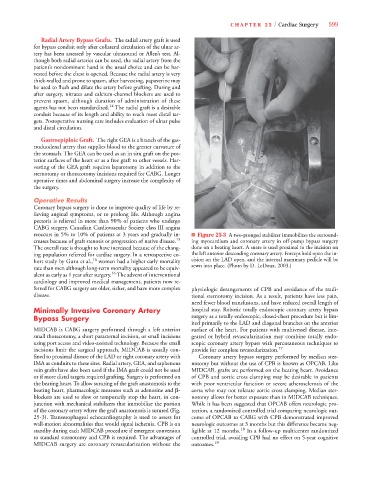
                   reoccurs in 5% to 10% of patients at 3 years and gradually in-  ■ Figure 25-3 A two-pronged stabilizer immobilizes the surround-
                   creases because of graft stenosis or progression of native disease. 15  ing myocardium and coronary artery in off-pump bypass surgery
                   The overall rate is thought to have increased because of the chang-  done on a beating heart. A snare is used proximal to the incision on
                   ing population referred for cardiac surgery. In a retrospective co-  the left anterior descending coronary artery. Forceps hold open the in-
                                      16
                   hort study by Guru et al., women had a higher early mortality  cision on the LAD open, and the internal mammary pedicle will be
                   rate than men although long-term mortality appeared to be equiv-  sewn into place. (Photo by D. LeDoux, 2003.)
                                            16
                   alent as early as 1 year after surgery. The advent of interventional
                   cardiology and improved medical management, patients now re-
                   ferred for CABG surgery are older, sicker, and have more complex  physiologic derangements of CPB and avoidance of the tradi-
                   disease.                                            tional sternotomy incision. As a result, patients have less pain,
                                                                       need fewer blood transfusions, and have reduced overall length of
                   Minimally Invasive Coronary Artery                  hospital stay. Robotic totally endoscopic coronary artery bypass
                   Bypass Surgery                                      surgery as a totally endoscopic, closed-chest procedure but is lim-
                                                                       ited primarily to the LAD and diagonal branches on the anterior
                   MIDCAB is CABG surgery performed through a left anterior  surface of the heart. For patients with multivessel disease, inte-
                   small thoracotomy, a short parasternal incision, or small incisions  grated or hybrid revascularization may combine totally endo-
                   using port access and video-assisted technology. Because the small  scopic coronary artery bypass with percutaneous techniques to
                   incisions limit the surgical approach, MIDCAB is usually con-  provide for complete revascularization. 17
                   fined to proximal disease of the LAD or right coronary artery with  Coronary artery bypass surgery performed by median ster-
                   IMA as conduits to these sites. Radial artery, GEA, and saphenous  notomy but without the use of CPB is known as OPCAB. Like
                   vein grafts have also been used if the IMA graft could not be used  MIDCAB, grafts are performed on the beating heart. Avoidance
                   or if more distal targets required grafting. Surgery is performed on  of CPB and aortic cross clamping may be desirable in patients
                   the beating heart. To allow suturing of the graft anastomosis to the  with poor ventricular function or severe atherosclerosis of the
                   beating heart, pharmacologic measures such as adenosine and  -  aorta who may not tolerate aortic cross clamping. Median ster-
                   blockers are used to slow or temporarily stop the heart, in con-  notomy allows for better exposure than in MIDCAB techniques.
                   junction with mechanical stabilizers that immobilize the portion  While it has been suggested that OPCAB offers neurologic pro-
                   of the coronary artery where the graft anastomosis is sutured (Fig.  tection, a randomized controlled trial comparing neurologic out-
                   25-3). Transesophageal echocardiography is used to assess for  come of OPCAB to CABG with CPB demonstrated improved
                   wall-motion abnormalities that would signal ischemia. CPB is on  neurologic outcomes at 3 months but this difference became neg-
                   standby during each MIDCAB procedure if emergent conversion  ligible at 12 months. 18  In a follow-up multicenter randomized
                   to standard sternotomy and CPB is required. The advantages of  controlled trial, avoiding CPB had no effect on 5-year cognitive
                   MIDCAB surgery are coronary revascularization without the  outcomes. 19

