


Page 627 - Cardiac Nursing
P. 627
LWBK340-c25_p595-622.qxd  06/30/2009  17:45  Page 603 Aptara


                                                                                   C HAPTER 2 5 / Cardiac Surgery  603


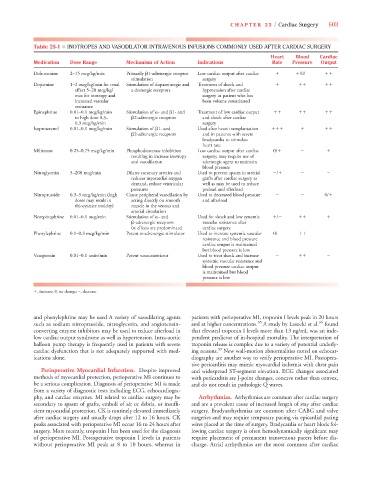
                   Table 25-1 ■ INOTROPES AND VASODILATOR INTRAVENOUS INFUSIONS COMMONLY USED AFTER CARDIAC SURGERY
                                                                                                 Heart   Blood   Cardiac
                   Medication  Dose Range        Mechanism of Action     Indications             Rate   Pressure  Output
                   Dobutamine  2–15 mcg/kg/min   Primarily  1-adrenergic receptor   Low cardiac output after cardiac

/0/
                                                   stimulation            surgery
                   Dopamine    1–2 mcg/kg/min for renal  Stimulation of dopaminergic and  Treatment of shock and
                                 effect 5–20 mcg/kg/  a drenergic receptors  hypotension after cardiac
                                 min for inotropy and                     surgery in patient who has
                                 increased vascular                       been volume resuscitated
                                 resistance
                   Epinephrine  0.01–0.1 mcg/kg/min  Stimulation of  - and  1- and   Treatment of low cardiac output
                                 to high dose 0.3–   2-adrenergic receptors  and shock after cardiac
                                 0.3 mcg/kg/min                           surgery
                   Isoproterenol  0.01–0.1 mcg/kg/min  Stimulation of  1- and   Used after heart transplantation
                                                    2-adrenergic receptors  and in patients with severe
                                                                          bradycardia to stimulate
                                                                          heart rate
                   Milrinone   0.25–0.75 mcg/kg/min  Phosphodiesterase inhibition   Low cardiac output after cardiac   0/
                                                   resulting in increase inotropy   surgery; may require use of
                                                   and vasodilation       adrenergic agent to maintain
                                                                          blood pressure
                   Nitroglycerin  5–200 mcg/min  Dilates coronary arteries and   Used to prevent spasm in arterial   /
                                                   reduces myocardial oxygen   grafts after cardiac surgery as
                                                   demand, reduce ventricular   well as may be used to reduce
                                                   pressures              preload and afterload
                   Nitroprusside  0.3–5 mcg/kg/min (high   Cause peripheral vasodilation by   Used to decreased blood pressure        0/
                                 doses may result in   acting directly on smooth   and afterload
                                 thiocyanate toxicity)  muscle in the venous and
                                                   arterial circulation
                   Norepinephrine  0.01–0.1 mcg/min  Stimulation of  - and   Used for shock and low systemic
/
                                                    -adrenergic receptors   vascular resistance after
                                                   (  effects are predominate)  cardiac surgery
                   Phenylephrine  0.1–0.3 mcg/kg/min  Potent  -adrenergic stimulator  Used to increase systemic vascular   0/
                                                                          resistance and blood pressure
                                                                          cardiac output is maintained
                                                                          but blood pressure is low
                   Vasopressin  0.01–0.1 units/min  Potent vasoconstrictor  Used to treat shock and increase
                                                                          systemic vascular resistance and
                                                                          blood pressure cardiac output
                                                                          is maintained but blood
                                                                          pressure is low


, increase; 0, no change; –, decrease.


                   and phenylephrine may be used A variety of vasodilating agents  patients with perioperative MI, troponin I levels peak in 20 hours
                                                                                            35
                   such as sodium nitroprusside, nitroglycerin, and angiotensin-  and at higher concentrations. A study by Lasocki et al. 36  found
                   converting enzyme inhibitors may be used to reduce afterload in  that elevated troponin I levels more than 13 ng/mL was an inde-
                   low cardiac output syndrome as well as hypertension. Intra-aortic  pendent predictor of in-hospital mortality. The interpretation of
                   balloon pump therapy is frequently used in patients with severe  troponin release is complex due to a variety of potential underly-
                                                                               37
                   cardiac dysfunction that is not adequately supported with med-  ing reasons. New wall-motion abnormalities noted on echocar-
                   ications alone.                                     diography are another way to verify perioperative MI. Postopera-
                                                                       tive pericarditis may mimic myocardial ischemia with chest pain
                     Perioperative Myocardial Infarction. Despite improved  and widespread ST-segment elevation. ECG changes associated
                   methods of myocardial protection, perioperative MI continues to  with pericarditis are J-point changes, concave rather than convex,
                   be a serious complication. Diagnosis of perioperative MI is made  and do not result in pathologic Q waves.
                   from a variety of diagnostic tests including ECG, echocardiogra-
                   phy, and cardiac enzymes. MI related to cardiac surgery may be  Arrhythmias. Arrhythmias are common after cardiac surgery
                   secondary to spasm of grafts, emboli of air or debris, or insuffi-  and are a prevalent cause of increased length of stay after cardiac
                   cient myocardial protection. CK is routinely elevated immediately  surgery. Bradyarrhythmias are common after CABG and valve
                   after cardiac surgery and usually drops after 12 to 16 hours. CK  surgeries and may require temporary pacing via epicardial pacing
                   peaks associated with perioperative MI occur 16 to 24 hours after  wires placed at the time of surgery. Bradycardia or heart block fol-
                   surgery. More recently, troponin I has been used for the diagnosis  lowing cardiac surgery is often hemodynamically significant may
                   of perioperative MI. Postoperative troponin I levels in patients  require placement of permanent transvenous pacers before dis-
                   without perioperative MI peak at 8 to 10  hours, whereas in  charge. Atrial arrhythmias are the most common after cardiac

