


Page 810 - Cardiac Nursing
P. 810
6
6
/
0
/
/
0
/
009
1
1
009
2
2
009
98.
98.
qx
98.
3-7
3-7
3-7
qx
0
0
0
3
d
d
3
2:0
g
g
e 7
Pa
M
M
Pa
e 7
Apt
ara
ara
Apt
86
86
86
A
A
A
7 A
2:0
2:0
7 A
A
A
A
M
A
A
A
A
0-c
0-c
K34
34_
p78
p78
34_
K34
LWB
LWBK340-c34_p78p783-798.qxd 30/06/2009 12:07 AM Page 786 Aptara
K34
LWB
786 PA R T V / Health Promotion and Disease Prevention
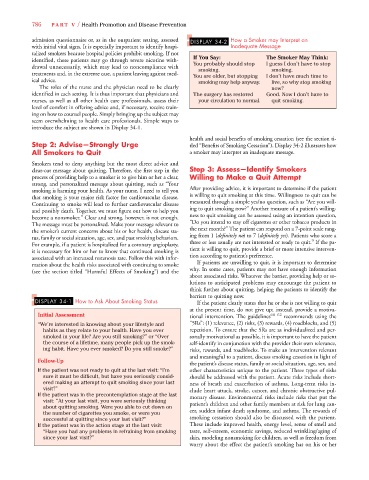
admission questionnaire or, as in the outpatient setting, assessed DISPLAY 34-2 How a Smoker may Interpret an
with initial vital signs. It is especially important to identify hospi- Inadequate Message
talized smokers because hospital policies prohibit smoking. If not
identified, these patients may go through severe nicotine with- If You Say: The Smoker May Think:
drawal unnecessarily, which may lead to noncompliance with You probably should stop I guess I don’t have to stop
smoking.
smoking.
treatments and, in the extreme case, a patient leaving against med- You are older, but stopping I don’t have much time to
ical advice. smoking may help anyway. live, so why stop smoking
The roles of the nurse and the physician need to be clearly now?
identified in each setting. It is thus important that physicians and The surgery has restored Good. Now I don’t have to
nurses, as well as all other health care professionals, assess their your circulation to normal. quit smoking.
level of comfort in offering advice and, if necessary, receive train-
ing on how to counsel people. Simply bringing up the subject may
seem overwhelming to health care professionals. Simple ways to
introduce the subject are shown in Display 34-1.
health and social benefits of smoking cessation (see the section ti-
Step 2: Advise—Strongly Urge tled “Benefits of Smoking Cessation”). Display 34-2 illustrates how
All Smokers to Quit a smoker may interpret an inadequate message.
Smokers tend to deny anything but the most direct advice and
clear-cut message about quitting. Therefore, the first step in the Step 3: Assess—Identify Smokers
process of providing help to a smoker is to give him or her a clear, Willing to Make a Quit Attempt
strong, and personalized message about quitting, such as “Your
smoking is harming your health. As your nurse, I need to tell you After providing advice, it is important to determine if the patient
that smoking is your major risk factor for cardiovascular disease. is willing to quit smoking at this time. Willingness to quit can be
Continuing to smoke will lead to further cardiovascular disease measured through a simple yes/no question, such as “Are you will-
and possibly death. Together, we must figure out how to help you ing to quit smoking now?” Another measure of a patient’s willing-
become a nonsmoker.” Clear and strong, however, is not enough. ness to quit smoking can be assessed using an intention question,
The message must be personalized. Make your message relevant to “Do you intend to stay off cigarettes or other tobacco products in
the smoker’s current concerns about his or her health, disease sta- the next month?” The patient can respond on a 7-point scale rang-
o
s
s
o
tus, family or social situation, age, sex, and past smoking behaviors. ing from 1 (definitely no) to 7 (definitely yes). Patients who score a
9
For example, if a patient is hospitalized for a coronary angioplasty, three or less usually are not interested or ready to quit. If the pa-
it is necessary for him or her to know that continued smoking is tient is willing to quit, provide a brief or more intensive interven-
associated with an increased restenosis rate. Follow this with infor- tion according to patient’s preference.
mation about the health risks associated with continuing to smoke If patients are unwilling to quit, it is important to determine
(see the section titled “Harmful Effects of Smoking”) and the why. In some cases, patients may not have enough information
about associated risks. Whatever the barrier, providing help or so-
lutions to anticipated problems may encourage the patient to
think further about quitting, helping the patients to identify the
barriers to quitting now.
DISPLAY 34-1 How to Ask About Smoking Status If the patient clearly states that he or she is not willing to quit
at the present time, do not give up; instead, provide a motiva-
Initial Assessment tional intervention. The guidelines 60–62 recommends using the
“We’re interested in knowing about your lifestyle and “5Rs”: (1) relevance, (2) risks, (3) rewards, (4) roadblocks, and (5)
habits as they relate to your health. Have you ever repetition. To ensure that the 5Rs are as individualized and per-
smoked in your life? Are you still smoking?” or “Over sonally motivational as possible, it is important to have the patient
the course of a lifetime, many people pick up the smok- self-identify in conjunction with the provider their own relevance,
ing habit. Have you ever smoked? Do you still smoke?” risks, rewards, and roadblocks. To make an intervention relevant
and meaningful to a patient, discuss smoking cessation in light of
Follow-Up
the patient’s disease status, family or social situation, age, sex, and
If the patient was not ready to quit at the last visit: “I’m other characteristics unique to the patient. Three types of risks
sure it must be difficult, but have you seriously consid- should be addressed with the patient. Acute risks include short-
ered making an attempt to quit smoking since your last ness of breath and exacerbation of asthma. Long-term risks in-
visit?” clude heart attack, stroke, cancer, and chronic obstructive pul-
If the patient was in the precontemplation stage at the last monary disease. Environmental risks include risks that put the
visit: “At your last visit, you were seriously thinking patient’s children and other family members at risk for lung can-
about quitting smoking. Were you able to cut down on
the number of cigarettes you smoke, or were you cer, sudden infant death syndrome, and asthma. The rewards of
successful at quitting since your last visit?” smoking cessation should also be discussed with the patient.
If the patient was in the action stage at the last visit: These include improved health, energy level, sense of smell and
“Have you had any problems in refraining from smoking taste, self-esteem, economic savings, reduced wrinkling/aging of
since your last visit?” skin, modeling nonsmoking for children, as well as freedom from
worry about the effect the patient’s smoking has on his or her

