


Page 812 - Cardiac Nursing
P. 812
LWBK340-c34_p783-798.qxd  30/06/2009  12:07 AM  Page 788 Aptara


                  788    PA R T  V / Health Promotion and Disease Prevention

                                                                      the initial quit date, leading many to conclude that there is no safe
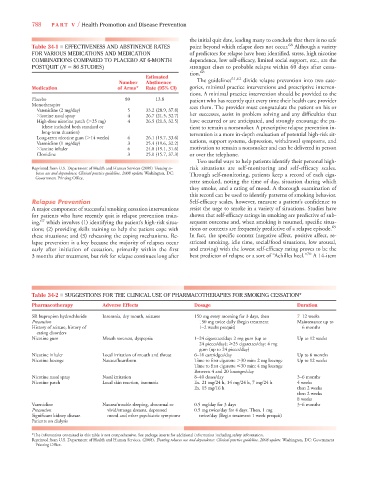
                  Table 34-1 ■ EFFECTIVENESS AND ABSTINENCE RATES     point beyond which relapse does not occur. 68  Although a variety
                  FOR VARIOUS MEDICATIONS AND MEDICATION              of predictors for relapse have been identified, stress, high nicotine
                  COMBINATIONS COMPARED TO PLACEBO AT 6-MONTH         dependence, low self-efficacy, limited social support, etc., are the
                            (
                            (
                  POSTQUIT (N   86 STUDIES)                           strongest clues to probable relapse within 60 days after cessa-
                                                                      tion. 68
                                                        Estimated                   61,62
                                               Number   Abstinence      The guidelines  divide relapse prevention into two cate-
                  Medication                  of Arms*  Rate (95% CI)  gories, minimal practice interventions and prescriptive interven-
                                                                      tions. A minimal practice intervention should be provided to the
                  Placebo                        80        13.8       patient who has recently quit every time their health care provider
                  Monotherapies
                    Varenicline (2 mg/day)        5     33.2 (28.9, 37.8)  sees them. The provider must congratulate the patient on his or
                    Nicotine nasal spray          4     26.7 (21.5, 32.7)  her successes, assist in problem solving and any difficulties that
                    High-dose nicotine patch ( 25 mg)  4  26.5 (21.3, 32.5)  have occurred or are anticipated, and strongly encourage the pa-
                      (these included both standard or                tient to remain a nonsmoker. A prescriptive relapse prevention in-
                      long-term duration)                             tervention is a more in-depth evaluation of potential high-risk sit-
                    Long-term nicotine gum ( 14 weeks)  6  26.1 (19.7, 33.6)
                    Varenicline (1 mg/day)        3     25.4 (19.6, 32.2)  uations, support systems, depression, withdrawal symptoms, and
                    Nicotine inhaler              6     24.8 (19.1, 31.6)  motivation to remain a nonsmoker and can be delivered in person
                    Clonidine                     3     25.0 (15.7, 37.3)   or over the telephone.
                                                                        Two useful ways to help patients identify their personal high-
                  Reprinted from U.S. Department of Health and Human Services (2008) Treating to-  risk situations are self-monitoring and self-efficacy scales.
                    bacco use and dependence: Clinical practice guideline, 2008 update. Washington, DC:  Through self-monitoring, patients keep a record of each ciga-
                    Government Printing Office.
                                                                      rette smoked, noting the time of day, situation during which
                                                                      they smoke, and a rating of mood. A thorough examination of
                                                                      this record can be used to identify patterns of smoking behavior.
                  Relapse Prevention                                  Self-efficacy scales, however, measure a patient’s confidence to
                  A major component of successful smoking cessation interventions  resist the urge to smoke in a variety of situations. Studies have
                  for patients who have recently quit is relapse prevention train-  shown that self-efficacy ratings in smoking are predictive of sub-
                  ing, 67  which involves (1) identifying the patient’s high-risk situa-  sequent outcome and, when smoking is resumed, specific situa-
                  tions; (2) providing skills training to help the patient cope with  tions or contexts are frequently predictive of a relapse episode. 69
                  these situations; and (3) rehearsing the coping mechanisms. Re-  In fact, the specific context (negative affect, positive affect, re-
                  lapse prevention is a key because the majority of relapses occur  stricted smoking, idle time, social/food situations, low arousal,
                  early after initiation of cessation, primarily within the first   and craving) with the lowest self-efficacy rating proves to be the
                  3 months after treatment, but risk for relapse continues long after  best predictor of relapse or a sort of “Achilles heel.” 70  A 14-item


                  Table 34-2 ■ SUGGESTIONS FOR THE CLINICAL USE OF PHARMACOTHERAPIES FOR SMOKING CESSATION*
                  Pharmacotherapy        Adverse Effects                Dosage                           Duration
                  SR bupropion hydrochloride  Insomnia, dry mouth, seizures  150 mg every morning for 3 days, then  7–12 weeks
                  Precaution                                             150 mg twice daily (begin treatment  Maintenance up to
                  History of seizure, history of                         1–2 weeks prequit)                6 months
                    eating disorders
                  Nicotine gum           Mouth soreness, dyspepsia      1–24 cigarettes/day: 2 mg gum (up to   Up to 12 weeks
                                                                         24 pieces/day);  25 cigarettes/day: 4 mg
                                                                         gum (up to 24 pieces/day)
                  Nicotine inhaler       Local irritation of mouth and throat  6–16 cartridges/day       Up to 6 months
                  Nicotine lozenge       Nausea/heartburn               Time to first cigarette  30 min: 2 mg lozenge  Up to 12 weeks
                                                                        Time to first cigarette  30 min: 4 mg lozenge
                                                                        Between 4 and 20 lozenges/day
                  Nicotine nasal spray   Nasal irritation               8–40 doses/day                   3–6 months
                  Nicotine patch         Local skin reaction, insomnia  Ex. 21 mg/24 h, 14 mg/24 h, 7 mg/24 h  4 weeks
                                                                        Ex. 15 mg/16 h                   then 2 weeks
                                                                                                         then 2 weeks
                                                                                                         8 weeks
                  Varenicline            Nausea/trouble sleeping, abnormal or   0.5 mg/day for 3 days    3–6 months
                  Precaution               vivid/strange dreams, depressed   0.5 mg twice/day for 4 days. Then, 1 mg
                  Significant kidney disease  mood and other psychiatric symptoms  twice/day (Begin treatment 1 week prequit)
                  Patients on dialysis

                  *The information contained in this table is not comprehensive. See package inserts for additional information including safety information.
                  Reprinted from U.S. Department of Health and Human Services. (2008). Treating tobacco use and dependence: Clinical practice guideline, 2008 update. Washington, DC: Government
                    Printing Office.

