


Page 813 - Cardiac Nursing
P. 813
6
                                     6
                                      /
                                    0
                                   /
                                   /
                                    0
                                      /
                                        009
                                            1
                                            1
                                        009
                                       2
                                       2
                                        009
                          98.
                          98.
                             qx
                          98.
                        3-7
                        3-7
                        3-7
                             qx
                                  0
                                  0
                                  0
                                 3
                               d
                               d
                                 3
                                             2:0
                                                      g
                                                      g
                                                       e 7
                                                    Pa
                                                  M
                                                  M
                                                    Pa
                                                       e 7
                                                            Apt
                                                               ara
                                                               ara
                                                            Apt
                                                         89
                                                         89
                                                         89
                                                 A
                                                 A
                                                 A
                                               7 A
                                             2:0
                                             2:0
                                               7 A
                                                 A
                                                 A
                                                 A
                                                  M
                                                 A
                                                 A
                                                 A
                                                 A
            K34
                0-c
                0-c
         LWBK340-c34_p78p783-798.qxd  30/06/2009  12:07 AM  Page 789 Aptara
            K34
            K34
                  34_
                     p78
                     p78
                  34_
                                                             C HAPTER  3 4 / Smoking Cessation and Relapse Prevention  789
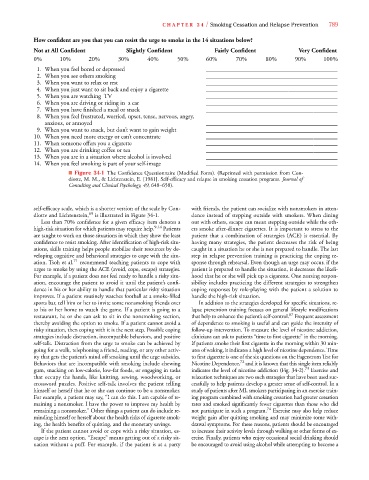
                   How confident are you that you can resist the urge to smoke in the 14 situations below?
                   Not at All Confident           Slightly Confident            Fairly Confident             Very Confident
                   0%      10%       20%       30%      40%       50%      60%       70%       80%      90%       100%
                    1. When you feel bored or depressed                    ___________________________________________
                    2. When you see others smoking                         ___________________________________________
                    3. When you want to relax or rest                      ___________________________________________
                    4. When you just want to sit back and enjoy a cigarette  ___________________________________________
                    5. When you are watching  TV                           ___________________________________________
                    6. When you are driving or riding in  a car            ___________________________________________
                    7. When you have finished a meal or snack               ___________________________________________
                    8. When you feel frustrated, worried, upset, tense, nervous, angry,
                       anxious, or annoyed                                 ___________________________________________
                    9. When you want to snack, but don’t want to gain weight  ___________________________________________
                   10. When you need more energy or can’t concentrate      ___________________________________________
                   11. When someone offers you a cigarette                 ___________________________________________
                   12. When you are drinking coffee or tea                 ___________________________________________
                   13. When you are in a situation where alcohol is involved  ___________________________________________
                   14. When you feel smoking is part of your self-image    ___________________________________________
                              ■ Figure 34-1 The Confidence Questionnaire (Modified Form). (Reprinted with permission from Con-
                              diotte, M. M., & Lichtenstein, E. [1981]. Self-efficacy and relapse in smoking cessation programs. Journal of
                              Consulting and Clinical Psychology, 49, 648–658).
                                                        9
                                                        9
                   self-efficacy scale, which is a shorter version of the scale by Con-  with friends, the patient can socialize with nonsmokers in atten-
                   diotte and Lichtenstein, 69  is illustrated in Figure 34-1.  dance instead of stepping outside with smokers. When dining
                     Less than 70% confidence for a given efficacy item denotes a  out with others, escape can mean stepping outside while the oth-
                   high-risk situation for which patients may require help. 9,14  Patients  ers smoke after-dinner cigarettes. It is important to stress to the
                   are taught to work on those situations in which they show the least  patient that a combination of strategies (ACE) is essential. By
                   confidence to resist smoking. After identification of high-risk situ-  having many strategies, the patient decreases the risk of being
                   ations, skills training helps people mobilize their resources by de-  caught in a situation he or she is not prepared to handle. The last
                   veloping cognitive and behavioral strategies to cope with the situ-  step in relapse prevention training is practicing the coping re-
                   ation. Tsoh et al. 71  recommend teaching patients to cope with  sponse through rehearsal. Even though an urge may occur, if the
                   urges to smoke by using the ACE (avoid, cope, escape) strategies.  patient is prepared to handle the situation, it decreases the likeli-
                   For example, if a patient does not feel ready to handle a risky situ-  hood that he or she will pick up a cigarette. One nursing respon-
                   ation, encourage the patient to avoid it until the patient’s confi-  sibility includes practicing the different strategies to strengthen
                   dence in his or her ability to handle that particular risky situation  coping responses by role-playing with the patient a solution to
                   improves. If a patient routinely watches football at a smoke-filled  handle the high-risk situation.
                   sports bar, tell him or her to invite some nonsmoking friends over  In addition to the strategies developed for specific situations, re-
                   to his or her home to watch the game. If a patient is going to a  lapse prevention training focuses on general lifestyle modifications
                                                                                                       67
                   restaurant, he or she can ask to sit in the nonsmoking section,  that help to enhance the patient’s self-control. Frequent assessment
                   thereby avoiding the option to smoke. If a patient cannot avoid a  of dependence to smoking is useful and can guide the intensity of
                   risky situation, then coping with it is the next step. Possible coping  follow-up intervention. To measure the level of nicotine addiction,
                   strategies include distraction, incompatible behaviors, and positive  clinicians can ask to patients “time to first cigarette” in the morning.
                   self-talk. Distraction from the urge to smoke can be achieved by  If patients smoke their first cigarette in the morning within 30 min-
                   going for a walk, telephoning a friend, reading, or any other activ-  utes of waking, it indicates a high level of nicotine dependence. Time
                   ity that gets the patient’s mind off smoking until the urge subsides.  to first cigarette is one of the six questions on the Fagerstrom Test for
                                                                                       72
                   Behaviors that are incompatible with smoking include chewing  Nicotine Dependence, and it is known that this single item reliably
                   gum, snacking on low-calorie, low-fat foods, or engaging in tasks  indicates the level of nicotine addiction (Fig. 34-2). 73  Exercise and
                   that occupy the hands, like knitting, sewing, woodworking, or  relaxation techniques are two such strategies that have been used suc-
                   crossword puzzles. Positive self-talk involves the patient telling  cessfully to help patients develop a greater sense of self-control. In a
                   himself or herself that he or she can continue to be a nonsmoker.  study of patients after MI, smokers participating in an exercise train-
                   For example, a patient may say, “I can do this. I am capable of re-  ing program combined with smoking cessation had greater cessation
                   maining a nonsmoker. I have the power to improve my health by  rates and smoked significantly fewer cigarettes than those who did
                   remaining a nonsmoker.” Other things a patient can do include re-  not participate in such a program. 74  Exercise may also help reduce
                   minding himself or herself about the health risks of cigarette smok-  weight gain after quitting smoking and may minimize some with-
                   ing, the health benefits of quitting, and the monetary savings.  drawal symptoms. For these reasons, patients should be encouraged
                     If the patient cannot avoid or cope with a risky situation, es-  to increase their activity levels through walking or other forms of ex-
                   cape is the next option. “Escape” means getting out of a risky sit-  ercise. Finally, patients who enjoy occasional social drinking should
                   uation without a puff. For example, if the patient is at a party  be encouraged to avoid using alcohol while attempting to become a

