


Page 861 - Cardiac Nursing
P. 861
LWBK340-c36_p823-841.qxd  29/06/2009  09:01 PM  Page 837 Aptara


                                                          C HAP TE R  36 / Lipid Management and Cardiovascular Disease  837


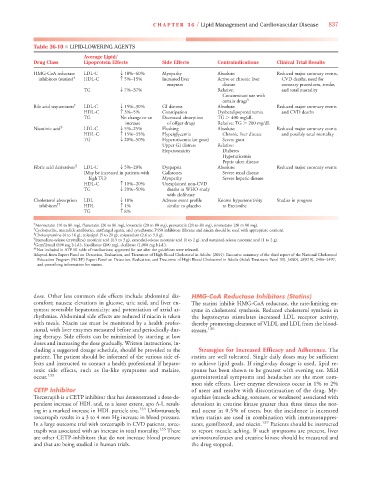
                   Table 36-10 ■ LIPID-LOWERING AGENTS
                                   Average Lipid/
                   Drug Class      Lipoprotein Effects       Side Effects      Contraindications   Clinical Trial Results
                   HMG-CoA reductase  LDL-C    T 18%–60%     Myopathy          Absolute:           Reduced major coronary events,
                     inhibitors (statins)*  HDL-C  c 5%–15%  Increased liver   Active or chronic liver   CVD deaths, need for
                                                               enzymes           disease            coronary procedures, stroke,
                                   TG          T 7%–37%                        Relative:            and total mortality
                                                                                 Concomitant use with
                                                                                 certain drugs †
                   Bile acid sequestrants ‡  LDL-C  T 15%–30%  GI distress     Absolute:           Reduced major coronary events
                                   HDL-C       c 3%–5%       Constipation      Dysbetalipoproteinemia  and CVD deaths
                                   TG          No change or an   Decreased absorption   TG   400 mg/dL
                                                 increase      of offger drugs  Relative: TG   200 mg/dL
                   Nicotinic acid §  LDL-C     T 5%–25%      Flushing          Absolute:           Reduced major coronary events
                                   HDL-C       c 15%–35%     Hyperglycemia       Chronic liver disease  and possibly total mortality
                                   TG          T 20%–50%     Hyperuricemia (or gout)  Severe gout
                                                             Upper GI distress  Relative:
                                                             Hepatotoxicity      Diabetes
                                                                                 Hyperuricemia
                                                                                 Peptic ulcer disease
                   Fibric acid derivatives ||  LDL-C  T 5%–20%  Dyspepsia      Absolute:           Reduced major coronary events
                                   (May be increased in patients with   Gallstones  Severe renal disease
                                     high TG)                Myopathy            Severe hepatic disease
                                   HDL-C       c 10%–20%     Unexplained non-CVD
                                   TG          T 20%–50%       deaths in WHO study
                                                               with clofibrate
                   Cholesterol absorption  LDL  T 18%        Adverse event profile   Known hypersensitivity   Studies in progress
                     inhibitors ††  HDL        c 1%            similar to placebo  to Ezetimibe
                                   TG          c 8%

                   *Atorvastatin (10 to 80 mg), fluvastatin (20 to 80 mg), lovastatin (20 to 80 mg), pravastatin (20 to 80 mg), simvastatin (20 to 80 mg).
                   † Cyclosporine, macrolide antibiotics, antifungal agents, and cytochrome P450 inhibitors (fibrates and niacin should be used with appropriate caution).
                   ‡ Cholestyramine (4 to 16 g), colestipol (5 to 20 g), colesevelam (2.6 to 3.8 g).
                   § Immediate-release (crystalline) nicotinic acid (1.5 to 3 g), extended-release nicotinic acid (1 to 2 g), and sustained-release nicotinic acid (1 to 2 g).
                   || Gemfibrozil (600 mg b.i.d.), fenofibrate (200 mg), clofibrate (1,000 mg b.i.d.).
                   †† Not included in ATP III table of medications; approved for use after the guidelines were released.
                   Adapted from Expert Panel on Detection, Evaluation, and Treatment of High Blood Cholesterol in Adults. (2001). Executive summary of the third report of the National Cholesterol
                    Education Program (NCEP) Expert Panel on Detection, Evaluation, and Treatment of High Blood Cholesterol in Adults (Adult Treatment Panel III). JAMA, 285(19), 2486–2497,
                    and prescribing information for statins.


                   dose. Other less common side effects include abdominal dis-  HMG-CoA Reductase Inhibitors (Statins)
                   comfort; nausea; elevations in glucose, uric acid, and liver en-  The statins inhibit HMG-CoA reductase, the rate-limiting en-
                   zymes; reversible hepatotoxicity; and potentiation of atrial ar-  zyme in cholesterol synthesis. Reduced cholesterol synthesis in
                   rhythmias. Abdominal side effects are reduced if niacin is taken  the  hepatocytes stimulates increased LDL receptor activity,
                   with meals. Niacin use must be monitored by a health profes-  thereby promoting clearance of VLDL and LDL from the blood-
                   sional, with liver enzymes measured before and periodically dur-  stream. 136
                   ing therapy. Side effects can be minimized by starting at low
                   doses and increasing the dose gradually. Written instructions, in-
                   cluding a suggested dosage schedule, should be provided to the  Strategies for Increased Efficacy and Adherence. The
                   patient. The patient should be informed of the various side ef-  statins are well tolerated. Single daily doses may be sufficient
                   fects and instructed to contact a health professional if hepato-  to achieve lipid goals. If single-day dosage is used, lipid re-
                   toxic side effects, such as  flu-like symptoms and malaise,  sponse has been shown to be greatest with evening use. Mild
                   occur. 133                                          gastrointestinal symptoms and headaches are the most com-
                                                                       mon side effects. Liver enzyme elevations occur in 1% to 2%
                   CETP Inhibitor                                      of users and resolve with discontinuation of the drug. My-
                   Torcetrapib is a CETP inhibitor that has demonstrated a dose-de-  opathies (muscle aching, soreness, or weakness) associated with
                   pendent increase of HDL and, to a lesser extent, apo A-I, result-  elevations in creatine kinase greater than three times the nor-
                   ing in a marked increase in HDL particle size. 134  Unfortunately,  mal occur in 0.5% of users, but the incidence is increased
                   torcetrapib results in a 3 to 4 mm Hg increase in blood pressure.  when statins are used in combination with immunosuppres-
                   In a large outcome trial with torcetrapib in CVD patients, torce-  sants, gemfibrozil, and niacin. 137  Patients should be instructed
                   trapib was associated with an increase in total mortality. 135  There  to report muscle aching. If such symptoms are present, liver
                   are other CETP-inhibitors that do not increase blood pressure  aminotransferases and creatine kinase should be measured and
                   and that are being studied in human trials.         the drug stopped.

