


Page 857 - Cardiac Nursing
P. 857
LWBK340-c36_p823-841.qxd  29/06/2009  09:01 PM  Page 833 Aptara


                                                          C HAP TE R  36 / Lipid Management and Cardiovascular Disease  833

                   times each week is a safe and prudent alternative. Plants sterols and  Dietary Recommendations
                   stanols at doses of 2 g/day or greater can lower LDL cholesterol by
                   9% to 14%. Studies on other additives, such as soy protein, soluble  The goal of diet therapy is to reduce LDL cholesterol to desirable
                   fiber, antioxidants, and garlic, have been inconsistent and at best  levels predicated by the person’s CVD risk status while maintain-
                   have shown very modest LDL (3% or less) reductions. 80  ing a nutritionally sound eating pattern. The most recent dietary
                     The marked increase in obesity of the U.S. population has  recommendations from the American Heart Association include
                                                                                                             89
                   been attributed to increased consumption of carbohydrates as re-  both dietary and healthy lifestyle recommendations.  The over-
                   placement for dietary fat and has further added to the diet con-  arching recommendations call for (1) balancing calorie intake and
                   troversy. In an effort to reduce dietary fat, Americans frequently  physical activity to achieve desirable weight, (2) consuming a diet
                   select low-fat manufactured products containing sugar rather than  rich in fruits and vegetables, (3) using whole grain and high-fiber
                   choosing plant-based carbohydrate foods. This is evident in that  foods, (4) consuming fish two or more times per week, (5) re-
                                                                                                                 s
                                                                                                                 s
                   the consumption of refined sugar has increased from 120 lb per  stricting saturated fat to less than 7% of total calories, trans-fats to
                   person in 1970 to 150 lb per person in 1995, and fiber intake re-  less than 1% of calories, and cholesterol intake to less than 300 mg/
                   mains low. 86  Even those researchers who advocated diets high in  day, (6) use little or no salt, (7) restrict intake of sweetened bever-
                   monounsaturated fats are recommending lower consumption of  ages and foods with added sugar, and (8) use alcohol only in mod-
                   refined carbohydrates and increased consumption of fruits and  eration. The major change in these goals recognizes the impor-
                   vegetables similar to the Mediterranean dietary pattern and the  tance of a balanced diet and contrary to the previous National
                   Dietary Approaches to Stop Hypertension (DASH) diet advo-  Cholesterol Education Program (NCEP) (NCEP III) diet plan,
                   cated for persons with hypertension. 80,87,88  Taken together, the  total fat intake is not restricted rather the quality of the fat is em-
                                                                             2
                   above studies confirmed the effects of diet on blood lipids and  phasized. These dietary recommendations are consistent with the
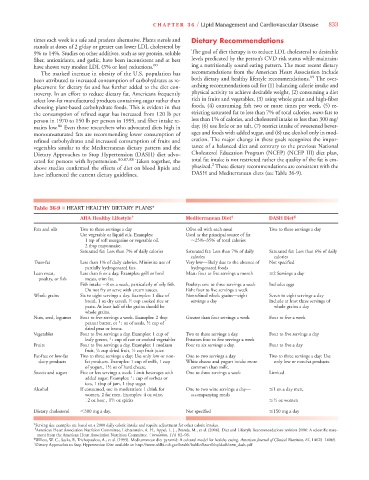
                   have influenced the current dietary guidelines.      DASH and Mediterranean diets (see Table 36-9).


                   Table 36-9 ■ HEART HEALTHY DIETARY PLANS*
                                  AHA Healthy Lifestyle †            Mediterranean Diet ‡       DASH Diet §

                   Fats and oils  Two to three servings a day        Olive oil with each meal   Two to three servings a day
                                  Use vegetable or liquid oils. Examples:  Used as the principal source of fat
                                    1 tsp of soft margarine or vegetable oil.   25%–35% of total calories
                                    2 tbsp mayonnaise.
                                  Saturated fat: Less than 7% of daily calories  Saturated fat: Less than 7% of daily  Saturated fat: Less than 6% of daily
                                                                      calories                    calories
                      s
                      s
                   Trans-fat      Less than 1% of daily calories. Minimize use of   Very low—likely due to the absence of   Not specified
                                    partially hydrogenated fats.      hydrogenated foods
                   Lean meat,     Less than 6 oz a day. Examples: grill or broil  Meat: four to five servings a month   2 Servings a day
                     poultry, or fish  meats, trim fat.
                                  Fish intake  8 oz a week, particularly of oily fish.  Poultry: one to three servings a week  Includes eggs
                                    Do not fry or serve with cream sauces.  Fish: four to five servings a week
                   Whole grains   Six to eight servings a day. Examples: 1 slice of   Nonrefined whole grains—eight   Seven to eight servings a day
                                                  1 1
                                                   ⁄
                                                   ⁄
                                    bread, 1 oz dry cereal,  ⁄2 cup cooked rice or   servings a day  Include at least three servings of
                                    pasta. At least half of the grains should be                  whole grains a day
                                    whole grains.
                   Nuts, seed, legumes  Four to five servings a week. Examples: 2 tbsp   Greater than four servings a week  Four to five a week
                                                        1 1
                                               1 1
                                               ⁄
                                    peanut butter, or  ⁄2 oz of seeds, ⁄2 cup of
                                               ⁄
                                                        ⁄
                                                        ⁄
                                    dried peas or beans.
                   Vegetables     Four to five servings a day. Examples: 1 cup of   Two to three servings a day.  Four to five servings a day
                                            1 1
                                            ⁄
                                            ⁄
                                    leafy greens,  ⁄2 cup of raw or cooked vegetables  Potatoes four to five servings a week
                   Fruits         Four to five servings a day. Examples: 1 medium   Four to six servings a day.  Four to five a day
                                       1 1
                                                   1 1
                                                    ⁄
                                                    ⁄
                                    fruit, ⁄4 cup dried fruit, ⁄2 cup fruit juice
                                        ⁄
                                        ⁄
                   Fat-free or low-fat   Two to three servings a day: Use only low or non-  One to two servings a day  Two to three servings a day: Use
                     dairy products  fat products. Examples: 1 cup of milk, 1 cup   White cheese and yogurt intake more   only low or non-fat products.
                                           1 1
                                            ⁄
                                            ⁄
                                    of yogurt, 1 ⁄2 oz of hard cheese.  common than milk.
                   Sweets and sugars  Five or less servings a week. Limit beverages with   One to three servings a week  Limited
                                                   1 1
                                                   ⁄
                                                   ⁄
                                    added sugar. Examples:  ⁄2 cup of sorbets or
                                    ices, 1 tbsp of jam, 1 tbsp sugar.
                   Alcohol        If consumed, use in moderation: 1 drink for   One to two wine servings a day—   1 oz a day men,
                                    women, 2 for men. Examples: 4 oz wine,   accompanying meals
                                            1 1
                                                                                                 1 1
                                                                                                  ⁄
                                                                                                  ⁄
                                    12 oz beer , 1 ⁄2 oz spirits                                  ⁄2 oz women
                                             ⁄
                                             ⁄
                   Dietary cholesterol   300 mg a day.               Not specified                150 mg a day
                   *Serving size examples are based on a 2000 daily caloric intake and require adjustment for other calorie intakes.
                   †
                    American Heart Association Nutrition Committee, Lichtenstein, A. H., Appel, L. J., Brands, M., et al. (2006). Diet and Lifestyle Recommendations revision 2006: A scientific state-
                    ment from the American Heart Association Nutrition Committee. Circulation, 114, 82–96.
                                                                 4
                                                                 4
                   ‡
                    Willett, W. C., Sacks, F., Trichopoulou, A., et al. (1995). Mediterranean diet pyramid: A cultural model for healthy eating. American Journal of Clinical Nutrition, 61, 1402S–1406S.
                   §
                    Dietary Approaches to Stop Hypertension Diet available at: http://www.nhlbi.nih.gov/health/bublic/heart/hbp/dash/new_dash.pdf

