


Page 907 - Cardiac Nursing
P. 907
LWBK340-c39_p876-888.qxd  29/06/2009  10:01 PM  Page 883 Aptara


                                                             C HAP TE R  39 / Diabetes Mellitus and Metabolic Syndrome  883

                   importance of treating hyperglycemia and encouraging at risk
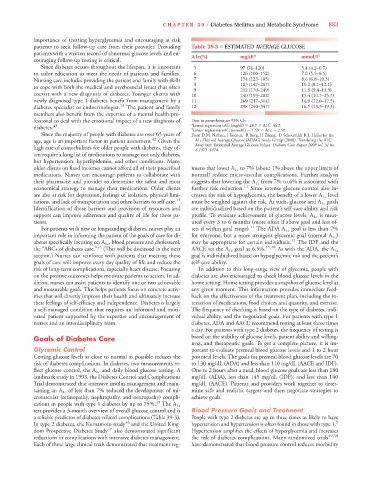
                   patients to seek follow-up care from their provider. Providing  Table 39-3 ■ ESTIMATED AVERAGE GLUCOSE
                   patients with a written record of abnormal glucose levels and en-  A1c(%)  mg/dl*       mmol/l †
                   couraging follow-up testing is critical.
                     Since diabetes occurs throughout the lifespan, it is important  5  97 (76–120)        5.4 (4.2–6.7)
                   to tailor education to meet the needs of patients and families.  6  126 (100–152)       7.0 (5.5–8.5)
                   Nursing care includes providing the patient and family with skills  7  154 (123–185)    8.6 (6.8–10.3)
                   to cope with both the medical and psychosocial issues that often  8 9  183 (147–217)    10.2 (8.1–12.1)
                                                                                                           11.8 (9.4–13.9)
                                                                                       212 (170–249)
                   coexist with a new diagnosis of diabetes. Younger clients with  10  240 (193–282)       13.4 (10.7–15.7)
                   newly diagnosed type 1 diabetes benefit from management by a  11     269 (217–314)       14.9 (12.0–17.5)
                   diabetes specialist or endocrinologist. 15  The patient and family  12  298 (240–347)   16.5 (13.3–19.3)
                   members also benefit from the expertise of a mental health pro-
                   fessional to deal with the emotional impact of a new diagnosis of  Data in parentheses are 95% Cls.
                   diabetes. 43                                        *Linear regression eAG (mg/dl)   28.7   A1C–46.7.
                                                                       †
                                                                       Linear regression eAG (mmol/l)   1.59   A1c   2.59.
                     Since the majority of people with diabetes are over 65 years of  From D.M. Nathan, J Kuenen,  R Borg, H Zheng,  D Schoenfeld, R J. Heine for the
                   age, age is an important factor in patient assessment. 42  Given the  A1c-Derived Average Glucose (ADAG) Study Group (2008). Translating the A1C
                   high rate of comorbidities for older people with diabetes, they of-  Assay Into Estimated Average Glucose Values. Diabetes Care August 2008 vol. 31 no.
                                                                        8 1473–1478.
                   ten require a long list of medications to manage not only diabetes,
                   but hypertension, hyperlipidemia, and other conditions. Many
                   older clients on fixed incomes cannot afford all of their prescribed  imens that lower A 1c to 7% (about 1% above the upper limits of
                   medications. Nurses can encourage patients to collaborate with  normal) reduce microvascular complications. Further analysis
                   their pharmacist and provider to determine the safest and most  suggests that lowering the A 1c from 7% to 6% is associated with
                   economical strategy to manage their medications. Older clients  further risk reduction. 11  Since intense glucose control also in-
                   are also at risk for depression, feelings of isolation, physical limi-  creases the risk of hypoglycemia, the benefit of a lower A 1c level
                   tations, and lack of transportation and other barriers to self care. 13  must be weighed against the risk. As such, glucose and A 1c goals
                   Identification of these barriers and provision of resources and  are individualized based on the patient’s self-care ability and risk
                   support can improve adherence and quality of life for these pa-  profile. To evaluate achievement of glucose levels, A 1c is meas-
                   tients.                                             ured every 3 to 6 months (more often if above goal and less of-
                     For patients with new or longstanding diabetes, nurses play an  ten if within goal range). 11  The ADA A 1c goal is less than 7%
                   important role in informing the patient of the goals of care for di-  for everyone, but a more stringent glycemic goal (normal A 1c )
                   abetes specifically focusing on A 1c , blood pressure and cholesterol,  may be appropriate for certain individuals. 11  The IDF and the
                   the “ABCs of diabetes care.” 44  (This will be discussed in the next  AACE set the A 1c goal at 6.5%. 15,48  As with the ADA, the A 1c
                   section.) Nurses can reinforce with patients that meeting these  goal is individualized based on hypoglycemic risk and the patient’s
                   goals of care will improve every day quality of life and reduce the  self-care ability.
                   risk of long-term complications, especially heart disease. Focusing  In addition to this long-range view of glycemia, people with
                   on the positive outcomes helps motivate patients to action. In ad-  diabetes are also encouraged to check blood glucose levels in the
                   dition, nurses can assist patients to identify one or two achievable  home setting. Home testing provides a snapshot of glucose level at
                   and measurable goals. This helps patients focus on concrete activ-  any given moment. This information provides immediate feed-
                   ities that will directly improve their health and ultimately increase  back on the effectiveness of the treatment plan, including the in-
                   their feelings of self-efficacy and independence. Diabetes is largely  teraction of medications, food choices and quantity, and exercise.
                   a self-managed condition that requires an informed and moti-  The frequency of checking is based on the type of diabetes, indi-
                   vated patient supported by the expertise and encouragement of  vidual ability, and the negotiated goals. For patients with type 1
                   nurses and an interdisciplinary team.               diabetes, ADA and AACE recommend testing at least three times
                                                                       a day. For patients with type 2 diabetes, the frequency of testing is
                   Goals of Diabetes Care                              based on the stability of glucose levels, patient ability and willing-
                                                                       ness, and therapeutic goals. To get a complete picture, it is im-
                   Glycemic Control                                    portant to evaluate premeal blood glucose levels and 1 to 2 hour
                   Getting glucose levels as close to normal as possible reduces the  postmeal levels. The goals for premeal blood glucose levels are 70
                   risk of diabetes complications. In diabetes, two measurements re-  to 130 mg/dL (ADA) and less than 110 mg/dL (AACE and IDF).
                   flect glucose control, the A 1c and daily blood glucose testing. A  One to 2 hours after a meal, blood glucose goals are less than 180
                   landmark study in 1993, the Diabetes Control and Complications  mg/dL (ADA), less than 145 mg/dL (IDF), and less than 140
                   Trial demonstrated that intensive insulin management and main-  mg/dL (AACE). Patients and providers work together to deter-
                   taining an A 1c of less than 7% reduced the development of mi-  mine safe and realistic targets and then negotiate strategies to
                   crovascular (retinopathy, nephropathy, and neuropathy) compli-  achieve goals.
                   cations in people with type 1 diabetes by up to 75%. 45  The A 1c
                   test provides a 3-month overview of overall glucose control and is  Blood Pressure Goals and Treatment
                   a reliable predictor of diabetes-related complications (Table 39-3).  People with type 2 diabetes are up to three times as likely to have
                   In type 2 diabetes, the Kumamoto studyy 46  and the United King-  hypertension and hypertension is often found in those with type 1. 5
                   dom Prospective Diabetes Studyy 47  also demonstrated significant  Hypertension amplifies the effects of hyperglycemia and increases
                   reductions in complications with intensive diabetes management.  the risk of diabetes complications. Many randomized trials 49,50
                   Each of these large clinical trials demonstrated that treatment reg-  have demonstrated that blood pressure control reduces morbidity

