


Page 941 - Cardiac Nursing
P. 941
/
                                  9
                                  9
                                    0
                                        009
                                       2
                                     6
                        6-9
                        6-9
                     p90
                          20.
                                 2
                               d
                             qx
                                        009
                                                         17
                                                       e 9
                                                      g
                                                            Apt
                                                                a
                                                              ar
                                                            Apt
                                             1:2
                                            1
                                            1
                                             1:2
                                                    Pa
                                                  M
                                               0 P
         LWBK340-c41_41_p90p906-920.qxd  29/06/2009  11:20 PM  Page 917 Aptara
         L L LWB
         LWB K34 0-c 41_ p90 6-9 20. qx d  2 9 / 0 6 / / 2 009   1 1:2 0 P M  Pa g e 9 17  Apt ar a
            K34
                  41_
                0-c
                                      C HAPTER 41 / Complementary and Alternative Approaches in Cardiovascular Disease  917
                                                                       as being able to teach. The nurse should proceed in an open,
                                                                       nonjudgmental fashion, avoiding terms that suggest disapproval,
                                                                       such as “unproven.” The nurse should ask the patient how well
                                                                       the remedy has worked or not worked before stating an opinion.
                                                                       It may be appropriate to ask the patient’s permission to coordi-
                                                                       nate with the other therapists. Some suggested questions are as
                                                                       follows:
                                                                        1. What are your values and beliefs related to health and illness?
                                                                        2. Are there health practices that are part of your cultural, spiri-
                                                                         tual, or religious beliefs?
                                                                        3.What therapies have you used to maintain or improve your
                                                                         health?
                                                                        4. Have you consulted with or been treated by a naturopathic,
                                                                         acupuncturist, or homeopathic provider? (Elicit specific de-
                                                                         tails.)
                                                                        5. Have you consulted with any specialized healers, such as prac-
                                                                         titioners of oriental medicine or Native American healing
                                                                         practices?
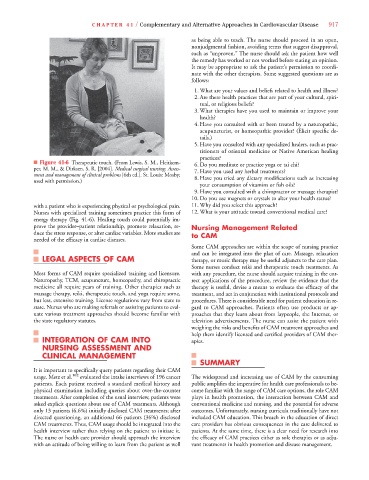
                   ■ Figure 41-6 Therapeutic touch. (From Lewis, S. M., Heitkem-  6. Do you meditate or practice yoga or tai chi?
                   per, M. M., & Dirksen. S. R. [2004]. Medical surgical nursing: Assess-  7. Have you used any herbal treatments?
                   ment and management of clinical problems [6th ed.]. St. Louis: Mosby;  8. Have you tried any dietary modifications such as increasing
                   used with permission.)
                                                                         your consumption of vitamins or fish oils?
                                                                        9. Have you consulted with a chiropractor or massage therapist?
                                                                       10. Do you use magnets or crystals to alter your health status?
                   with a patient who is experiencing physical or psychological pain.  11. Why did you select this approach?
                   Nurses with specialized training sometimes practice this form of  12. What is your attitude toward conventional medical care?
                   energy therapy (Fig. 41-6). Healing touch could potentially im-
                   prove the provider–patient relationship, promote relaxation, re-  Nursing Management Related
                   duce the stress response, or alter cardiac variables. More studies are  to CAM
                   needed of the efficacy in cardiac diseases.
                                                                       Some CAM approaches are within the scope of nursing practice
                                                                       and can be integrated into the plan of care. Massage, relaxation
                      LEGAL ASPECTS OF CAM                             therapy, or music therapy may be useful adjuncts to the care plan.
                                                                       Some nurses conduct reiki and therapeutic touch treatments. As
                   Most forms of CAM require specialized training and licensure.  with any procedure, the nurse should acquire training in the cor-
                   Naturopathy, TCM, acupuncture, homeopathy, and chiropractic  rect applications of the procedure, review the evidence that the
                   medicine all require years of training. Other therapies such as  therapy is useful, devise a means to evaluate the efficacy of the
                   massage therapy, reiki, therapeutic touch, and yoga require some,  treatment, and act in conjunction with institutional protocols and
                   but less, extensive training. License regulations vary from state to  procedures. There is considerable need for patient education in re-
                   state. Nurses who are making referrals or assisting patients to eval-  gard to CAM approaches. Patients often use products or ap-
                   uate various treatment approaches should become familiar with  proaches that they learn about from laypeople, the Internet, or
                   the state regulatory statutes.                      television advertisements. The nurse can assist the patient with
                                                                       weighing the risks and benefits of CAM treatment approaches and
                                                                       help them identify licensed and certified providers of CAM ther-
                      INTEGRATION OF CAM INTO                          apies.
                      NURSING ASSESSMENT AND
                      CLINICAL MANAGEMENT
                                                                         SUMMARY
                   It is important to specifically query patients regarding their CAM
                   usage. Metz et al. 102  evaluated the intake interviews of 196 cancer  The widespread and increasing use of CAM by the consuming
                   patients. Each patient received a standard medical history and  public amplifies the imperative for health care professionals to be-
                   physical examination including queries about over-the-counter  come familiar with the range of CAM care options, the role CAM
                   treatments. After completion of the usual interview, patients were  plays in health promotion, the interaction between CAM and
                   asked explicit questions about use of CAM treatments. Although  conventional medicine and nursing, and the potential for adverse
                   only 13 patients (6.6%) initially disclosed CAM treatments; after  outcomes. Unfortunately, nursing curricula traditionally have not
                   directed questioning, an additional 66 patients (36%) disclosed  included CAM education. This breach in the education of direct
                   CAM treatments. Thus, CAM usage should be integrated into the  care providers has obvious consequences in the care delivered to
                   health interview rather than relying on the patient to initiate it.  patients. At the same time, there is a clear need for research into
                   The nurse or health care provider should approach the interview  the efficacy of CAM practices either as sole therapies or as adju-
                   with an attitude of being willing to learn from the patient as well  vant treatments in health promotion and disease management.

