


Page 280 - Encyclopedia of Nursing Research
P. 280
HyperTeNSION  n  247


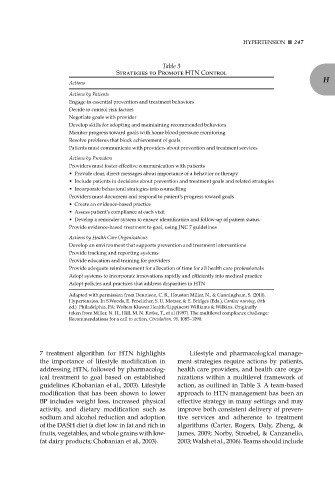
                                                  Table 3
                                    Strategies to promote HTN control
                                                                                                  H
                      Actions
                      Actions by Patients
                      engage in essential prevention and treatment behaviors
                      Decide to control risk factors
                      Negotiate goals with provider
                      Develop skills for adopting and maintaining recommended behaviors
                      Monitor progress toward goals with home blood pressure monitoring
                      resolve problems that block achievement of goals
                      patients must communicate with providers about prevention and treatment services
                      Actions by Providers
                      providers must foster effective communication with patients
                      •  Provide clear, direct messages about importance of a behavior or therapy
                      •  Include patients in decisions about prevention and treatment goals and related strategies
                      •  Incorporate behavioral strategies into counselling
                      providers must document and respond to patient’s progress toward goals
                      •  Create an evidence-based practice
                      •  Assess patient’s compliance at each visit
                      •  Develop a reminder system to ensure identification and follow-up of patient status
                      provide evidence-based treatment to goal, using JNc 7 guidelines
                      Actions by Health Care Organizations
                      Develop an environment that supports prevention and treatment interventions
                      provide tracking and reporting systems
                      provide education and training for providers
                      provide adequate reimbursement for allocation of time for all health care professionals
                      Adopt systems to incorporate innovations rapidly and efficiently into medical practice
                      Adopt policies and practices that address disparities in HTN
                      Adapted with permission from Dennison, c. r., Houston Miller, N., & cunningham, S. (2010).
                      Hypertension. In S.Woods, e. Froelicher, S. U. Motzer, & e. Bridges (eds.), Cardiac nursing, (6th
                      ed.). philadelphia, pA: Wolters Kluwer Health/lippincott Williams & Wilkins. Originally
                      taken from Miller, N. H., Hill, M. N. Kotke, T., et al (1997). The multilevel compliance challenge:
                      recommendations for a call to action. Circulation, 95, 1085–1090.


             7  treatment  algorithm  for  HTN  highlights   lifestyle and pharmacological manage-
             the  importance  of  lifestyle  modification  in   ment  strategies  require  actions  by  patients,
             addressing HTN, followed by pharmacolog-  health care providers, and health care orga-
             ical  treatment  to  goal  based  on  established   nizations  within  a  multilevel  framework  of
             guidelines (chobanian et al., 2003). lifestyle   action, as outlined in Table 3. A team-based
             modification  that  has  been  shown  to  lower   approach to HTN management has been an
             Bp  includes  weight  loss,  increased  physical   effective strategy in many settings and may
             activity,  and  dietary  modification  such  as   improve both consistent delivery of preven-
             sodium and alcohol reduction and adoption   tive  services  and  adherence  to  treatment
             of the DASH diet (a diet low in fat and rich in   algorithms  (carter,  rogers,  Daly,  Zheng,  &
             fruits, vegetables, and whole grains with low-  James, 2009; Norby, Stroebel, & canzanello,
             fat dairy products; chobanian et al., 2003).  2003; Walsh et al., 2006). Teams should include

