


Page 183 - ACCCN's Critical Care Nursing
P. 183
160  P R I N C I P L E S   A N D   P R A C T I C E   O F   C R I T I C A L   C A R E


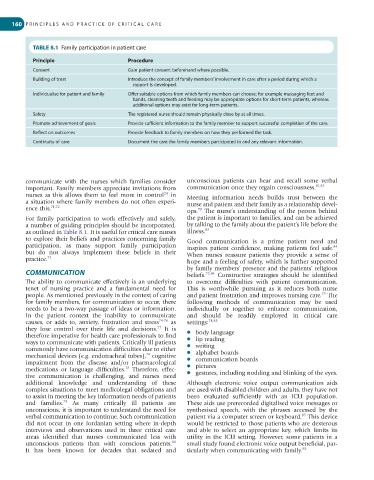
            TABLE 8.1  Family participation in patient care

            Principle                      Procedure
            Consent                        Gain patient consent beforehand where possible.
            Building of trust              Introduce the concept of family members’ involvement in care after a period during which a
                                            rapport is developed.
            Individualise for patient and family  Offer suitable options from which family members can choose: for example massaging feet and
                                            hands, cleaning teeth and feeding may be appropriate options for short-term patients, whereas
                                            additional options may exist for long-term patients.
            Safety                         The registered nurse should remain physically close by at all times.
            Promote achievement of goals   Provide sufficient information to the family member to support successful completion of the care.
            Reflect on outcomes            Provide feedback to family members on how they performed the task.
            Continuity of care             Document the care the family members participated in and any relevant information.


         communicate  with  the  nurses  which  families  consider   unconscious  patients  can  hear  and  recall  some  verbal
         important. Family members appreciate invitations from   communication once they regain consciousness. 81,82
         nurses  as  this  allows  them  to  feel  more  in  control   in   Meeting  information  needs  builds  trust  between  the
                                                       24
         a situation where family members do not often experi-  nurse and patient and their family as a relationship devel-
         ence this. 71,72                                     ops.   The  nurse’s  understanding  of  the  person  behind
                                                                  79
         For  family  participation  to  work  effectively  and  safely,    the patient is important to families, and can be achieved
         a number of guiding principles should be incorporated,   by talking to the family about the patient’s life before the
         as outlined in Table 8.1. It is useful for critical care nurses   illness. 83
         to explore their beliefs and practices concerning family   Good  communication  is  a  prime  patient  need  and
         participation,  as  many  support  family  participation     inspires  patient  confidence,  making  patients  feel  safe.
                                                                                                              84
         but  do  not  always  implement  these  beliefs  in  their   When  nurses  reassure  patients  they  provide  a  sense  of
         practice. 73                                         hope and a feeling of safety, which is further supported
                                                              by family members’ presence and the patients’ religious
         COMMUNICATION                                        beliefs. 77,84   Constructive  strategies  should  be  identified
         The ability to communicate effectively is an underlying   to  overcome  difficulties  with  patient  communication.
         tenet  of  nursing  practice  and  a  fundamental  need  for   This  is  worthwhile  pursuing  as  it  reduces  both  nurse
                                                                                                          75
         people. As mentioned previously in the context of caring   and patient frustration and improves nursing care.  The
         for family members, for communication to occur, there   following  methods  of  communication  may  be  used
         needs to be a two-way passage of ideas or information.   individually  or  together  to  enhance  communication,
         In  the  patient  context  the  inability  to  communicate   and  should  be  readily  employed  in  critical  care
         causes,  or  adds  to,  anxiety,  frustration  and  stress 74-76   as   settings: 74,85
                                                    77
         they  lose  control  over  their  life  and  decisions.   It  is   ●  body language
         therefore imperative for health care professionals to find   ●  lip reading
         ways to communicate with patients. Critically ill patients   ●  writing
         commonly have communication difficulties due to either   ●  alphabet boards
                                                 74
         mechanical devices (e.g. endotracheal tubes),  cognitive   ●  communication boards
         impairment  from  the  disease  and/or  pharmacological   ●  pictures
                                          78
         medications  or  language  difficulties.   Therefore,  effec-  ●  gestures, including nodding and blinking of the eyes.
         tive  communication  is  challenging,  and  nurses  need
         additional  knowledge  and  understanding  of  these   Although  electronic  voice  output  communication  aids
         complex situations to meet medicolegal obligations and   are used with disabled children and adults, they have not
         to assist in meeting the key information needs of patients   been  evaluated  sufficiently  with  an  ICU  population.
                      79
         and  families.   As  many  critically  ill  patients  are   These aids use prerecorded digitalised voice messages or
         unconscious, it is important to understand the need for   synthesised  speech,  with  the  phrases  accessed  by  the
                                                                                                    85
         verbal communication to continue. Such communication   patient via a computer screen or keyboard.  This device
         did  not  occur  in  one  Jordanian  setting  where  in-depth   would be restricted to those patients who are dexterous
         interviews  and  observations  used  in  three  critical  care   and  able  to  select  an  appropriate  key,  which  limits  its
         areas  identified  that  nurses  communicated  less  with   utility  in  the  ICU  setting.  However,  some  patients  in  a
                                                         80
         unconscious  patients  than  with  conscious  patients.    small study found electronic voice output beneficial, par-
         It  has  been  known  for  decades  that  sedated  and    ticularly when communicating with family. 85

