


Page 186 - ACCCN's Critical Care Nursing
P. 186
Family and Cultural Care of the Critically Ill Patient  163


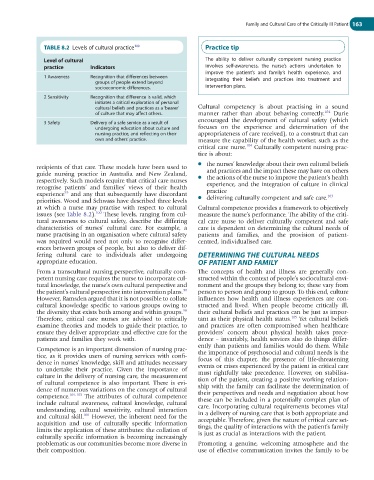
               TABLE 8.2  Levels of cultural practice 100           Practice tip

               Level of cultural                                    The  ability  to  deliver  culturally  competent  nursing  practice
               practice        Indicators                           involves  self-awareness,  the  nurse’s  actions  undertaken  to
                                                                    improve  the  patient’s  and  family’s  health  experience,  and
               1 Awareness     Recognition that differences between   integrating  their  beliefs  and  practices  into  treatment  and
                                groups of people extend beyond
                                socioeconomic differences.          intervention plans.
               2 Sensitivity   Recognition that difference is valid, which
                                initiates a critical exploration of personal
                                cultural beliefs and practices as a ‘bearer’   Cultural  competency  is  about  practising  in  a  sound
                                                                                                           104
                                of culture that may affect others.  manner  rather  than  about  behaving  correctly.   Durie
                                                                  encouraged  the  development  of  cultural  safety  (which
               3 Safety        Delivery of a safe service as a result of
                                undergoing education about culture and   focuses  on  the  experience  and  determination  of  the
                                nursing practice, and reflecting on their   appropriateness of care received), to a construct that can
                                own and others’ practice.         measure the capability of the health worker, such as the
                                                                  critical care nurse.  Culturally competent nursing prac-
                                                                                  104
                                                                  tice is about:
                                                                  ●  the nurses’ knowledge about their own cultural beliefs
             recipients of that care. These models have been used to
             guide  nursing  practice  in  Australia  and  New  Zealand,   and practices and the impact these may have on others
             respectively. Such models require that critical care nurses   ●  the actions of the nurse to improve the patient’s health
             recognise  patients’  and  families’  views  of  their  health   experience, and the integration of culture in clinical
                      93
             experience  and any that subsequently have discordant   practice                               103
             priorities. Wood and Schwass have described three levels   ●  delivering culturally competent and safe care.
             at  which  a  nurse  may  practise  with  respect  to  cultural   Cultural competence provides a framework to objectively
                                100
             issues (see Table 8.2).  These levels, ranging from cul-  measure the nurse’s performance. The ability of the criti-
             tural awareness to cultural safety, describe the differing   cal  care  nurse  to  deliver  culturally  competent  and  safe
             characteristics  of  nurses’  cultural  care.  For  example,  a   care is dependent on determining the cultural needs of
             nurse practising in an organisation where cultural safety   patients  and  families,  and  the  provision  of  patient-
             was  required  would  need  not  only  to  recognise  differ-  centred, individualised care.
             ences between groups of people, but also to deliver dif-
             fering  cultural  care  to  individuals  after  undergoing   DETERMINING THE CULTURAL NEEDS
             appropriate education.                               OF PATIENT AND FAMILY
             From a transcultural nursing perspective, culturally com-  The  concepts  of  health  and  illness  are  generally  con-
             petent nursing care requires the nurse to incorporate cul-  structed within the context of people’s sociocultural envi-
             tural knowledge, the nurse’s own cultural perspective and   ronment and the groups they belong to; these vary from
             the patient’s cultural perspective into intervention plans.    person to person and group to group. To this end, culture
                                                             90
             However, Ramsden argued that it is not possible to collate   influences  how  health  and  illness  experiences  are  con-
             cultural  knowledge  specific  to  various  groups  owing  to   structed  and  lived.  When  people  become  critically  ill,
             the diversity that exists both among and within groups.    their cultural beliefs and practices can be just as impor-
                                                             98
             Therefore,  critical  care  nurses  are  advised  to  critically   tant as their physical health status.  Yet cultural beliefs
                                                                                                105
             examine theories and models to guide their practice, to   and  practices  are  often  compromised  when  healthcare
             ensure they deliver appropriate and effective care for the   providers’  concern  about  physical  health  takes  prece-
             patients and families they work with.                dence – invariably, health services also do things differ-
                                                                  ently than patients and families would do them. While
             Competence is an important dimension of nursing prac-  the importance of psychosocial and cultural needs is the
             tice,  as  it  provides  users  of  nursing  services  with  confi-  focus  of  this  chapter,  the  presence  of  life-threatening
             dence in nurses’ knowledge, skill and attitudes necessary   events or crises experienced by the patient in critical care
             to  undertake  their  practice.  Given  the  importance  of   must  rightfully  take  precedence.  However,  on  stabilisa-
             culture in the delivery of nursing care, the measurement   tion of the patient, creating a positive working relation-
             of  cultural  competence  is  also  important.  There  is  evi-  ship with the family can facilitate the determination of
             dence of numerous variations on the concept of cultural   their perspectives and needs and negotiation about how
             competence. 101-103   The  attributes  of  cultural  competence   these can be included in a potentially complex plan of
             include cultural awareness, cultural knowledge, cultural   care. Incorporating cultural requirements becomes vital
             understanding,  cultural  sensitivity,  cultural  interaction   in a delivery of nursing care that is both appropriate and
                            101
             and cultural skill.  However, the inherent need for the   acceptable. Therefore, given the nature of critical care set-
             acquisition  and  use  of  culturally  specific  information   tings, the quality of interactions with the patient’s family
             limits the application of these attributes: the collation of   is just as crucial as interactions with the patient.
             culturally specific information is becoming increasingly
             problematic as our communities become more diverse in   Promoting  a  genuine,  welcoming  atmosphere  and  the
             their composition.                                   use of effective communication invites the family to be

