


Page 193 - ACCCN's Critical Care Nursing
P. 193
170  P R I N C I P L E S   A N D   P R A C T I C E   O F   C R I T I C A L   C A R E

         ●  Aboriginal  Health  Workers  are  central  to  the   transfusions  for  those  belonging  to  the  Seventh  Day
            care of Aboriginal people and are the links between   Adventist religion. Having a standardised list of religions
            the Aboriginal communities and mainstream health.  and procedural considerations is flawed due to the varia-
         ●  Aboriginal culture influences health beliefs, and this   tions that exist, and in some instances the variations are
            can act adversely if not recognised.              great. Thus, as part of the initial assessment the critical
                                                              nurse should determine whether the patient has religious
         RELIGIOUS CONSIDERATIONS                             beliefs and practices that must be observed or not, and
                                                              incorporate these into the care plan.
         Religious  beliefs  and  practices  contribute  to  a  person’s
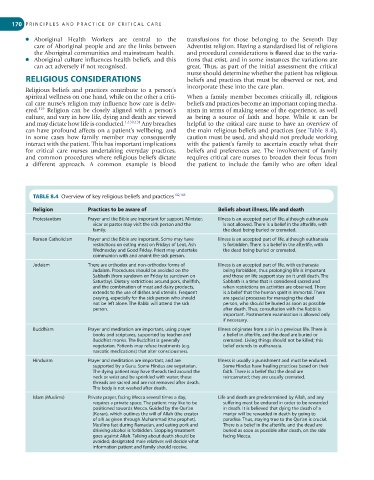
         spiritual wellness on one hand, while on the other a criti-  When a family member becomes critically ill, religious
         cal care nurse’s religion may influence how care is deliv-  beliefs and practices become an important coping mecha-
         ered. 129   Religion  can  be  closely  aligned  with  a  person’s   nism in terms of making sense of the experience, as well
         culture, and vary in how life, dying and death are viewed   as  being  a  source  of  faith  and  hope.  While  it  can  be
         and may dictate how life is conducted. 1,130,131  Any breaches   helpful to the critical care nurse to have an overview of
         can have profound affects on a patient’s wellbeing, and   the main religious beliefs and practices (see Table 8.4),
         in  some  cases  how  family  member  may  consequently   caution must be used, and should not preclude working
         interact with the patient. This has important implications   with the patient’s family to ascertain exactly what their
         for  critical  care  nurses  undertaking  everyday  practices,   beliefs  and  preferences  are.  The  involvement  of  family
         and common procedures where religious beliefs dictate     requires critical care nurses to broaden their focus from
         a  different  approach.  A  common  example  is  blood   the  patient  to  include  the  family  who  are  often  ideal


            TABLE 8.4  Overview of key religious beliefs and practices 132,165

            Religion          Practices to be aware of                  Beliefs about illness, life and death
            Protestantism     Prayer and the Bible are important for support. Minister,   Illness is an accepted part of life, although euthanasia
                               vicar or pastor may visit the sick person and the   is not allowed. There is a belief in the afterlife, with
                               family.                                    the dead being buried or cremated.
            Roman Catholicism  Prayer and the Bible are important. Some may have   Illness is an accepted part of life, although euthanasia
                               restrictions on eating meat on Fridays of Lent, Ash   is forbidden. There is a belief in the afterlife, with
                               Wednesday and Good Friday. Priest may undertake   the dead being buried or cremated.
                               communion with and anoint the sick person.
            Judaism           There are orthodox and non-orthodox forms of   Illness is an accepted part of life, with euthanasia
                               Judaism. Procedures should be avoided on the   being forbidden, thus prolonging life is important
                               Sabbath (from sundown on Friday to sundown on   and those on life support stay on it until death. The
                               Saturday). Dietary restrictions around pork, shellfish,   Sabbath is a time that is considered sacred and
                               and the combination of meat and dairy products,   when restrictions on activities are observed. There
                               extends to the use of dishes and utensils. Frequent   is a belief that the human spirit is immortal. There
                               praying, especially for the sick person who should   are special processes for managing the dead
                               not be left alone. The Rabbi will attend the sick   person, who should be buried as soon as possible
                               person.                                    after death. Thus, consultation with the Rabbi is
                                                                          important. Postmortem examination is allowed only
                                                                          if necessary.
            Buddhism          Prayer and meditation are important, using prayer   Illness originates from a sin in a previous life. There is
                               books and scriptures, supported by teacher and   a belief in afterlife, and the dead are buried or
                               Buddhist monks. The Buddhist is generally   cremated. Living things should not be killed; this
                               vegetarian. Patients may refuse treatments (e.g.   belief extends to euthanasia.
                               narcotic medications) that alter consciousness.
            Hinduism          Prayer and meditation are important, and are   Illness is usually a punishment and must be endured.
                               supported by a Guru. Some Hindus are vegetarian.   Some Hindus have healing practices based on their
                               The dying patient may have threads tied around the   faith. There is a belief that the dead are
                               neck or wrist and be sprinkled with water; these   reincarnated; they are usually cremated.
                               threads are sacred and are not removed after death.
                               The body is not washed after death.
            Islam (Muslims)   Private prayer, facing Mecca several times a day,   Life and death are predetermined by Allah, and any
                               requires a private space. The patient may like to be   suffering must be endured in order to be rewarded
                               positioned towards Mecca. Guided by the Qur’an   in death. It is believed that dying the death of a
                               (Koran), which outlines the will of Allah (the creator   martyr will be rewarded in death by going to
                               of all) as given through Muhammad (the prophet).   paradise. Thus, staying true to the Qur’an is crucial.
                               Muslims fast during Ramadan, and eating pork and   There is a belief in the afterlife, and the dead are
                               drinking alcohol is forbidden. Stopping treatment   buried as soon as possible after death, on the side
                               goes against Allah. Talking about death should be   facing Mecca.
                               avoided; designated male relatives will decide what
                               information patient and family should receive.

