


Page 194 - ACCCN's Critical Care Nursing
P. 194
Family and Cultural Care of the Critically Ill Patient  171

             informants regarding the religious needs of the patient.   enable a person’s spiritual or religious needs to be deter-
             Having  said  this,  some  patients  have  adopted  religions   mined. The critical care nurse needs to ascertain whether
             separate from their family of origin, and in these circum-  the  patient  and  family  have  any  spiritual  or  religious
             stances family cannot be relied upon as informants, and   beliefs and practices to be observed during their time in
             in some situations there may be a conflict between the   the critical care setting. 1,132  Once the spiritual or religious
             religious values and practices of the patient and those of   beliefs and practices have been determined, the critical
             the  family.  Religious  beliefs  and  practices,  like  cultural   care nurse can facilitate opportunities for the patient and/
             beliefs and practices, will vary between orthodox or tra-  or family to carry out their beliefs and practices, and will
             ditional and contemporary interpretations.           importantly avoid any insensitive actions. 132  In this way
                                                                  the critical care nurse can be sensitive to, and recognise,
             Patients  generally  fall  into  three  groups  with  regard  to   any  spiritual  distress  evident  in  the  patient  and  family
             their religious practices. 132  There are those who:  members.
                1.  practise their religious beliefs regularly    A person’s spirituality, whether informed by religion or
                2.  practise their religious beliefs on an irregular basis,   some other basis, manifests in a variety of relationships
                   often in times of need and stress              with  self,  others,  nature  and  ‘divine’  beings.  It  is  the
                3.  have no religious interests.                  essence of who a person is, or who groups of people are.
                                                                  While assessing spiritual or religious needs is one aspect,
             All patients should have access to religious support where   presence and being with, empathetic listening, reality ori-
             they indicate a need. Therefore, it is beneficial for critical   entation of the family, and enabling visiting and contact
             care nurses to have knowledge of how to access the rel-  are all important nursing activities that can support the
             evant religious resources if needed. The focus of the criti-  spiritual and religious needs of patients and their fami-
             cal care setting often involves going to extreme lengths to   lies.  When families are confronted with the possibility
                                                                     1
             keep patients alive, which may well be in direct opposi-  of death, the documentation of a death plan that outlines
             tion to some religious beliefs. Religious beliefs can either   the preferred care during the process of dying and death
             facilitate  or  disrupt  the  process  of  living  or  dying. 130,131    is  recommended. 132   Death  plans  are  about  empower-
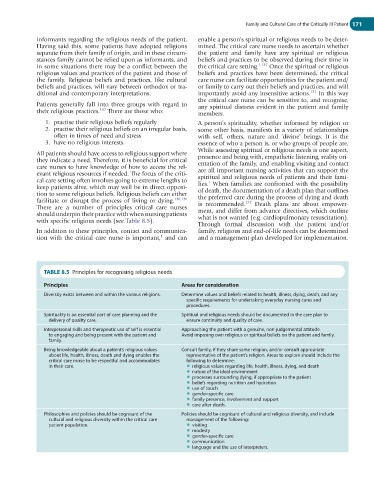
             There  are  a  number  of  principles  critical  care  nurses   ment, and differ from advance directives, which outline
             should underpin their practice with when nursing patients   what is not wanted (e.g. cardiopulmonary resuscitation).
             with specific religious needs (see Table 8.5).
                                                                  Through  formal  discussion  with  the  patient  and/or
             In addition to these principles, contact and communica-  family, religious and end-of-life needs can be determined
                                                      1
             tion  with  the  critical  care  nurse  is  important,   and  can   and a management plan developed for implementation.


               TABLE 8.5  Principles for recognising religious needs
               Principles                                   Areas for consideration
               Diversity exists between and within the various religions.  Determine values and beliefs related to health, illness, dying, death, and any
                                                              specific requirements for undertaking everyday nursing cares and
                                                              procedures.
               Spirituality is an essential part of care planning and the   Spiritual and religious needs should be documented in the care plan to
                 delivery of quality care.                    ensure continuity and quality of care.
               Interpersonal skills and therapeutic use of self is essential   Approaching the patient with a genuine, non-judgemental attitude.
                 to engaging and being present with the patient and   Avoid imposing own religious or spiritual beliefs on the patient and family.
                 family.
               Being knowledgeable about a patient’s religious values   Consult family, if they share same religion, and/or consult appropriate
                 about life, health, illness, death and dying enables the   representative of the patient’s religion. Areas to explore should include the
                 critical care nurse to be respectful and accommodates   following to determine:
                 in their care.                               ●  religious values regarding life, health, illness, dying, and death
                                                              ●  nature of the ideal environment
                                                              ●  processes surrounding dying, if appropriate to the patient
                                                              ●  beliefs regarding nutrition and hydration
                                                              ●  use of touch
                                                              ●  gender-specific care
                                                              ●  family presence, involvement and support
                                                              ●  care after death.
               Philosophies and policies should be cognisant of the   Policies should be cognisant of cultural and religious diversity, and include
                 cultural and religious diversity within the critical care   management of the following:
                 patient population.                          ●  visiting
                                                              ●  modesty
                                                              ●  gender-specific care
                                                              ●  communication
                                                              ●  language and the use of interpreters.

