


Page 28 - ACCCN's Critical Care Nursing
P. 28
Scope of Critical Care Practice 5


                            ‘beginner’         ‘competent’         ‘specialist’         ‘expert’

                                                continuing experience/experiential learning       Practice
                       Induction/
                       orientation
                       to critical           short courses/skills updates/in-service education    Training
                         care
                        nursing
                                        initial competencies       increasing complexity of competencies  Education
                           Postgraduate      Graduate           Graduate            Masters
                             education       Certificate         Diploma
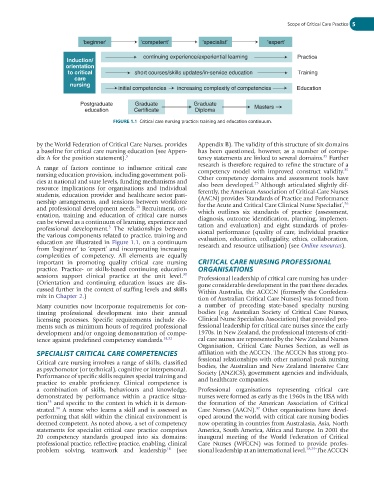
                                      FIGURE 1.1  Critical care nursing practice: training and education continuum.


             by the World Federation of Critical Care Nurses, provides   Appendix B). The validity of this structure of six domains
             a baseline for critical care nursing education (see Appen-  has been questioned, however, as a number of compe-
                                                                                                           35
             dix A for the position statement). 5                 tency statements are linked to several domains.  Further
                                                                  research is therefore required to refine the structure of a
             A  range  of  factors  continue  to  influence  critical  care                                       35
             nursing education provision, including government poli-  competency  model  with  improved  construct  validity.
             cies at national and state levels, funding mechanisms and   Other  competency  domains  and  assessment  tools  have
                                                                                    25
             resource  implications  for  organisations  and  individual   also been developed.  Although articulated slightly dif-
             students, education provider and healthcare sector part-  ferently, the American Association of Critical-Care Nurses
             nership  arrangements,  and  tensions  between  workforce   (AACN) provides ‘Standards of Practice and Performance
                                                                                                                  36
             and professional development needs.  Recruitment, ori-  for the Acute and Critical Care Clinical Nurse Specialist’,
                                              13
             entation,  training  and  education  of  critical  care  nurses   which  outlines  six  standards  of  practice  (assessment,
             can be viewed as a continuum of learning, experience and   diagnosis, outcome identification, planning, implemen-
             professional  development.   The  relationships  between   tation  and  evaluation)  and  eight  standards  of  profes-
                                     5
             the various components related to practice, training and   sional performance (quality of care, individual practice
             education are illustrated in Figure 1.1, on a continuum   evaluation, education, collegiality, ethics, collaboration,
             from ‘beginner’ to ‘expert’ and incorporating increasing   research and resource utilisation) (see Online resources).
             complexities  of  competency.  All  elements  are  equally
             important  in  promoting  quality  critical  care  nursing    CRITICAL CARE NURSING PROFESSIONAL
             practice.  Practice-  or  skills-based  continuing  education   ORGANISATIONS
             sessions  support  clinical  practice  at  the  unit  level.    Professional leadership of critical care nursing has under-
                                                             30
             (Orientation  and  continuing  education  issues  are  dis-  gone considerable development in the past three decades.
             cussed further in the context of staffing levels and skills   Within Australia, the ACCCN (formerly the Confedera-
             mix in Chapter 2.)                                   tion of Australian Critical Care Nurses) was formed from
             Many countries now incorporate requirements for con-  a  number  of  preceding  state-based  specialty  nursing
             tinuing  professional  development  into  their  annual   bodies  (e.g.  Australian  Society  of  Critical  Care  Nurses,
             licensing  processes.  Specific  requirements  include  ele-  Clinical Nurse Specialists Association) that provided pro-
             ments such as minimum hours of required professional   fessional leadership for critical care nurses since the early
             development and/or ongoing demonstration of compe-   1970s. In New Zealand, the professional interests of criti-
             tence against predefined competency standards. 31,32  cal care nurses are represented by the New Zealand Nurses
                                                                  Organisation,  Critical  Care  Nurses  Section,  as  well  as
             SPECIALIST CRITICAL CARE COMPETENCIES                affiliation with the ACCCN. The ACCCN has strong pro-
             Critical care nursing involves a range of skills, classified   fessional relationships with other national peak nursing
                                                                  bodies, the Australian and New Zealand Intensive Care
             as psychomotor (or technical), cognitive or interpersonal.   Society (ANZICS), government agencies and individuals,
             Performance of specific skills requires special training and   and healthcare companies.
             practice  to  enable  proficiency.  Clinical  competence  is
             a  combination  of  skills,  behaviours  and  knowledge,    Professional  organisations  representing  critical  care
             demonstrated  by  performance  within  a  practice  situa-  nurses were formed as early as the 1960s in the USA with
                 33
             tion  and specific to the context in which it is demon-  the  formation  of  the  American  Association  of  Critical
                                                                                     37
                   34
             strated.   A  nurse  who  learns  a  skill  and  is  assessed  as   Care Nurses (AACN).  Other organisations have devel-
             performing that skill within the clinical environment is   oped around the world, with critical care nursing bodies
             deemed competent. As noted above, a set of competency   now operating in countries from Australasia, Asia, North
             statements  for  specialist  critical  care  practice  comprises   America, South America, Africa and Europe. In 2001 the
             20  competency  standards  grouped  into  six  domains:     inaugural  meeting  of  the  World  Federation  of  Critical
             professional practice, reflective practice, enabling, clinical   Care  Nurses  (WFCCN)  was  formed  to  provide  profes-
                                                        14
             problem  solving,  teamwork  and  leadership   (see   sional leadership at an international level. 38,39  The ACCCN

