


Page 31 - ACCCN's Critical Care Nursing
P. 31
8  S C O P E   O F   C R I T I C A L   C A R E


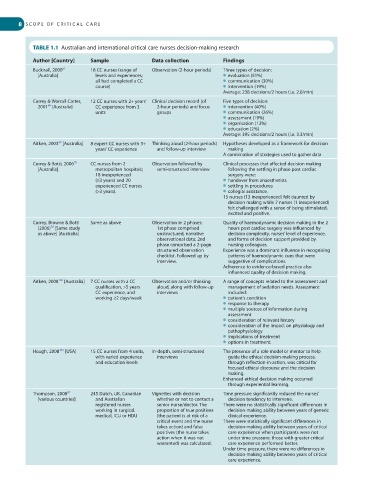
            TABLE 1.1  Australian and international critical care nurses decision-making research

            Author [Country]   Sample              Data collection        Findings
                     61
            Bucknall, 2000     18 CC nurses (range of   Observation (2-hour periods)  Three types of decision:
             [Australia]        levels and experiences;                   ●  evaluation (51%)
                                all had completed a CC                    ●  communication (30%)
                                course)                                   ●  intervention (19%)
                                                                          Average: 238 decisions/2 hours (i.e. 2.0/min)
            Currey & Worrall-Carter,   12 CC nurses with 2+ years’   Clinical decision record (of   Five types of decision:
             2001  [Australia]  CC experience from 3   2-hour periods) and focus   ●  intervention (40%)
                 68
                                units               groups                ●  communication (26%)
                                                                          ●  assessment (19%)
                                                                          ●  organisation (13%)
                                                                          ●  education (2%)
                                                                          Average: 395 decisions/2 hours (i.e. 3.3/min)
                    69
            Aitken, 2003  [Australia]  8 expert CC nurses with 5+   Thinking aloud (2-hour periods)  Hypotheses developed as a framework for decision
                                years’ CC experience  and follow-up interview  making
                                                                          A combination of strategies used to gather data
                         70
            Currey & Botti, 2006    CC nurses from 2   Observation followed by   Clinical processes that affected decision making
             [Australia]        metropolitan hospitals;   semi-structured interview  following the settling in phase post cardiac
                                18 inexperienced                            surgery were:
                                (≤3 years) and 20                         ●  handover from anaesthetists
                                experienced CC nurses                     ●  settling in procedures
                                (>3 years).                               ●  collegial assistance.
                                                                          15 nurses (13 inexperienced) felt daunted by
                                                                            decision making while 7 nurses (1 inexperienced)
                                                                            felt challenged with a sense of being stimulated,
                                                                            excited and positive.
            Currey, Browne & Botti   Same as above  Observation in 2 phases:    Quality of haemodynamic decision making in the 2
             (2006)  [Same study                    1st phase comprised     hours post cardiac surgery was influenced by
                  70
             as above] [Australia]                  unstructured, narrative   decision complexity, nurses’ level of experience,
                                                    observational data; 2nd   and forms of decision support provided by
                                                    phase comprised a 2-page   nursing colleagues.
                                                    structured observation   Experience was a dominant influence in recognising
                                                    checklist. Followed up by   patterns of haemodynamic cues that were
                                                    interview.              suggestive of complications.
                                                                          Adherence to evidence-based practice also
                                                                            influenced quality of decision making.
            Aitken, 2008  [Australia]  7 CC nurses with a CC   Observation and/or thinking   A range of concepts related to the assessment and
                    102
                                qualification, >5 years   aloud, along with follow-up   management of sedation needs. Assessment
                                CC experience, and   interviews             included:
                                working ≥2 days/week                      ●  patient’s condition
                                                                          ●  response to therapy
                                                                          ●  multiple sources of information during
                                                                            assessment
                                                                          ●  consideration of relevant history
                                                                          ●  consideration of the impact on physiology and
                                                                            pathophysiology
                                                                          ●  implications of treatment
                                                                          ●  options in treatment.
                    103
            Hough, 2008  [USA]  15 CC nurses from 4 units,   In-depth, semi-structured   The presence of a role model or mentor to help
                                with varied experience   interviews         guide the ethical decision-making process,
                                and education levels                        through reflection-in-action, was critical for
                                                                            focused ethical discourse and the decision
                                                                            making.
                                                                          Enhanced ethical decision making occurred
                                                                            through experiential learning.
                       67
            Thompson, 2008     245 Dutch, UK, Canadian   Vignettes with decision   Time pressure significantly reduced the nurses’
             [various countries]  and Australian    whether or not to contact a   decision tendency to intervene.
                                registered nurses   senior nurse/doctor. The   There were no statistically significant differences in
                                working in surgical,   proportion of true positives   decision-making ability between years of generic
                                medical, ICU or HDU  (the patient is at risk of a   clinical experience.
                                                    critical event and the nurse   There were statistically significant differences in
                                                    takes action) and false   decision-making ability between years of critical
                                                    positives (the nurse takes   care experience when participants were not
                                                    action when it was not   under time pressure: those with greater critical
                                                    warranted) was calculated.  care experience performed better.
                                                                          Under time pressure, there were no differences in
                                                                            decision-making ability between years of critical
                                                                            care experience.

