


Page 32 - ACCCN's Critical Care Nursing
P. 32
Scope of Critical Care Practice 9


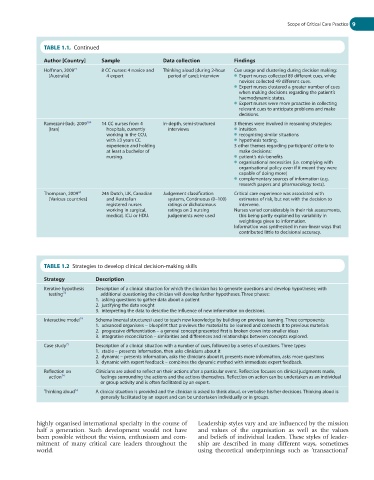
               TABLE 1.1,  Continued

               Author [Country]   Sample              Data collection         Findings
                         71
               Hoffman, 2009      8 CC nurses: 4 novice and   Thinking aloud (during 2-hour   Cue usage and clustering during decision making:
                 [Australia]        4 expert            period of care); interview  ●  Expert nurses collected 89 different cues, while
                                                                               novices collected 49 different cues.
                                                                              ●  Expert nurses clustered a greater number of cues
                                                                               when making decisions regarding the patient’s
                                                                               haemodynamic status.
                                                                              ●  Expert nurses were more proactive in collecting
                                                                               relevant cues to anticipate problems and make
                                                                               decisions.
                             104
               Ramezani-Badr, 2009    14 CC nurses from 4   In-depth, semi-structured   3 themes were involved in reasoning strategies:
                 [Iran]             hospitals, currently   interviews         ●  intuition
                                    working in the CCU,                       ●  recognising similar situations
                                    with ≥3 years CC                          ●  hypothesis testing.
                                    experience and holding                    3 other themes regarding participants’ criteria to
                                    at least a bachelor of                     make decisions:
                                    nursing.                                  ●  patient’s risk-benefits
                                                                              ●  organisational necessities (i.e. complying with
                                                                               organisational policy even if it meant they were
                                                                               capable of doing more)
                                                                              ●  complementary sources of information (e.g.
                                                                               research papers and pharmacology texts).
                           66
               Thompson, 2009     245 Dutch, UK, Canadian   Judgement classification   Critical care experience was associated with
                 [Various countries]  and Australian    systems, Continuous (0–100)   estimates of risk, but not with the decision to
                                    registered nurses   ratings or dichotomous   intervene.
                                    working in surgical,   ratings on 3 nursing   Nurses varied considerably in their risk assessments,
                                    medical, ICU or HDU.  judgements were used  this being partly explained by variability in
                                                                               weightings given to information.
                                                                              Information was synthesised in non-linear ways that
                                                                               contributed little to decisional accuracy.


               TABLE 1.2  Strategies to develop clinical decision-making skills
               Strategy         Description
               Iterative hypothesis   Description of a clinical situation for which the clinician has to generate questions and develop hypotheses; with
                 testing 74       additional questioning the clinician will develop further hypotheses. Three phases:
                                1.  asking questions to gather data about a patient
                                2.  justifying the data sought
                                3.  interpreting the data to describe the influence of new information on decisions.
               Interactive model 74  Schema (mental structures) used to teach new knowledge by building on previous learning. Three components:
                                1.  advanced organisers – blueprint that previews the material to be learned and connects it to previous materials
                                2.  progressive differentiation – a general concept presented first is broken down into smaller ideas
                                3.  integrative reconciliation – similarities and differences and relationships between concepts explored.
               Case study 75    Description of a clinical situation with a number of cues, followed by a series of questions. Three types:
                                1.  stable – presents information, then asks clinicians about it
                                2.  dynamic – presents information, asks the clinicians about it, presents more information, asks more questions
                                3.  dynamic with expert feedback – combines the dynamic method with immediate expert feedback.
               Reflection on    Clinicians are asked to reflect on their actions after a particular event. Reflection focuses on clinical judgments made,
                 action 74        feelings surrounding the actions and the actions themselves. Reflection on action can be undertaken as an individual
                                  or group activity and is often facilitated by an expert.
               Thinking aloud 74  A clinical situation is provided and the clinician is asked to think aloud, or verbalise his/her decisions. Thinking aloud is
                                  generally facilitated by an expert and can be undertaken individually or in groups.


             highly organised international specialty in the course of   Leadership styles vary and are influenced by the mission
             half  a  generation.  Such  development  would  not  have   and  values  of  the  organisation  as  well  as  the  values
             been possible without the vision, enthusiasm and com-  and beliefs of individual leaders. These styles of leader-
             mitment  of  many  critical  care  leaders  throughout  the   ship  are  described  in  many  different  ways,  sometimes
             world.                                               using  theoretical  underpinnings  such  as  ‘transactional’

