


Page 35 - ACCCN's Critical Care Nursing
P. 35
12  S C O P E   O F   C R I T I C A L   C A R E


                                                    Research program


                   Practice           Patient          Technology         Education            Policy
                   issues            outcomes          assessment          & training          issues

                    Practice         Health status/   Clinical information                  Commonwealth &
                  development          HRQOL              systems         Competencies        state policies

                    Evidence-         Patient/family      Product                              Impact of
                  based practice      experiences        evaluation        Credentialling   international factors

                                                          Impact of
                    Resource           Economic         technology on        Program            Ethical &
                    utilisation        evaluation                           evaluation         legal issues
                                                         patient care
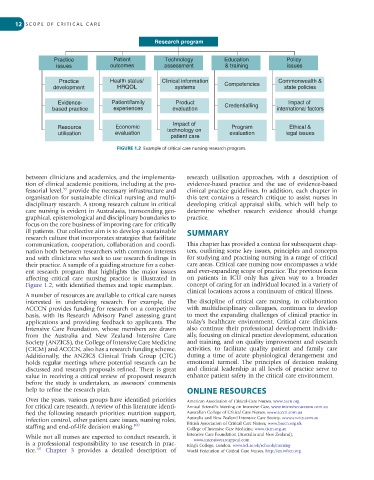
                                       FIGURE 1.2  Example of critical care nursing research program.


         between clinicians and academics, and the implementa-  research  utilisation  approaches,  with  a  description  of
         tion of clinical academic positions, including at the pro-  evidence-based  practice  and  the  use  of  evidence-based
                      99
         fessorial level,  provide the necessary infrastructure and   clinical practice guidelines. In addition, each chapter in
         organisation for sustainable clinical nursing and multi-  this  text  contains  a  research  critique  to  assist  nurses  in
         disciplinary research. A strong research culture in critical   developing  critical  appraisal  skills,  which  will  help  to
         care nursing is evident in Australasia, transcending geo-  determine  whether  research  evidence  should  change
         graphical, epistemological and disciplinary boundaries to   practice.
         focus on the core business of improving care for critically
         ill patients. Our collective aim is to develop a sustainable   SUMMARY
         research culture that incorporates strategies that facilitate
         communication, cooperation, collaboration and coordi-  This chapter has provided a context for subsequent chap-
         nation both between researchers with common interests   ters, outlining some key issues, principles and concepts
         and with clinicians who seek to use research findings in   for studying and practising nursing in a range of critical
         their practice. A sample of a guiding structure for a coher-  care areas. Critical care nursing now encompasses a wide
         ent  research  program  that  highlights  the  major  issues   and ever-expanding scope of practice. The previous focus
         affecting  critical  care  nursing  practice  is  illustrated  in   on  patients  in  ICU  only  has  given  way  to  a  broader
         Figure 1.2, with identified themes and topic exemplars.  concept of caring for an individual located in a variety of
                                                              clinical locations across a continuum of critical illness.
         A number of resources are available to critical care nurses
         interested  in  undertaking  research.  For  example,  the   The  discipline  of  critical  care  nursing,  in  collaboration
         ACCCN provides funding for research on a competitive   with multidisciplinary colleagues, continues to develop
         basis,  with  its  Research  Advisory  Panel  assessing  grant   to meet the expanding challenges of clinical practice in
         applications  and  providing  feedback  to  applicants.  The   today’s  healthcare  environment.  Critical  care  clinicians
         Intensive  Care  Foundation,  whose  members  are  drawn   also  continue  their  professional  development  individu-
         from  the  Australia  and  New  Zealand  Intensive  Care   ally, focusing on clinical practice development, education
         Society (ANZICS), the College of Intensive Care Medicine   and training, and on quality improvement and research
         (CICM) and ACCCN, also has a research funding scheme.   activities,  to  facilitate  quality  patient  and  family  care
         Additionally,  the  ANZICS  Clinical  Trials  Group  (CTG)   during  a  time  of  acute  physiological  derangement  and
         holds regular meetings where potential research can be   emotional  turmoil.  The  principles  of  decision  making
         discussed and research proposals refined. There is great   and  clinical  leadership  at  all  levels  of  practice  serve  to
         value in receiving a critical review of proposed research   enhance patient safety in the critical care environment.
         before the study is undertaken, as assessors’ comments
         help to refine the research plan.                    ONLINE RESOURCES
         Over the years, various groups have identified priorities   American Association of Critical-Care Nurses, www.aacn.org
         for critical care research. A review of this literature identi-  Annual Scientific Meeting on Intensive Care, www.intensivecareasm.com.au
         fied the following research priorities: nutrition support,   Australian College of Critical Care Nurses, www.acccn.com.au
         infection control, other patient care issues, nursing roles,   Australia and New Zealand Intensive Care Society, www.anzics.com.au
         staffing and end-of-life decision making. 100        British Association of Critical Care Nurses, www.baccn.org.uk
                                                              College of Intensive Care Medicine, www.cicm.org.au
         While not all nurses are expected to conduct research, it   Intensive Care Foundation (Australia and New Zealand),
                                                                www.intensivecareappeal.com
         is  a  professional  responsibility  to  use  research  in  prac-  King’s College, London, www.kcl.ac.uk/schools/nursing
             101
         tice.   Chapter  3  provides  a  detailed  description  of   World Federation of Critical Care Nurses, http://en.wfccn.org

