


Page 531 - ACCCN's Critical Care Nursing
P. 531
508  P R I N C I P L E S   A N D   P R A C T I C E   O F   C R I T I C A L   C A R E


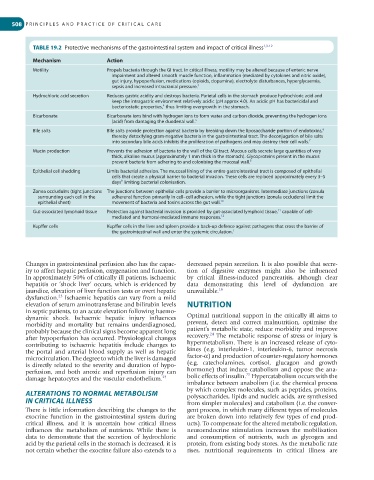
            TABLE 19.2  Protective mechanisms of the gastrointestinal system and impact of critical illness 1,3-12

            Mechanism               Action
            Motility                Propels bacteria through the GI tract. In critical illness, motility may be altered because of enteric nerve
                                      impairment and altered smooth muscle function, inflammation (mediated by cytokines and nitric oxide),
                                      gut injury, hypoperfusion, medications (opioids, dopamine), electrolyte disturbances, hyperglycaemia,
                                      sepsis and increased intracranial pressure. 3
            Hydrochloric acid secretion  Reduces gastric acidity and destroys bacteria. Parietal cells in the stomach produce hydrochloric acid and
                                      keep the intragastric environment relatively acidic (pH approx 4.0). An acidic pH has bactericidal and
                                      bacteriostatic properties,  thus limiting overgrowth in the stomach.
                                                      4
            Bicarbonate             Bicarbonate ions bind with hydrogen ions to form water and carbon dioxide, preventing the hydrogen ions
                                      (acid) from damaging the duodenal wall. 5
            Bile salts              Bile salts provide protection against bacteria by breaking down the liposaccharide portion of endotoxins,   6
                                      thereby detoxifying gram-negative bacteria in the gastrointestinal tract. The deconjugation of bile salts
                                      into secondary bile acids inhibits the proliferation of pathogens and may destroy their cell walls. 7
            Mucin production        Prevents the adhesion of bacteria to the wall of the GI tract. Mucous cells secrete large quantities of very
                                      thick, alkaline mucus (approximately 1 mm thick in the stomach). Glycoproteins present in the mucus
                                      prevent bacteria from adhering to and colonising the mucosal wall. 8
            Epithelial cell shedding  Limits bacterial adhesion. The mucosal lining of the entire gastrointestinal tract is composed of epithelial
                                      cells that create a physical barrier to bacterial invasion. These cells are replaced approximately every 3–5
                                      days  limiting bacterial colonisation.
                                         9
            Zonea occludulns (tight junctions  The junctions between epithelial cells provide a barrier to microorganisms. Intermediate junctions (zonula
             surrounding each cell in the   adherens) function primarily in cell–cell adhesion, while the tight junctions (zonula occludens) limit the
             epithelial sheet)        movement of bacteria and toxins across the gut wall. 10
            Gut-associated lymphoid tissue  Protection against bacterial invasion is provided by gut-associated lymphoid tissue,  capable of cell-
                                                                                            11
                                      mediated and humoral-mediated immune responses. 12
            Kupffer cells           Kupffer cells in the liver and spleen provide a back-up defence against pathogens that cross the barrier of
                                      the gastrointestinal wall and enter the systemic circulation. 1


         Changes in gastrointestinal perfusion also has the capac-  decreased pepsin secretion. It is also possible that secre-
         ity to affect hepatic perfusion, oxygenation and function.   tion  of  digestive  enzymes  might  also  be  influenced
         In approximately 50% of critically ill patients, ischaemic   by  critical  illness-induced  pancreatitis,  although  clear
         hepatitis  or  ‘shock  liver’  occurs,  which  is  evidenced  by   data  demonstrating  this  level  of  dysfunction  are
         jaundice, elevation of liver function tests or overt hepatic   unavailable. 16
                    23
         dysfunction.  Ischaemic hepatitis can vary from a mild
         elevation of serum aminotransferase and bilirubin levels   NUTRITION
         in septic patients, to an acute elevation following haemo-
         dynamic  shock.  Ischaemic  hepatic  injury  influences    Optimal nutritional support in the critically ill aims to
         morbidity  and  mortality  but  remains  underdiagnosed,   prevent,  detect  and  correct  malnutrition,  optimise  the
         probably because the clinical signs become apparent long   patient’s metabolic state, reduce morbidity and improve
                                                                      24
         after hypoperfusion has occurred. Physiological changes   recovery.  The metabolic response of stress or injury is
         contributing  to  ischaemic  hepatitis  include  changes  to   hypermetabolism. There is an increased release of cyto-
         the  portal  and  arterial  blood  supply  as  well  as  hepatic   kines  (e.g.  interleukin-1,  interleukin-6,  tumor  necrosis
         microcirculation. The degree to which the liver is damaged   factor-α) and production of counter-regulatory hormones
         is directly related to the severity and duration of hypo-  (e.g.  catecholamines,  cortisol,  glucagon  and  growth
         perfusion,  and  both  anoxic  and  reperfusion  injury  can   hormone) that induce catabolism and oppose the ana-
                                                                                  25
         damage hepatocytes and the vascular endothelium. 23  bolic effects of insulin.  Hypercatabolism occurs with the
                                                              imbalance between anabolism (i.e. the chemical process
         ALTERATIONS TO NORMAL METABOLISM                     by which complex molecules, such as peptides, proteins,
                                                              polysaccharides, lipids and nucleic acids, are synthesised
         IN CRITICAL ILLNESS                                  from simpler molecules) and catabolism (i.e. the conver-
         There is little information describing the changes to the   gent process, in which many different types of molecules
         exocrine  function  in  the  gastrointestinal  system  during   are broken down into relatively few types of end prod-
         critical  illness,  and  it  is  uncertain  how  critical  illness   ucts). To compensate for the altered metabolic regulation,
         influences  the  metabolism  of  nutrients.  While  there  is   neuroendocrine  stimulation  increases  the  mobilisation
         data  to  demonstrate  that  the  secretion  of  hydrochloric   and  consumption  of  nutrients,  such  as  glycogen  and
         acid by the parietal cells in the stomach is decreased, it is   protein, from existing body stores. As the metabolic rate
         not certain whether the exocrine failure also extends to a   rises,  nutritional  requirements  in  critical  illness  are

