


Page 534 - ACCCN's Critical Care Nursing
P. 534
Gastrointestinal, Liver and Nutritional Alterations 511

             ●  Analysis of the pH of gastric secretions is not reliable.
                A pH of 0–5 may be used to indicate gastric placement   TABLE 19.4  Methods of feed delivery
                of enteral feeding tubes, although this technique may
                be  problematic  for  patients  receiving  histamine-2-   Method  Description
                receptor antagonists or proton pump inhibitors. If the
                aspirated fluid has a low pH, it may be assumed that   Bolus   ●  Delivery of a large volume of tube feed into the
                                                                                stomach over a short period of time (>100 mL)
                the fluid originated in the stomach but the pH of fluid        ●  Associated with complications, such as
                                                            115
                from an infected pleural space can also be acidic,              aspiration and vomiting 127,128
                therefore  pH  testing  as  a  sole  method  to  determine
                tube placement is not recommended. 116              Intermittent  ●  A several-hour infusion a few times a day (e.g.
                                                                                150 mL/h for 3 hours, three times per day), or
             ●  End-tidal  CO 2   (ETCO 2 )  detectors:  capnometry  and        delivered over a longer period (12–16 hours)
                capnography.  Capnometry  and  capnography  use                 with an 8–12-hour rest period 127
                ETCO 2  CO 2  detectors to evaluate enteral tube place-        ●  Allows gastric acidity and therefore limits
                ment  but  they  are  not  used  in  routine  clinical          bacterial overgrowth
                practice. 107,117-122  Differentiating between oesophageal,    ●  Requires a higher hourly rate to meet caloric
                stomach or intestinal placement is not possible. 116            requirements
             ●  Pepsin/trypsin.  Measuring  the  concentrations  of   Continuous  ●  The delivery of small amounts of formula per
                pepsin  and  trypsin  in  feeding  tube  aspirates  can  be     hour over a 24-hour period 129
                used  as  a  method  of  predicting  tube  placement           ●  May make caloric requirements more
                however  methods  to  measure  pepsin  and  trypsin  at         achievable
                the bedside are currently unavailable. 123                     ●  Continuous dilution of gastric acid may
                                                                                contribute to bacterial overgrowth
             Ongoing assessment of feeding tube placement is essen-
             tial, as feeding tubes may migrate after initial placement.   their  daily  caloric  requirements  should  be  employed.
             Marking the feeding tube at the point where it exits the   When a patient has experienced a prolonged period of
             nose and measurement of tube length protruding from   starvation  or  total  parenteral  nutrition,  the  approach
             the anterior nares will facilitate detection of migration of   to enteral feeding is somewhat more reserved, as the risk
             the  enteral  tube.  Radio-opaque  tubes  have  markers  to   of  refeeding  syndrome  is  increased. 130-132   Although  not
             enable  accurate  measurement  and  documentation  of   common, this syndrome is associated with severe derange-
             tube position. It should be used with the methods previ-  ment  in  fluid  and  electrolyte  levels  (particularly  hypo-
             ously described for ongoing assessment.              phosphataemia, hypomagnesaemia and hypokalaemia),
                                                                  and may result in significant morbidity and mortality.
             In  the  absence  of  X-ray,  several  approaches  should  be
             used  in  combination  to  verify  tube  position.  Metheny   Managing complications of enteral feeding
                          114
             and colleagues  found measuring: (a) length of tubing   Once  enteral  feeding  is  established,  it  is  important  to
             extending from the insertion site, (b) volume of aspirate   assess for such complications as:
             from the feeding tube, (c) appearance of the aspirate, and
             (d) pH of the aspirate were able to correctly differentiate   ●  feeding intolerance
             between gastric and bowel tube placement during con-  ●  gastric distension
             tinuous  feedings  in  81%  of  the  predictions.  Ongoing   ●  vomiting
             assessment of feeding tube placement is also essential, as   ●  diarrhoea
             feeding tubes may migrate after initial placement.   ●  pulmonary aspiration
                                                                  ●  hyperglycaemia
             Feeding regimens                                     ●  hypercarbia
                                                                  ●  electrolyte imbalances
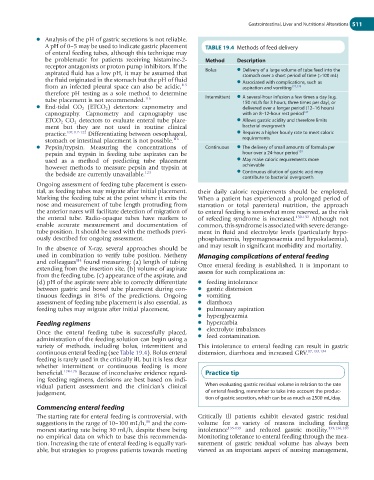
             Once  the  enteral  feeding  tube  is  successfully  placed,   ●  feed contamination.
             administration of the feeding solution can begin using a
             variety  of  methods,  including  bolus,  intermittent  and   This  intolerance  to  enteral  feeding  can  result  in  gastric
             continuous enteral feeding (see Table 19.4). Bolus enteral   distension, diarrhoea and increased GRV. 87,133,134
             feeding is rarely used in the critically ill, but it is less clear
             whether  intermittent  or  continuous  feeding  is  more
             beneficial. 124-126  Because of inconclusive evidence regard-  Practice tip
             ing feeding regimens, decisions are best based on indi-
             vidual  patient  assessment  and  the  clinician’s  clinical   When evaluating gastric residual volume in relation to the rate
             judgement.                                             of enteral feeding, remember to take into account the produc-
                                                                    tion of gastric secretion, which can be as much as 2500 mL/day.
             Commencing enteral feeding
             The starting rate for enteral feeding is controversial, with   Critically  ill  patients  exhibit  elevated  gastric  residual
                                                 86
             suggestions in the range of 10–100 mL/h,  and the com-  volume  for  a  variety  of  reasons  including  feeding
             monest starting rate being 30 mL/h, despite there being   intolerance 135-139   and  reduced  gastric  motility. 135,136,140
             no  empirical  data  on  which  to  base  this  recommenda-  Monitoring tolerance to enteral feeding through the mea-
             tion. Increasing the rate of enteral feeding is equally vari-  surement  of  gastric  residual  volume  has  always  been
             able, but strategies to progress patients towards meeting   viewed as an important aspect of nursing management,

