


Page 536 - ACCCN's Critical Care Nursing
P. 536
Gastrointestinal, Liver and Nutritional Alterations 513

                Also, patients not receiving enteral feeding can have
                                           181
                detectable glucose in aspirates.  This is further con-  TABLE 19.5  Components of TPN solutions
                founded  by  the  presence  of  blood,  which  is  closely
                associated  with  glucose  values  >20 mg/dL;  conse-  Component Implication
                quently, any blood in the respiratory tract could con-
                                            181
                tribute to a false-positive result.  These findings led   Carbohydrate  ●  This should supply approximately 70% of the
                                                                                 patient’s non-protein to prevent protein
                to the consensus that glucose monitoring in respira-             catabolism needs. 190
                tory secretions should also be abandoned. 179                  ●  Insulin production will usually be increased to
             ●  Measurement  of  pepsin  in  tracheobronchial  secre-            maintain normoglycaemia, although some
                tions has been used in an animal study suggested that            patients, such as those with diabetes, may
                the detection of pepsin, a component of gastric secre-           require an insulin infusion to maintain
                                                                                 normoglycaemia.
                tions, may be useful in determining pulmonary aspi-            ●  Glucose solutions over 25% are hyperosmolar
                ration. 182  however, further investigation in acutely ill       and may cause thrombophlebitis.
                patients receiving enteral feeding is necessary.               ●  Glucose solutions mixed with lipids can
                                                                                 protect the vein from thrombophlebitis,
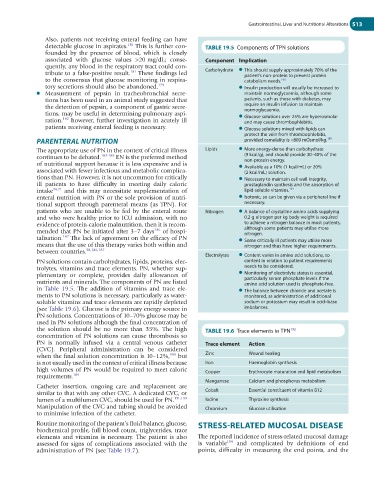
             PARENTERAL NUTRITION                                                provided osmolality is <800 mOsmol/kg. 189
             The appropriate use of PN in the context of critical illness   Lipids  ●  More energy-dense than carbohydrate
             continues to be debated. 183-185  EN is the preferred method        (9 kcal/g), and should provide 30–40% of the
                                                                                 non-protein energy.
             of nutritional support because it is less expensive and is        ●  Available as a 10% (1 kcal/mL) or 20%
             associated with fewer infectious and metabolic complica-            (2 kcal/mL) solution.
             tions than PN. However, it is not uncommon for critically         ●  Necessary to maintain cell wall integrity,
             ill  patients  to  have  difficulty  in  meeting  daily  caloric    prostaglandin synthesis and the absorption of
             intake 34,71   and  this  may  necessitate  supplementation  of     lipid-soluble vitamins. 191
             enteral nutrition with PN or the sole provision of nutri-         ●  Isotonic, so can be given via a peripheral line if
             tional support through parenteral means (as TPN). For               necessary.
             patients who are unable to be fed by the enteral route    Nitrogen  ●  A balance of crystalline amino acids supplying
             and who were healthy prior to ICU admission, with no                0.2 g nitrogen per kg body weight is required
             evidence of protein-calorie malnutrition, then it is recom-         to achieve a nitrogen balance in most patients,
             mended that PN be initiated after 3–7 days 186  of hospi-           although some patients may utilise more
                                                                                 nitrogen.
             talisation. 187  The lack of agreement on the efficacy of PN      ●  Some critically ill patients may utilise more
             means that the use of this therapy varies both within and           nitrogen and thus have higher requirements.
             between countries. 58,186,187
                                                                    Electrolytes  ●  Content varies in amino acid solutions, so
             PN solutions contain carbohydrates, lipids, proteins, elec-         content in relation to patient requirements
             trolytes, vitamins and trace elements. PN, whether sup-             needs to be considered.
             plementary  or  complete,  provides  daily  allowances  of        ●  Monitoring of electrolyte status is essential,
             nutrients and minerals. The components of PN are listed             particularly serum phosphate levels if the
                                                                                 amino acid solution used is phosphate-free.
             in  Table  19.5.  The  addition  of  vitamins  and  trace  ele-   ●  The balance between chloride and acetate is
             ments to PN solutions is necessary, particularly as water-          monitored, as administration of additional
             soluble vitamins and trace elements are rapidly depleted            sodium or potassium may result in acid–base
             (see Table 19.6). Glucose is the primary energy source in           imbalances.
             PN solutions. Concentrations of 10–70% glucose may be
             used in PN solutions although the final concentration of
             the  solution  should  be  no  more  than  35%.  The  high   TABLE 19.6  Trace elements in TPN 192
             concentration of PN solutions can cause thrombosis so
             PN  is  normally  infused  via  a  central  venous  catheter   Trace element  Action
             (CVC).  Peripheral  administration  can  be  considered
             when the final solution concentration is 10–12%, 188  but   Zinc     Wound healing
             is not usually used in the context of critical illness because   Iron  Haemoglobin synthesis
             high volumes of PN would be required to meet caloric   Copper        Erythrocyte maturation and lipid metabolism
             requirements. 189
                                                                    Manganese     Calcium and phosphorus metabolism
             Catheter  insertion,  ongoing  care  and  replacement  are
             similar to that with any other CVC. A dedicated CVC, or   Cobalt     Essential constituent of vitamin B12
             lumen of a multilumen CVC, should be used for PN. 191,193    Iodine  Thyroxine synthesis
             Manipulation of the CVC and tubing should be avoided   Chromium      Glucose utilisation
             to minimise infection of the catheter.
             Routine monitoring of the patient’s fluid balance, glucose,   STRESS-RELATED MUCOSAL DISEASE
             biochemical profile, full blood count, triglycerides, trace
             elements  and  vitamins  is  necessary.  The  patient  is  also   The reported incidence of stress-related mucosal damage
             assessed  for  signs  of  complications  associated  with  the   is  variable 194   and  complicated  by  definitions  of  end
             administration of PN (see Table 19.7).               points,  difficulty  in  measuring  the  end  points,  and  the

