


Page 578 - ACCCN's Critical Care Nursing
P. 578
Management of Shock 555

             However, in this study, less than 1% of the population   be considered when there are two or more organ systems
             actually  suffered  an  anaphylactic  reaction  manifesting   involved. 125
             with generalised multisystem allergic reaction, including   Of note is the high mortality in patients with asthma and
             evidence of airway involvement, rashes, GIT and cardio-  those on beta-blocker or ACE inhibitor medications; 119,126
             vascular dysfunction. 123
                                                                  these medications may limit the effectiveness of adrena-
             This  allergic  response  is  via  a  host  mast-cell  reaction   line  therapy.  Age  and  preexisting  lung  disease  are  the
             mediated by immunoglobulin E (IgE),  and an antibody   most  important  factors  in  relation  to  severity;  older
                                              118
             produced in response to the allergen that is attached to   people and those with asthma or airways disease have a
             basophils  (mast  cells).  Once  sensitised  to  an  allergen,   higher risk of a life-threatening reaction. 124
             subsequent exposure may lead to an anaphylactic reac-
             tion in affected individuals. The mechanism is that sub-  NURSING PRACTICE AND COLLABORATIVE
             sequent exposure leads to mast-cell–allergen complexes   CARE: INITIAL MANAGEMENT
             and the release of histamine. 124  Reactions to an allergen   Diagnosis of an anaphylactic reaction requires an appro-
             cannot  be  predicted  in  anaphylaxis,  with  a  subsequent   priate  assessment  and  history,  including  acute  onset,
                                                            119
             exposure  leading  to  an  amplified  or  lesser  response.    history of allergic reaction and initial measures instituted
             There  can  be  an  initial  reaction,  which  subsides  with   to  support  airway,  breathing  and  circulation  (ABC).
             treatment over about 24 hours, but often described is a   Removal  of  the  causative  agent  (if  possible)  and  early
             second or rebound reaction up to 8–10 hours after initial   treatment (within 30 minutes of exposure to an allergen)
             exposure to an allergen. 118,122
                                                                  results in improved outcomes. ABC measures are impor-
             CLINICAL MANIFESTATIONS                              tant considering the rapid impact of circulating mediators
                                                                  and  potential  decline  in  respiratory  and  cardiovascular
             Exposure to an allergen causes release of histamine and   function. Securing the airway is vital as most anaphylactic
             other  mediators,  with  subsequent  vasodilation  and   related  deaths  are  due  to  asphyxiation.   Adrenaline  is
                                                                                                     121
             increased  microvascular  permeability  –  a  distributive   recommended as first-line drug treatment 119,121,122,124  often
             form of shock. Histamine acts, and is metabolised, rapidly   as an IM injection.
             while  other  mediators  have  a  sustained  effect.   The
                                                        121
             antigen–antibody reaction may directly damage vascular   NURSING PRACTICE AND COLLABORATIVE
             walls, while release of vasoactive mediators such as his-  CARE: AIRWAY MANAGEMENT
             tamine, serotonin, bradykinins and prostaglandins trigger
             a  systemic  response,  resulting  in  vasodilation  and   Early  elective  intubation  is  recommended  for  patients
             increased capillary permeability, with widespread loss of   with airway oedema, stridor, or any oropharyngeal swell-
             fluid into the interstitial space and hypovolaemia. Blood   ing.  Patients  with  airway  swelling  and/or  angiooedema
             pressure and cardiac output/index may fall with a com-  are  at  high  risk  for  rapid  deterioration  and  respiratory
                                                                             125
             pensatory  rise  in  heart  rate.  Severe  bronchospasm  may   compromise.   Late presentation to hospital or delayed
             also occur from mediator-induced bronchial oedema and   intubation  when  airway  swelling  is  present  may  mean
             pulmonary  smooth  muscle  contraction.   Abdominal   that intubation and other emergency airway procedures
                                                  9
             pain is thought to be due to the inflammation of Peyer’s   may be extremely difficult. Multiple attempts at intuba-
             patches  (clusters  of  lymphatic  tissue  containing   tion  increase  laryngeal  oedema  or  cause  trauma  to  the
             B-lymphocytes, located in the mucosa and submucosa of   airway. Early recognition of the potentially difficult airway
             the small intestine). 124  A list of signs and symptoms for   allows  planning  for  alternative  airway  management  by
                                                                                         125
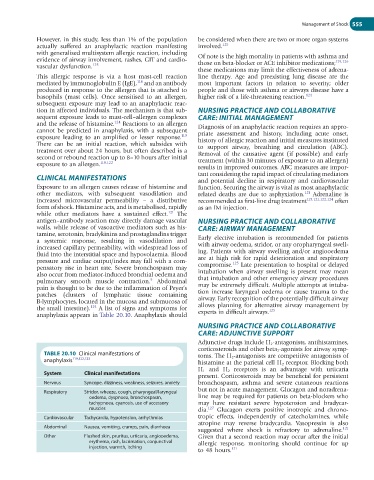
             anaphylaxis appears in Table 20.10. Anaphylaxis should   experts in difficult airways.
                                                                  NURSING PRACTICE AND COLLABORATIVE
                                                                  CARE: ADJUNCTIVE SUPPORT
                                                                  Adjunctive drugs include H 2 -antagonists, antihistamines,
                                                                  corticosteroids and other beta 2 -agonists for airway symp-
               TABLE 20.10  Clinical manifestations of            toms. The H 2 -antagonists are competitive antagonists of
               anaphylaxis 119,122,123                            histamine at the parietal cell H 2  receptor. Blocking both
                                                                  H 1   and  H 2   receptors  is  an  advantage  with  urticaria
               System        Clinical manifestations              present. Corticosteroids may be beneficial for persistent
               Nervous       Syncope, dizziness, weakness, seizures, anxiety  bronchospasm,  asthma  and  severe  cutaneous  reactions
               Respiratory   Stridor, wheeze, cough, pharyngeal/laryngeal   but not in acute management. Glucagon and noradrena-
                              oedema, dyspnoea, bronchospasm,     line may be required for patients on beta-blockers who
                              tachypnoea, cyanosis, use of accessory   may  have  resistant  severe  hypotension  and  bradycar-
                              muscles                             dia. 127   Glucagon  exerts  positive  inotropic  and  chrono-
               Cardiovascular  Tachycardia, hypotension, arrhythmias  tropic  effects,  independently  of  catecholamines,  while
                                                                  atropine  may  reverse  bradycardia.  Vasopressin  is  also
               Abdominal     Nausea, vomiting, cramps, pain, diarrhoea                                           121
                                                                  suggested  where  shock  is  refractory  to  adrenaline.
               Other         Flushed skin, pruritus, urticaria, angiooedema,   Given that a second reaction may occur after the initial
                              erythema, rash, lacrimation, conjunctival   allergic  response,  monitoring  should  continue  for  up
                              injection, warmth, itching                     121
                                                                  to 48 hours.

