


Page 579 - ACCCN's Critical Care Nursing
P. 579
556  P R I N C I P L E S   A N D   P R A C T I C E   O F   C R I T I C A L   C A R E

         PREVENTATIVE CARE                                    NURSING PRACTICE AND COLLABORATIVE
         Individuals with known allergies are taught avoidance of   MANAGEMENT
         allergens, and the use of emergency kits with adrenaline   The  extent  of  injury,  whether  complete  (no  sensory  or
         for IM injection. 120,124  Desensitisation therapy may reduce   motor function) or incomplete (some sensory or motor
         severity of symptoms.                                function), determines clinical medical management. Pri-
                                                              ority focuses on airway, breathing and circulation.
         NEUROGENIC/SPINAL SHOCK                              After neck and torso stabilisation, a patient is placed in a

         Neurogenic shock is a form of distributive shock caused   position that supports spinal precautions (neutral neck
         by loss of vasomotor (sympathetic) tone from disruption   positioning) with the spinal boards removed within 20
         to or inhibition of neural output. Characteristics include   minutes if possible. Caution for spinal instability remains
         SBP <90–100 mmHg and a HR <80 bpm without other      despite medical imaging clearance, due to the potential
         obvious causes. 128  Note that the HR is within otherwise   for  spinal  ligament  damage.  The  patient  is  positioned
         accepted  normal  limits.  Most  often  it  is  described  as  a   supine, with their legs in alignment with the torso. Eleva-
         triad of hypotension, bradycardia and hypothermia. The   tion of the head may cause pooling of blood in the lower
                                                                                          130
         primary cause is a spinal cord injury above T6, secondary   limbs, exacerbating hypotension,  and makes the patient
         to disruption of sympathetic outflow from T1–L2 and to   sensitive to sudden position changes.
         unopposed  vagal  tone,  leading  to  decreased  vascular   Loss  of  sympathetic  outflow  requires  close  cardiac  and
         resistance and associated vascular dilation. 129  It may also   haemodynamic monitoring for bradycardia and hypoten-
         develop  after  anaesthesia,  particularly  spinal,  cerebral   sion. Symptomatic bradycardia is treated and may require
         medullary ischaemia or when there is spinal cord com-  cardiac  pacing  if  unresponsive  to  atropine.  Therapies
         plete or partial injury above the midthoracic region (tho-  include fluid resuscitation with the addition of inotropes
         racic outflow tract).                                if  necessary  to  improve  vasomotor  tone  to  increase
         Spinal  shock  is  a  subclass  of  neurogenic  shock,  with  a   preload and maintain a MAP >80–85 mmHg 129  to restore
         transient  physiological  (rather  than  anatomical)  reflex   spinal cord perfusion and to prevent secondary neuronal
                                                                           131
         depression of cord function below the level of injury and   hypoperfusion.  A higher (supranormal) MAP may be
         associated loss of sensorimotor functions. Incidence has   targeted to improve recovery and prevent secondary inju-
                                                                  131
         been reported at 14% of patients presenting to the ED   ries.  Volume expansion with colloids and crystalloids
         within  2  hours  of  injury  and  predominantly  affects   or blood products will vary depending on patient situa-
         patients  with  cervical  damage. 128   Spinal  shock  can  also   tion, however subgroup analysis in the SAFE trial indi-
         occur with a spinal cord laceration or contusion, and is   cated that colloids and hypotonic solutions may not be
                                                                             44
         associated  with  varying  degrees  of  motor  and  sensory   the best options.
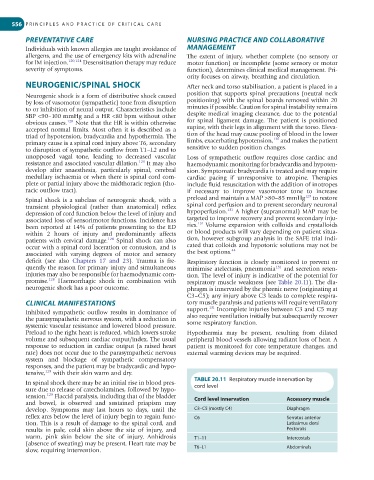
         deficit  (see  also  Chapters  17  and  23).  Trauma  is  fre-  Respiratory function is closely monitored to prevent or
         quently the reason for primary injury and simultaneous   minimise atelectasis, pneumonia  and secretion reten-
                                                                                           131
         injuries may also be responsible for haemodynamic com-  tion. The level of injury is indicative of the potential for
         promise. 128   Haemorrhagic  shock  in  combination  with   respiratory muscle weakness (see Table 20.11). The dia-
         neurogenic shock has a poor outcome.                 phragm is innervated by the phrenic nerve (originating at
                                                              C3–C5); any injury above C3 leads to complete respira-
         CLINICAL MANIFESTATIONS                              tory muscle paralysis and patients will require ventilatory
                                                                     131
                                                              support.  Incomplete injuries between C3 and C5 may
         Inhibited  sympathetic  outflow  results  in  dominance  of
         the parasympathetic nervous system, with a reduction in   also require ventilation initially but subsequently recover
         systemic vascular resistance and lowered blood pressure.   some respiratory function.
         Preload to the right heart is reduced, which lowers stroke   Hypothermia  may  be  present,  resulting  from  dilated
         volume and subsequent cardiac output/index. The usual   peripheral blood vessels allowing radiant loss of heat. A
         response to reduction in cardiac output (a raised heart   patient is monitored for core temperature changes, and
         rate) does not occur due to the parasympathetic nervous   external warming devices may be required.
         system  and  blockage  of  sympathetic  compensatory
         responses, and the patient may be bradycardic and hypo-
         tensive, 129  with their skin warm and dry.
                                                                 TABLE 20.11  Respiratory muscle innervation by
         In spinal shock there may be an initial rise in blood pres-  cord level
         sure due to release of catecholamines, followed by hypo-
         tension. 129  Flaccid paralysis, including that of the bladder   Cord level innervation  Accessory muscle
         and  bowel,  is  observed  and  sustained  priapism  may
         develop.  Symptoms  may  last  hours  to  days,  until  the   C3–C5 (mostly C4)       Diaphragm
         reflex arcs below the level of injury begin to regain func-  C6                       Serratus anterior
         tion. This is a result of damage to the spinal cord, and                              Latissimus dorsi
         results  in  pale,  cold  skin  above  the  site  of  injury,  and                    Pectoralis
         warm,  pink  skin  below  the  site  of  injury.  Anhidrosis   T1–11                  Intercostals
         (absence of sweating) may be present. Heart rate may be
         slow, requiring intervention.                           T6–L1                         Abdominals

