


Page 575 - ACCCN's Critical Care Nursing
P. 575
552  P R I N C I P L E S   A N D   P R A C T I C E   O F   C R I T I C A L   C A R E


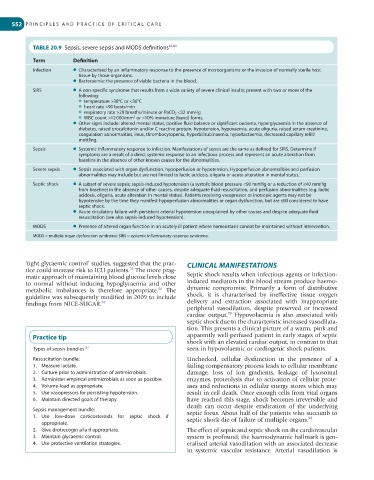
            TABLE 20.9  Sepsis, severe sepsis and MODS definitions 82,84

            Term         Definition
            Infection    ●  Characterised by an inflammatory response to the presence of microorganisms or the invasion of normally sterile host
                           tissue by those organisms.
                         ●  Bacteraemia: the presence of viable bacteria in the blood.
            SIRS         ●  A non-specific syndrome that results from a wide variety of severe clinical insults; present with two or more of the
                           following:
                           ●  temperature >38°C or <36°C
                           ●  heart rate >90 beats/min
                           ●  respiratory rate >20 breaths/minute or PaCO 2  <32 mmHg
                                             3
                           ●  WBC count >12 000/mm  or >10% immature (band) forms.
                         ●  Other signs include: altered mental status, positive fluid balance or significant oedema, hyperglycaemia in the absence of
                           diabetes, raised procalcitonin and/or C reactive protein, hypotension, hypoxaemia, acute oliguria, raised serum creatinine,
                           coagulation abnormalities, ileus, thrombocytopenia, hyperbilirubinaemia, hyperlactaemia, decreased capillary refill/
                           mottling.
            Sepsis       ●  Systemic inflammatory response to infection. Manifestations of sepsis are the same as defined for SIRS. Determine if
                           symptoms are a result of a direct systemic response to an infectious process and represent an acute alteration from
                           baseline in the absence of other known causes for the abnormalities.
            Severe sepsis  ●  Sepsis associated with organ dysfunction, hypoperfusion or hypotension. Hypoperfusion abnormalities and perfusion
                           abnormalities may include but are not limited to lactic acidosis, oliguria or acute alteration in mental status.
            Septic shock  ●  A subset of severe sepsis; sepsis-induced hypotension (a systolic blood pressure <90 mmHg or a reduction of ≥40 mmHg
                           from baseline) in the absence of other causes, despite adequate fluid resuscitation, and perfusion abnormalities (e.g. lactic
                           acidosis, oliguria, acute alteration in mental status). Patients receiving vasopressor or inotropic agents may not be
                           hypotensive by the time they manifest hypoperfusion abnormalities or organ dysfunction, but are still considered to have
                           septic shock.
                         ●  Acute circulatory failure with persistent arterial hypotension unexplained by other causes and despite adequate fluid
                           resuscitation (see also sepsis-induced hypotension).
            MODS         ●  Presence of altered organ function in an acutely ill patient where homeostasis cannot be maintained without intervention.
            MODS = multiple organ dysfunction syndrome; SIRS = systemic inflammatory response syndrome.


         ‘tight glycaemic control’ studies, suggested that the prac-  CLINICAL MANIFESTATIONS
         tice could increase risk to ICU patients.  The more prag-
                                           95
         matic approach of maintaining blood glucose levels close   Septic shock results when infectious agents or infection-
         to  normal  without  inducing  hypoglycaemia  and  other   induced mediators in the blood stream produce haemo-
         metabolic  imbalances  is  therefore  appropriate.   The   dynamic  compromise.  Primarily  a  form  of  distributive
                                                     96
         guideline was subsequently modified in 2009 to include   shock,  it  is  characterised  by  ineffective  tissue  oxygen
         findings from NICE-SUGAR. 97                         delivery  and  extraction  associated  with  inappropriate
                                                              peripheral  vasodilation,  despite  preserved  or  increased
                                                                            98
                                                              cardiac  output.   Hypovolaemia  is  also  associated  with
                                                              septic shock due to the characteristic increased vasodilata-
                                                              tion. This presents a clinical picture of a warm, pink and
            Practice tip                                      apparently well-perfused patient in early stages of septic
                                                              shock with an elevated cardiac output, in contrast to that
            Types of sepsis bundles 137                       seen in hypovolaemic or cardiogenic shock patients.
            Resuscitation bundle:                             Unchecked,  cellular  dysfunction  in  the  presence  of  a
            1.  Measure lactate.                              failing compensatory process leads to cellular membrane
            2.  Culture prior to administration of antimicrobials.  damage,  loss  of  ion  gradients,  leakage  of  lysosomal
            3.  Administer empirical antimicrobials as soon as possible.  enzymes, proteolysis due to activation of cellular prote-
            4.  Volume-load as appropriate.                   ases and reductions in cellular energy stores which may
            5.  Use vasopressors for persisting hypotension.  result in cell death. Once enough cells from vital organs
            6.  Maintain directed goals of therapy.           have reached this stage, shock becomes irreversible and
                                                              death  can  occur  despite  eradication  of  the  underlying
            Sepsis management bundle:                         septic focus. About half of the patients who succumb to
            1.  Use  low-dose  corticosteroids  for  septic  shock  if   septic shock die of failure of multiple organs. 98
               appropriate.
            2.  Give drotrecogin alfa if appropriate.         The effect of sepsis and septic shock on the cardiovascular
            3.  Maintain glycaemic control.                   system is profound; the haemodynamic hallmark is gen-
            4.  Use protective ventilation strategies.        eralised arterial vasodilation with an associated decrease
                                                              in  systemic  vascular  resistance.  Arterial  vasodilation  is

