


Page 612 - ACCCN's Critical Care Nursing
P. 612
Emergency Presentations 589

             notification of a disaster response a number of key posi-  Treatment
             tions should be allocated (medical coordinator, nursing   Treatment  provided  during  a  disaster  will  not  reflect
             coordinator,  triage  nurse,  medical  triage  officer).  These   routine practices; priorities focus on resuscitation, iden-
             personnel are senior staff with specific disaster training   tification  of  serious  injuries,  identification  of  patients
             and knowledge of the hospital’s disaster plan. 48,51  Nursing   requiring urgent surgery and stabilisation of patients for
             and medical coordinators are responsible for allocating   transfer out of the ED. The best overall outcome during
             staff to specific duties; all designated roles are outlined   a  disaster  are  achieved  when  the  routine  principles  of
             on action cards available for staff to read prior to com-  resuscitation and management are adapted to reflect the
             mencing their roles. 52                                              51,52
                                                                  resources available.
             The capacity of the ED to accommodate a large influx of
             patients needs to be maximised. Patients currently in the
             department are reviewed for a decision to admit. Patients   Transfer from the ED
             requiring  admission  are  transferred  out  of  the  Depart-  Patients are triaged, stabilised and transferred out to the
             ment to a suitable location in the hospital. Patients suit-  operating theatre or other clinical areas as soon as pos-
             able for discharge or referral to their local medical officer,   sible  using  designated  transfer  staff  and  a  coordinated
             including  patients  with  minor  complaints  currently   process outlined in the hospital plan. This will maintain
             waiting, should be discharged or referred to community   the  effectiveness  and  efficiency  of  the  department  as
             resources. A small number of patients may need to remain   victims continue to arrive.
             in the ED, and their care will need to be prioritised in
             conjunction with arriving disaster victims. 50-52
             Areas of the department are designated to accommodate   RESPIRATORY PRESENTATIONS
             the  expected  severity  of  the  victims  (e.g.  resuscitation   Patients  with  respiratory  dysfunctions  are  a  common
             room for priority 1 patients, observation areas for priority   presentation  to  the  ED  and  are  seen  across  all  age
             2).  Walking  wounded  casualties  with  relatively  minor   groups.  Respiratory  symptoms  can  be  associated  with
             injuries  and  who  are  unlikely  to  require  admission  to   a  broad  range  of  underlying  pathologies.  This  section
             hospital  are  best  accommodated  in  a  treatment  area   will  discuss  the  initial  assessment  and  treatment  of
             outside  the  ED,  as  this  cuts  congestion  and  increases     several  common  respiratory  diseases  seen  in  the  ED.
             the capacity for more significantly-injured victims to be   Chapter 14 provides more detailed information regard-
             managed. 51                                          ing  respiratory  diseases.
             Additional  staff  members  are  notified  from  the  current
             staff lists to participate in the disaster management. Staff
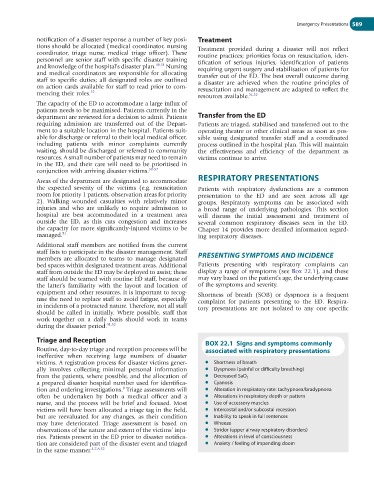
             members  are  allocated  to  teams  to  manage  designated   PRESENTING SYMPTOMS AND INCIDENCE
             bed spaces within designated treatment areas. Additional   Patients  presenting  with  respiratory  complaints  can
             staff from outside the ED may be deployed to assist; these   display a range of symptoms (see Box 22.1), and these
             staff should be teamed with routine ED staff, because of   may vary based on the patient’s age, the underlying cause
             the  latter’s  familiarity  with  the  layout  and  location  of   of the symptoms and severity.
             equipment and other resources. It is important to recog-  Shortness  of  breath  (SOB)  or  dyspnoea  is  a  frequent
             nise the need to replace staff to avoid fatigue, especially   complaint  for  patients  presenting  to  the  ED.  Respira-
             in incidents of a protracted nature. Therefore, not all staff   tory  presentations  are  not  isolated  to  any  one  specific
             should  be  called  in  initially.  Where  possible,  staff  that
             work  together  on  a  daily  basis  should  work  in  teams
             during the disaster period. 51,52
             Triage and Reception                                   BOX 22.1  Signs and symptoms commonly
             Routine, day-to-day triage and reception processes will be   associated with respiratory presentations
             ineffective  when  receiving  large  numbers  of  disaster
             victims. A registration process for disaster victims gener-  l  Shortness of breath
             ally  involves  collecting  minimal  personal  information   l  Dyspnoea (painful or difficulty breathing)
             from the patients, where possible, and the allocation of   l  Decreased SaO 2
             a prepared disaster hospital number used for identifica-  l  Cyanosis
                                         8
             tion and ordering investigations.  Triage assessments will   l  Alteration in respiratory rate: tachypnoea/bradypnoea
             often  be  undertaken  by  both  a  medical  officer  and  a   l  Alterations in respiratory depth or pattern
             nurse,  and  the  process  will  be  brief  and  focused.  Most   l  Use of accessory muscles
             victims will have been allocated a triage tag in the field,   l  Intercostal and/or subcostal recession
             but  are  reevaluated  for  any  changes,  as  their  condition   l  Inability to speak in full sentences
             may  have  deteriorated.  Triage  assessment  is  based  on   l  Wheeze
             observations of the nature and extent of the victims’ inju-  l  Stridor (upper airway respiratory disorders)
             ries. Patients present in the ED prior to disaster notifica-  l  Alterations in level of consciousness
             tion are considered part of the disaster event and triaged   l  Anxiety / feeling of impending doom
             in the same manner. 4,7,8,52

