


Page 626 - ACCCN's Critical Care Nursing
P. 626
Emergency Presentations 603

             CARBON MONOXIDE POISONING
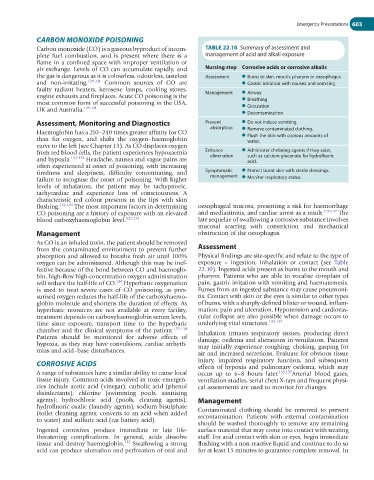
             Carbon monoxide (CO) is a gaseous byproduct of incom-  TABLE 22.10  Summary of assessment and
             plete  fuel  combustion,  and  is  present  where  there  is  a   management of acid and alkali exposure
             flame in a confined space with improper ventilation or
             air exchange. Levels of CO can accumulate rapidly, and   Nursing step Corrosive acids or corrosive alkalis
             the gas is dangerous as it is colourless, odourless, tasteless   Assessment  l  Burns to skin, mouth, pharynx or oesophagus
             and  non-irritating. 129-131   Common  sources  of  CO  are        l  Gastric irritation with nausea and vomiting
             faulty  radiant  heaters,  kerosene  lamps,  cooking  stoves,
             engine exhausts and fireplaces. Acute CO poisoning is the   Management  l  Airway
             most common form of successful poisoning in the USA,               l  Breathing
             UK and Australia. 129-131                                          l  Circulation
                                                                                l  Decontamination
             Assessment, Monitoring and Diagnostics                 Prevent     l  Do not induce vomiting.
             Haemoglobin has a 210–240 times greater affinity for CO   absorption  l  Remove contaminated clothing.
             than  for  oxygen,  and  shifts  the  oxygen–haemoglobin           l  Flush the skin with copious amounts of
                                                                                  water.
             curve to the left (see Chapter 13). As CO displaces oxygen
             from red blood cells, the patient experiences hypoxaemia   Enhance   l  Administer chelating agents if they exist,
             and hypoxia. 132-134  Headache, nausea and vague pains are   elimination  such as calcium gluconate for hydrofluoric
                                                                                  acid.
             often experienced at onset of poisoning, with increasing
             tiredness  and  sleepiness,  difficulty  concentrating,  and   Symptomatic   l  Protect burnt skin with sterile dressings.
             failure to recognise the onset of poisoning. With higher   management  l  Monitor respiratory status.
             levels  of  inhalation,  the  patient  may  be  tachypnoeic,
             tachycardiac  and  experience  loss  of  consciousness.  A
             characteristic  red  colour  presents  in  the  lips  with  skin
             flushing. 132-134  The most important factors in determining   oesophageal mucosa, presenting a risk for haemorrhage
             CO poisoning are a history of exposure with an elevated   and mediastinitis, and cardiac arrest as a result. 135-137  The
             blood carboxyhaemoglobin level. 132-134              late sequelae of swallowing a corrosive substance involves
                                                                  mucosal  scarring  with  constriction  and  mechanical
             Management                                           obstruction of the oesophagus.
             As CO is an inhaled toxin, the patient should be removed
             from the contaminated environment to prevent further   Assessment
             absorption and allowed to breathe fresh air until 100%   Physical findings are site-specific and relate to the type of
             oxygen can be administered. Although this may be inef-  exposure  –  ingestion,  inhalation  or  contact  (see  Table
             fective because of the bond between CO and haemoglo-  22.10). Ingested acids present as burns to the mouth and
             bin, high-flow high-concentration oxygen administration   pharynx. Patients who are able to vocalise complain of
                                       134
             will reduce the half-life of CO.  Hyperbaric oxygenation   pain, gastric irritation with vomiting and haematemesis.
             is  used  to  treat  severe  cases  of  CO  poisoning,  as  pres-  Fumes from an ingested substance may cause pneumoni-
             surised oxygen reduces the half-life of the carboxyhaemo-  tis. Contact with skin or the eyes is similar to other types
             globin molecule and shortens the duration of effects. As   of burns, with a sharply-defined blister or wound, inflam-
             hyperbaric  resources  are  not  available  at  every  facility,   mation, pain and ulceration. Hypotension and cardiovas-
             treatment depends on carboxyhaemoglobin serum levels,   cular collapse are also possible when damage occurs to
             time  since  exposure,  transport  time  to  the  hyperbaric   underlying vital structures. 135-137
             chamber and the clinical symptoms of the patient. 132-134    Inhalation  irritates  respiratory  tissues,  producing  direct
             Patients  should  be  monitored  for  adverse  effects  of   damage, oedema and alterations in ventilation. Patients
             hypoxia, as they may have convulsions, cardiac arrhyth-  may initially experience coughing, choking, gasping for
             mias and acid–base disturbances.
                                                                  air and increased secretions. Evaluate for obvious tissue
             CORROSIVE ACIDS                                      injury,  impaired  respiratory  function,  and  subsequent
                                                                  effects  of  hypoxia  and  pulmonary  oedema,  which  may
             A range of substances have a similar ability to cause local   occur  up  to  6–8  hours  later. 135,137 Arterial  blood  gases,
             tissue injury. Common acids involved in toxic emergen-  ventilation studies, serial chest X-rays and frequent physi-
             cies include acetic acid (vinegar); carbolic acid (phenol   cal assessments are used to monitor for changes.
             disinfectants);  chlorine  (swimming  pools,  sanitising
             agents);  hydrochloric  acid  (pools,  cleaning  agents);   Management
             hydrofluoric oxalic (laundry agents); sodium bisulphate
             (toilet cleaning agents; converts to an acid when added   Contaminated  clothing  should  be  removed  to  prevent
             to water) and sulfuric acid (car battery acid).      recontamination.  Patients  with  external  contamination
                                                                  should be washed thoroughly to remove any remaining
             Ingested  corrosives  produce  immediate  or  late  life-  surface material that may come into contact with treating
             threatening  complications.  In  general,  acids  dissolve   staff. For acid contact with skin or eyes, begin immediate
             tissue and destroy haemoglobin. 135  Swallowing a strong   flushing with a non-reactive liquid and continue to do so
             acid can produce ulceration and perforation of oral and   for at least 15 minutes to guarantee complete removal. In

