


Page 623 - ACCCN's Critical Care Nursing
P. 623
600  S P E C I A LT Y   P R A C T I C E   I N   C R I T I C A L   C A R E


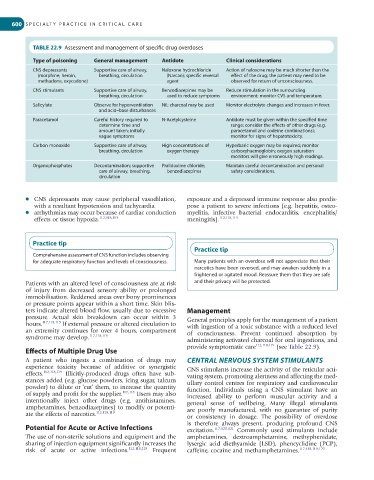
            TABLE 22.9  Assessment and management of specific drug overdoses

            Type of poisoning   General management    Antidote             Clinical considerations
            CNS depressants     Supportive care of airway,   Naloxone hydrochloride   Action of naloxone may be much shorter than the
             (morphine, heroin,   breathing, circulation  (Narcan); specific reversal   effect of the drug; the patient may need to be
             methadone, oxycodone)                      agent                observed for return of unconsciousness.
            CNS stimulants      Supportive care of airway,   Benzodiazepines may be   Reduce stimulation in the surrounding
                                 breathing, circulation  used to reduce symptoms  environment; monitor CVS and temperature.
            Salicylate          Observe for hyperventilation   Nil; charcoal may be used  Monitor electrolyte changes and increases in fever.
                                 and acid–base disturbances
            Paracetamol         Careful history required to   N-Acetylcysteine  Antidote must be given within the specified time
                                 determine time and                          range; consider the effects of other drugs (e.g.
                                 amount taken; initially                     paracetamol and codeine combinations);
                                 vague symptoms                              monitor for signs of hepatotoxicity.
            Carbon monoxide     Supportive care of airway,   High concentrations of   Hyperbaric oxygen may be required; monitor
                                 breathing, circulation  oxygen therapy      carboxyhaemoglobin; oxygen saturation
                                                                             monitors will give erroneously high readings.
            Organophosphates    Decontamination; supportive   Pralidoxime chloride;   Maintain careful decontamination and personal
                                 care of airway, breathing,   benzodiazepines  safety considerations.
                                 circulation


         l  CNS  depressants  may  cause  peripheral  vasodilation,   exposure and a depressed immune response also predis-
            with a resultant hypotension and tachycardia      pose a patient to severe infections (e.g. hepatitis, osteo-
         l  arrhythmias may occur because of cardiac conduction   myelitis,  infective  bacterial  endocarditis,  encephalitis/
            effects or tissue hypoxia. 112,118,119            meningitis). 112,118,119


            Practice tip
                                                                 Practice tip
            Comprehensive assessment of CNS function includes ob serving
            for adequate respiratory function and levels of consciousness.  Many patients with an overdose will not appreciate that their
                                                                 narcotics have been reversed, and may awaken suddenly in a
                                                                 frightened or agitated mood. Reassure them that they are safe
         Patients with an altered level of consciousness are at risk   and their privacy will be protected.
         of  injury  from  decreased  sensory  ability  or  prolonged
         immobilisation. Reddened areas over bony prominences
         or pressure points appear within a short time. Skin blis-
         ters indicate altered blood flow, usually due to excessive   Management
         pressure.  Actual  skin  breakdown  can  occur  within  3   General principles apply for the management of a patient
         hours. 112,118,119  If external pressure or altered circulation to   with ingestion of a toxic substance with a reduced level
         an  extremity  continues  for  over  4  hours,  compartment   of  consciousness.  Prevent  continued  absorption  by
         syndrome may develop. 112,118,119
                                                              administering activated charcoal for oral ingestions, and
                                                              provide symptomatic care 112,118,119  (see Table 22.9).
         Effects of Multiple Drug Use
         A  patient  who  ingests  a  combination  of  drugs  may    CENTRAL NERVOUS SYSTEM STIMULANTS
         experience  toxicity  because  of  additive  or  synergistic   CNS stimulants increase the activity of the reticular acti-
         effects. 112,118,119   Illicitly-produced  drugs  often  have  sub-  vating system, promoting alertness and affecting the med-
         stances added (e.g. glucose powders, icing sugar, talcum   ullary control centres for respiratory and cardiovascular
         powder) to dilute or ‘cut’ them, to increase the quantity   function.  Individuals  using  a  CNS  stimulant  have  an
         of supply and profit for the supplier. 117,118  Users may also   increased  ability  to  perform  muscular  activity  and  a
         intentionally  inject  other  drugs  (e.g.  antihistamines,   general  sense  of  wellbeing.  Many  illegal  stimulants
         amphetamines, benzodiazepines) to modify or potenti-  are  poorly  manufactured,  with  no  guarantee  of  purity
         ate the effects of narcotics. 112,118,119
                                                              or  consistency  in  dosage.  The  possibility  of  overdose
                                                              is  therefore  always  present,  producing  profound  CNS
         Potential for Acute or Active Infections             excitation. 117,120,121   Commonly  used  stimulants  include
         The use of non-sterile solutions and equipment and the   amphetamines,  dextroamphetamine,  methyphenidate,
         sharing of injection equipment significantly increases the   lysergic  acid  diethyamide  (LSD),  phencyclidine  (PCP),
         risk  of  acute  or  active  infections. 112,118,119   Frequent   caffeine, cocaine and methamphetamines. 112,118,119,125

