


Page 622 - ACCCN's Critical Care Nursing
P. 622
Emergency Presentations 599


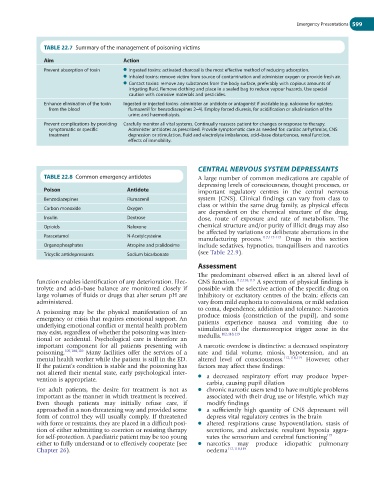
               TABLE 22.7  Summary of the management of poisoning victims

               Aim                       Action
               Prevent absorption of toxin  l  Ingested toxins: activated charcoal is the most effective method of reducing adsorption.
                                         l  Inhaled toxins: remove victim from source of contamination and administer oxygen or provide fresh air.
                                         l  Contact toxins: remove any substances from the body surface, preferably with copious amounts of
                                           irrigating fluid. Remove clothing and place in a sealed bag to reduce vapour hazards. Use special
                                           caution with corrosive materials and pesticides.
               Enhance elimination of the toxin    Ingested or injected toxins: administer an antidote or antagonist if available (e.g. naloxone for opiates;
                 from the blood            flumazenil for benzodiazepines 2–4). Employ forced diuresis, for acidification or alkalinisation of the
                                           urine; and haemodialysis.
               Prevent complications by providing   Carefully monitor all vital systems. Continually reassess patient for changes or response to therapy.
                 symptomatic or specific    Administer antidotes as prescribed. Provide symptomatic care as needed for: cardiac arrhythmias, CNS
                 treatment                 depression or stimulation, fluid and electrolyte imbalances, acid–base disturbances, renal function,
                                           effects of immobility.


                                                                  CENTRAL NERVOUS SYSTEM DEPRESSANTS
               TABLE 22.8  Common emergency antidotes             A large number of common medications are capable of
                                                                  depressing levels of consciousness, thought processes, or
               Poison                      Antidote               important  regulatory  centres  in  the  central  nervous
               Benzodiazepines             Flumazenil             system  (CNS).  Clinical  findings  can  vary  from  class  to
                                                                  class or within the same drug family, as physical effects
               Carbon monoxide             Oxygen
                                                                  are  dependent  on  the  chemical  structure  of  the  drug,
               Insulin                     Dextrose               dose,  route  of  exposure  and  rate  of  metabolism.  The
               Opioids                     Naloxone               chemical structure and/or purity of illicit drugs may also
                                                                  be affected by variations or deliberate aberrations in the
               Paracetamol                 N-Acetylcysteine                            112,117-119
                                                                  manufacturing  process.      Drugs  in  this  section
               Organophosphates            Atropine and pralidoxime  include sedatives, hypnotics, tranquillisers and narcotics
               Tricyclic antidepressants   Sodium bicarbonate     (see Table 22.9).
                                                                  Assessment
                                                                  The  predominant  observed  effect  is  an  altered  level  of
             function enables identification of any deterioration. Elec-  CNS function. 112,118,119  A spectrum of physical findings is
             trolyte  and  acid–base  balance  are  monitored  closely  if   possible with the selective action of the specific drug on
             large volumes of fluids or drugs that alter serum pH are   inhibitory or excitatory centres of the brain; effects can
             administered.                                        vary from mild euphoria to convulsions, or mild sedation
                                                                  to coma, dependence, addiction and tolerance. Narcotics
             A  poisoning  may  be  the  physical  manifestation  of  an
             emergency or crisis that requires emotional support. An   produce  miosis  (constriction  of  the  pupil),  and  some
             underlying emotional conflict or mental health problem   patients  experience  nausea  and  vomiting  due  to
             may exist, regardless of whether the poisoning was inten-  stimulation  of  the  chemoreceptor  trigger  zone  in  the
                                                                         112,118,119
             tional  or  accidental.  Psychological  care  is  therefore  an   medulla.
             important  component  for  all  patients  presenting  with   A narcotic overdose is distinctive: a decreased respiratory
             poisoning. 107,108,110   Many  facilities  offer  the  services  of  a   rate  and  tidal  volume,  miosis,  hypotension,  and  an
             mental health worker while the patient is still in the ED.   altered  level  of  consciousness. 112,118,119   However,  other
             If the patient’s condition is stable and the poisoning has   factors may affect these findings:
             not altered their mental state, early psychological inter-
             vention is appropriate.                              l  a  decreased  respiratory  effort  may  produce  hyper-
                                                                     carbia, causing pupil dilation
             For  adult  patients,  the  desire  for  treatment  is  not  as   l  chronic narcotic users tend to have multiple problems
             important as the manner in which treatment is received.   associated with their drug use or lifestyle, which may
             Even  though  patients  may  initially  refuse  care,  if   modify findings
             approached in a non-threatening way and provided some   l  a  sufficiently  high  quantity  of  CNS  depressant  will
             form of control they will usually comply. If threatened   depress vital regulatory centres in the brain
             with force or restraints, they are placed in a difficult posi-  l  altered  respirations  cause  hypoventilation,  stasis  of
             tion of either submitting to coercion or resisting therapy   secretions,  and  atelectasis;  resultant  hypoxia  aggra-
             for self-protection. A paediatric patient may be too young   vates the sensorium and cerebral functioning 119
             either to fully understand or to effectively cooperate (see   l  narcotics  may  produce  idiopathic  pulmonary
             Chapter 26).                                            oedema 112,118,119

