


Page 694 - ACCCN's Critical Care Nursing
P. 694
Resuscitation 671

             Conflicting evidence exists as to the psychological effects
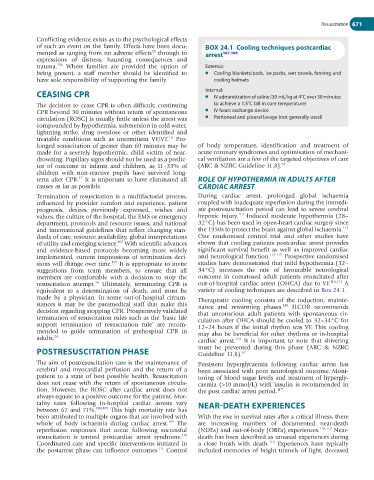
             of such an event on the family. Effects have been docu-  BOX 24.1  Cooling techniques postcardiac
                                                   98
             mented as ranging from no adverse effects  through to   arrest 107-109
             expressions  of  distress,  haunting  consequences  and
                    106
             trauma.   Where  families  are  provided  the  option  of   External:
             being  present,  a  staff  member  should  be  identified  to   l  Cooling blankets/pads, ice packs, wet towels, fanning and
             have sole responsibility of supporting the family.        cooling helmets
             CEASING CPR                                            Internal:
                                                                    l  IV administration of saline (30 mL/kg at 4°C over 30 minutes
             The decision to cease CPR is often difficult; continuing   to achieve a 1.5°C fall in core temperature)
             CPR beyond 30 minutes without return of spontaneous    l  IV heart exchange device
             circulation (ROSC) is usually futile unless the arrest was   l  Peritoneal and pleural lavage (not generally used)
             compounded by hypothermia, submersion in cold water,
             lightning  strike,  drug  overdose  or  other  identified  and
             treatable  conditions  such  as  intermittent  VF/VT.   Pro-
                                                        16
             longed resuscitation of greater than 60 minutes may be   of  body  temperature,  identification  and  treatment  of
             made  for  a  severely  hypothermic,  child  victim  of  near-  acute coronary syndromes and optimisation of mechani-
             drowning. Pupillary signs should not be used as a predic-  cal ventilation are a few of the targeted objectives of care
             tor  of  outcome  in  infants  and  children,  as  11–33%  of   (ARC & NZRC Guideline 11.8). 62
             children  with  non-reactive  pupils  have  survived  long-
                           17
             term after CPR.  It is important to have eliminated all   ROLE OF HYPOTHERMIA IN ADULTS AFTER
             causes as far as possible.                           CARDIAC ARREST
             Termination of resuscitation is a multifactorial process,   During  cardiac  arrest,  prolonged  global  ischaemia
             influenced by provider comfort and experience, patient   coupled with inadequate reperfusion during the immedi-
             prognosis,  desires  previously  expressed,  wishes  and   ate  postresuscitation  period  can  lead  to  severe  cerebral
                                                                               112
             values, the culture of the hospital, the EMS or emergency   hypoxic  injury.   Induced  moderate  hypothermia  (28–
             department, protocols and resource issues, and national   32°C) has been used in open-heart cardiac surgery since
                                                                                                                 113
             and  international  guidelines  that  reflect  changing  stan-  the 1950s to protect the brain against global ischaemia.
             dards of care, resource availability, global interpretations   One  randomised  control  trial  and  other  studies  have
                                        107
             of utility and emerging science.  With scientific advances   shown that cooling patients postcardiac arrest provides
             and  evidence-based  protocols  becoming  more  widely   significant  survival  benefit  as  well  as  improved  cardiac
             implemented,  current  impressions  of  termination  deci-  and neurological function. 113-115  Prospective randomised
                                      107
             sions will change over time.  It is appropriate to invite   studies have demonstrated that mild hypothermia (32–
             suggestions  from  team  members,  to  ensure  that  all   34°C)  increases  the  rate  of  favourable  neurological
             members  are  comfortable  with  a  decision  to  stop  the   outcome  in  comatosed  adult  patients  resuscitated  after
                                16
             resuscitation  attempt.   Ultimately,  terminating  CPR  is   out-of-hospital cardiac arrest (OHCA) due to VF. 114,115  A
             equivalent  to  a  determination  of  death,  and  must  be   variety of cooling techniques are described in Box 24.1.
             made  by  a  physician.  In  some  out-of-hospital  circum-  Therapeutic  cooling  consists  of  the  induction,  mainte-
             stances  it  may  be  the  paramedical  staff  that  make  this   nance  and  rewarming  phases.   ILCOR  recommends
                                                                                              116
             decision regarding stopping CPR. Prospectively validated   that  unconscious  adult  patients  with  spontaneous  cir-
             termination of resuscitation rules such as the ‘basic life   culation after OHCA should be cooled to 32–34°C for
             support  termination  of  resuscitation  rule’  are  recom-  12–24 hours if the initial rhythm was VF. This cooling
             mended  to  guide  termination  of  prehospital  CPR  in   may also be beneficial for other rhythms or in-hospital
             adults. 24                                                       113
                                                                  cardiac  arrest.   It  is  important  to  note  that  shivering
             POSTRESUSCITATION PHASE                              must  be  prevented  during  this  phase  (ARC  &  NZRC
                                                                                62
                                                                  Guideline  11.8).
             The aim of postresuscitation care is the maintenance of   Persistent  hyperglycaemia  following  cardiac  arrest  has
             cerebral  and  myocardial  perfusion  and  the  return  of  a   been associated with poor neurological outcome. Moni-
             patient  to  a  state  of  best  possible  health.  Resuscitation   toring of blood sugar levels and treatment of hypergly-
             does  not  cease  with  the  return  of  spontaneous  circula-  caemia  (>10 mmol/L)  with  insulin  is  recommended  in
             tion.  However,  the  ROSC  after  cardiac  arrest  does  not   the post cardiac arrest period. 117
             always equate to a positive outcome for the patient. Mor-
             tality  rates  following  in-hospital  cardiac  arrests  vary   NEAR-DEATH EXPERIENCES
             between 67 and 71%. 108,109  This high mortality rate has
             been attributed to multiple organs that are involved with   With the rise in survival rates after a critical illness, there
                                                        109
             whole  of  body  ischaemia  during  cardiac  arrest.   The   are  increasing  numbers  of  documented  near-death
             reperfusion  responses  that  occur  following  successful   (NDEs) and out-of-body (OBEs) experiences. 118,119  Near-
                                                            110
             resuscitation  is  termed  postcardiac  arrest  syndrome.    death has been described as unusual experiences during
                                                                                         118
             Coordinated care and specific interventions initiated in   a  close  brush  with  death.   Experiences  have  typically
                                                     111
             the postarrest phase can influence outcomes.  Control   included memories of bright tunnels of light, deceased

