


Page 691 - ACCCN's Critical Care Nursing
P. 691
668  S P E C I A LT Y   P R A C T I C E   I N   C R I T I C A L   C A R E


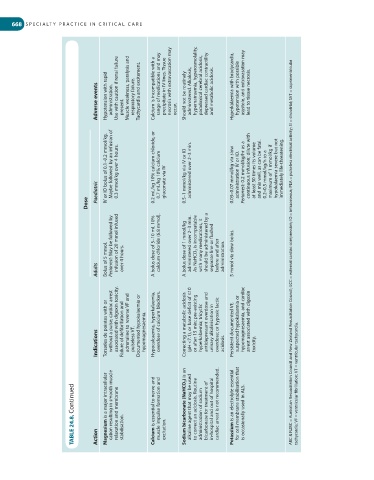
                                 Adverse events  Hypotension with rapid   administration. Use with caution if renal failure   present. Muscle weakness, paralysis and   respiratory failure. Tachycardia and excitement.  Calcium is incompatible with a  range of medications and may  precipitate in IV lines. Tissue  necrosis with extravascation may   occur.  Should not be routinely   administered. Alkalosis,  hypernatraemia, hyperosmolality,  paradoxical cerebral acidosis,  depressed card


                                    IV or IO bolus of 0.1–0.2 mmol/kg.  Maybe followed by an infusion of  0.3 mmol/kg over 4 hours.  0.2 mL/kg 10% calcium chloride, or   0.7 mL/kg 10% calcium   0.5–1 mmol/kg via IV or IO  administered over 2–3 min.  0.03–0.07 mmol/kg via slow   administration IV or IO. Periarrest: 0.2 mmol/kg/hr as a  continuous infusion; dilute with  at least 50 times its volume   and mix well, as can be fatal.   0.2–0.5 mmol/kg/h to a  maximum of 1 mmol/kg if  hypo


                                 Paediatric            gluconate via IV

                              Dose


                                    Bolus of 5 mmol.  Periarrest: May be followed by  infusion of 20 mmol infused   over 4 hours.  A bolus dose of 5–10 mL 10%  calcium chloride (6.8 mmol).  A bolus dose of 1 mmol/kg  administered over 2–3 min.  As NaHCO 3  is incompatable  with many medications, it  should be administered by a   separate line or flushed   before and after   administration.  5 mmol via slow bolus. ARC & NZRC = Australian Resuscitation Council and New Zealand Resuscita


                                 Adults


                                    Torsades de pointes with or  without a pulse; cardiac arrest  associated with digoxin toxicity. Failure of defibrillation and  adrenaline to reverse VF and   Documented hypokalaemia or   hypomagnesaemia.  Hypocalcaemia, hyperkalaemia,  overdose of calcium blockers.  Correcting a metabolic acidosis  (pH <7.1), or base deficit of ≤10  or after 15 min; pre-existing   hyperkalaemia; tricyclic  antidepressant overdose and   urinary alkalinisation in  ov


                                 Indications  pulseless VT.               acidosis.  toxicity.


                         TABLE 24.8, Continued  Action  Magnesium is a major intracellular  cation resulting in smooth muscle  relaxation and membrane   stabilisation.  Calcium is essential to nerve and  muscle impulse formation and   excitation.  Sodium bicarbonate (NaHCO 3 ) is an  alkaline agent that may be used   to correct an acidosis. Routine  administration of sodium  bicarbonate for treatment of  in-hospital and out of hospital  cardiac arrest is not recommended.  Potassium i

