


Page 690 - ACCCN's Critical Care Nursing
P. 690
Resuscitation 667


                                                                                                         Continued


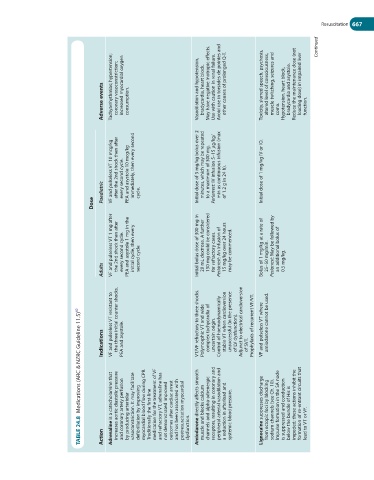
                                   Adverse events  Tachyarrhythmias; hypertension;  coronary vasoconstriction;  increased myocardial oxygen   consumption.  Vasodilation and hypotension,  bradycardia, heart block. May have negative inotropic effects. Use with caution in renal failure. Avoid use in torsades de pointes and  other causes of prolonged Q-T.  Toxicity, slurred speech, psychosis,  altered level of consciousness,  muscle twitching, seizures and   coma. Hypotension, heart bloc


                                      VF and pulseless VT 10 mcg/kg  after the 2nd shock then after   every second cycle. PEA and asystole 10 mcg/kg  immediately, then every second   Initial dose of 5 mg/kg bolus over 2  minutes, which may be repeated  to a maximum of 300 mg. Periarrest: IV infusion 5–15 µg/kg/ min as continuous infusion (max   Initial dose of 1 mg/kg IV or IO.


                                   Paediatric  cycle.                      of 1.2 g in 24 h).

                               Dose

                                      VF and pulseless VT 1 mg after  the 2nd shock then after   every second cycle. PEA and asystole 1 mg in the   initial cycle, then every   Initial bolus dose of 300 mg in  20 mL dextrose. A further  150 mg could be considered   for refractory cases. Periarrest: An infusion of  15 mg/kg over 24 hours   may be commenced.  Bolus of 1 mg/kg at a rate of   25–50 mg/min. Periarrest: May be followed by   an additional bolus of


                                   Adults      second cycle                                   0.5 mg/kg.


                           Medications (ARC & NZRC Guideline 11.5) 62  Indications  VF and pulseless VT resistant to  the three initial counter shocks.  PEA and asystole.  VT/VF refractory to three shocks. Polymorphic VT and wide   complex tachycardia of   uncertain origin. Control of haemodynamically  stable VT when cardioversion  unsuccessful (in the presence   of LV dysfunction). Adjunct to electrical cardioversion   of SVT. Prophylaxis of recurrent VF/VT.  VF and pulseless VT whe


                           TABLE 24.8   Action Adrenaline is a catecholamine that  increases aortic diastolic pressure  and coronary artery perfusion   by producing arteriolar  vasoconstriction. It may facilitate  defibrillation by improving  myocardial blood flow during CPR.  Traditionally the first-line  medication for the treatment of VF  and refractory VT, adrenaline has  not demonstrated improved  outcomes after cardiac arrest   and has been associated with  postresuscitation my

