


Page 94 - ACCCN's Critical Care Nursing
P. 94
Recovery and Rehabilitation 71


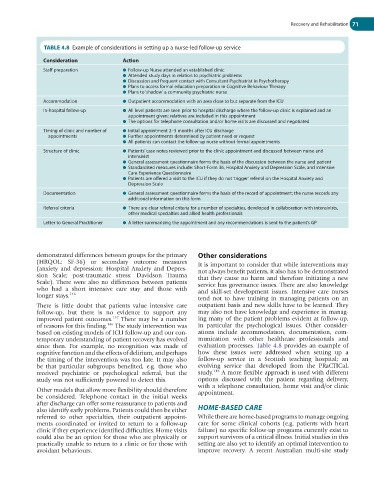
               TABLE 4.8  Example of considerations in setting up a nurse-led follow-up service

               Consideration             Action
               Staff preparation         ●  Follow-up Nurse attended an established clinic
                                         ●  Attended study days in relation to psychiatric problems
                                         ●  Discussion and frequent contact with Consultant Psychiatrist in Psychotherapy
                                         ●  Plans to access formal education preparation in Cognitive Behaviour Therapy
                                         ●  Plans to ‘shadow’ a community psychiatric nurse
               Accommodation             ●  Outpatient accommodation with an area close to but separate from the ICU
               In-hospital follow-up     ●  All level patients are seen prior to hospital discharge where the follow-up clinic is explained and an
                                           appointment given; relatives are included in this appointment
                                         ●  The options for telephone consultation and/or home visits are discussed and negotiated
               Timing of clinic and number of   ●  Initial appointment 2–3 months after ICU discharge
                 appointments            ●  Further appointments determined by patient need or request
                                         ●  All patients can contact the follow-up nurse without formal appointments
               Structure of clinic       ●  Patients’ case notes reviewed prior to the clinic appointment and discussed between nurse and
                                           intensivist
                                         ●  General assessment questionnaire forms the basis of the discussion between the nurse and patient
                                         ●  Standardised measures include: Short-Form 36, Hospital Anxiety and Depression Scale, and Intensive
                                           Care Experience Questionnaire
                                         ●  Patients are offered a visit to the ICU if they do not ‘trigger’ referral on the Hospital Anxiety and
                                           Depression Scale
               Documentation             ●  General assessment questionnaire forms the basis of the record of appointment; the nurse records any
                                           additional information on this form
               Referral criteria         ●  There are clear referral criteria for a number of specialties, developed in collaboration with intensivists,
                                           other medical specialties and allied health professionals
               Letter to General Practitioner  ●  A letter summarising the appointment and any recommendations is sent to the patient’s GP


             demonstrated differences between groups for the primary   Other considerations
             (HRQOL:  SF-36)  or  secondary  outcome  measures    It is important to consider that while interventions may
             (anxiety  and  depression:  Hospital  Anxiety  and  Depres-  not always benefit patients, it also has to be demonstrated
             sion  Scale;  post-traumatic  stress:  Davidson  Trauma   that they cause no harm and therefore initiating a new
             Scale). There were also no differences between patients   service has governance issues. There are also knowledge
             who  had  a  short  intensive  care  stay  and  those  with     and  skill-set  development  issues.  Intensive  care  nurses
             longer stays. 146
                                                                  tend  not  to  have  training  in  managing  patients  on  an
             There  is  little  doubt  that  patients  value  intensive  care   outpatient basis and new skills have to be learned. They
             follow-up,  but  there  is  no  evidence  to  support  any   may also not have knowledge and experience in manag-
             improved patient outcomes. 157  There may be a number   ing many of the patient problems evident at follow-up,
                                    146
             of reasons for this finding.  The study intervention was   in  particular  the  psychological  issues.  Other  consider-
             based on existing models of ICU follow-up and our con-  ations  include  accommodation,  documentation,  com-
             temporary understanding of patient recovery has evolved   munication  with  other  healthcare  professionals  and
             since  then.  For  example,  no  recognition  was  made  of   evaluation processes.  Table  4.8  provides  an  example  of
             cognitive function and the effects of delirium, and perhaps   how  these  issues  were  addressed  when  setting  up  a
             the timing of the intervention was too late. It may also   follow-up  service  in  a  Scottish  teaching  hospital;  an
             be  that  particular  subgroups  benefited,  e.g.  those  who   evolving  service  that  developed  from  the  PRaCTICaL
             received  psychiatric  or  psychological  referral,  but  the   study. 146  A more flexible approach is used with different
             study was not sufficiently powered to detect this.   options  discussed  with  the  patient  regarding  delivery,
                                                                  with a telephone consultation, home visit and/or clinic
             Other models that allow more flexibility should therefore   appointment.
             be  considered.  Telephone  contact  in  the  initial  weeks
             after discharge can offer some reassurance to patients and
             also identify early problems. Patients could then be either   HOME-BASED CARE
             referred  to  other  specialties,  their  outpatient  appoint-  While there are home-based programs to manage ongoing
             ments  coordinated  or  invited  to  return  to  a  follow-up   care  for  some  clinical  cohorts  (e.g.  patients  with  heart
             clinic if they experience identified difficulties. Home visits   failure) no specific follow-up programs currently exist to
             could also be an option for those who are physically or   support survivors of a critical illness. Initial studies in this
             practically unable to return to a clinic or for those with   setting are also yet to identify an optimal intervention to
             avoidant behaviours.                                 improve  recovery.  A  recent  Australian  multi-site  study

