


Page 90 - ACCCN's Critical Care Nursing
P. 90
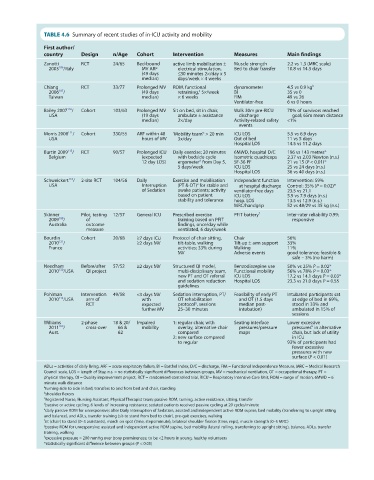
TABLE 4.6  Summary of recent studies of in-ICU activity and mobility

               First author/
               country      Design    n/Age   Cohort      Intervention        Measures         Main findings
               Zanotti      RCT       24/65   Bed-bound   active limb mobilisation ±   Muscle strength  2.2 vs 1.3 (MRC scale)
                 2003 /Italy                   MV ARF      electrical stimulation,    Bed to chair transfer  10.8 vs 14.3 days
                    186
                                               (49 days    ≤30 minutes 2×/day x 5
                                               median)     days/week × 4 weeks
               Chiang       RCT       33/77   Prolonged MV   ROM, functional   dynamometer     4.5 vs 0.9 kg b
                    187
                 2006 /                        (49 days    retraining,  5×/week  BI            35 vs 0
                                                                  a
                 Taiwan                        median)     × 6 weeks          FIM              49 vs 26
                                                                              Ventilator-free  6 vs 0 hours
                       110
               Bailey 2007 /  Cohort  103/63  Prolonged MV   Sit on bed, sit in chair,   Walk 30m pre-RICU   70% of survivors reached
                 USA                           (19 days    ambulate ± assistance   discharge     goal; 65m mean distance
                                               median)     2×/day             Activity-related safety   <1%
                                                                               events
                                                                   c
               Morris 2008 /  Cohort  330/55  ARF within 48   ‘Mobility team’  > 20 min   ICU LOS  5.5 vs 6.9 days
                       111
                 USA                           hours of MV  3x/day            Out of bed       11 vs 5 days
                                                                              Hospital LOS     14.5 vs 11.2 days
                       115
               Burtin 2009 /  RCT     90/57   Prolonged ICU   Daily exercise; 20 minutes   6MWD, hospital D/C  196 vs 143 metres*
                 Belgium                       (expected   with bedside cycle   Isometric quadriceps  2.37 vs 2.03 Newton (n.s.)
                                                                  d
                                               12 day LOS)  ergometer  from Day 5,   SF-36 PF  21 vs 15 (P < 0.01)*
                                                           5 days/week        ICU LOS          25 vs 24 days (n.s.)
                                                                              Hospital LOS     36 vs 40 days (n.s.)
               Schweickert /  2-site RCT  104/56  Daily   Exercise and mobilisation   independent function   Intervention: 59%
                       116
                                                                 e
                 USA                           Interruption   (PT & OT)  for stable and   at hospital discharge  Control: 35% (P = 0.02)*
                                               of Sedation  awake patients; activity   ventilator-free days  23.5 vs 21.1
                                                           based on patient   ICU LOS          5.9 vs 7.9 days (n.s.)
                                                           stability and tolerance  hosp. LOS  13.5 vs 12.9 (n.s.)
                                                                              MRC/handgrip     52 vs 48/29 vs 35 kg (n.s.)
               Skinner      Pilot, testing   12/57  General ICU  Prescribed exercise   PFIT battery f  Inter-rater reliability 0.99;
                 2009 /      of                            training based on PFIT                responsive
                    188
                 Australia   outcome                       findings, once/day while
                             measure                       ventilated, 6 days/week
               Bourdin      Cohort    20/68   ≥7 days ICU  Protocol of chair sitting,   Chair  56%
                    121
                 2010 /                       ≥2 days MV   tilt-table, walking   Tilt-up ± arm support  33%
                 France                                    activities; 33% during   Walking    11%
                                                           MV                 Adverse events   good tolerance; feasible &
                                                                                                 safe – 3% (no harm)
               Needham      Before/after   57/52  ≥2 days MV  Structured QI model,   Benzodiazepine use  50% vs 25% P = 0.02*
                 2010 /USA   QI project                    multi-disciplinary team,   Functional mobility  56% vs 78% P = 0.03*
                    130
                                                           new PT and OT referral   ICU LOS    17.2 vs 14.1 days P = 0.03*
                                                           and sedation reduction   Hospital LOS  23.3 vs 21.0 days P = 0.55
                                                           guidelines
               Pohlman      Intervention   49/58  <3 days MV   Sedation interruption, PT/  Feasibility of early PT   Intubated participants sat
                    112
                 2010 /USA   arm of            with        OT rehabilitation   and OT (1.5 days   at edge of bed in 69%,
                                                                 g
                             RCT               expected    protocol , sessions   median post-    stood in 33% and
                                               further MV  25–30 minutes       intubation)       ambulated in 15% of
                                                                                                 sessions
               Williams     2-phase   18 & 20/   Impaired   1: regular chair, with   Seating interface   Lower excessive
                                                                                                       h
                 2011 /      cross-over  66 &   mobility   overlay, alternative chair   pressures/pressure   pressures  in alternative
                    189
                 Aust.                  62                 compared            maps              chair, but lack of utility
                                                          2: new surface compared                in ICU
                                                           to regular                          93% of participants had
                                                                                                 fewer excessive
                                                                                                 pressures with new
                                                                                                 surface (P < 0.01)
               ADLs = activities of daily living, ARF = acute respiratory failure, BI = Barthel Index, D/C = discharge, FIM = Functional Independence Measure, MRC = Medical Research
               Council scale, LOS = length of Stay, n.s. = no statistically significant differences between groups, MV = mechanical ventilation, OT = occupational therapy, PT =
               physical therapy, QI = Quality improvement project, RCT = randomised controlled trial, RICU = Respiratory Intensive Care Unit, ROM = range of motion, 6MWD = 6
               minute walk distance
               a turning side to side in bed, transfers to and from bed and chair, standing
               b shoulder flexors
               c Registered Nurse, Nursing Assistant, Physical Therapist team; passive ROM, turning, active resistance, sitting, transfer
               d passive or active cycling, 6 levels of increasing resistance; sedated patients received passive cycling at 20 cycles/minute
               e daily passive ROM for unresponsive; after Daily Interruption of Sedation, assisted and independent active ROM supine, bed mobility (transferring to upright sitting
               and balance), and ADLs, transfer training (sit-to stand from bed to chair), pre-gait exercises, walking
               f sit (chair) to stand (0–3 assistants), march on spot (time, steps/minute), bilateral shoulder flexion (time, reps), muscle strength (0–5 MRC)
               g passive ROM for unresponsive; assisted and independent active ROM supine, bed mobility (lateral rolling, transferring to upright sitting), balance, ADLs, transfer
               training, walking
               h excessive pressure = 200 mmHg over bony prominences; to be <2 hours in young, healthy volunteers
               *statistically significant difference between groups (P < 0.05)

